










































Keystones to Foster Inclusive Knowledge Societies: Access to Information and Knowledge, Freedom of Expression, Privacy and Ethics on a Global Internet
"UNESCO's vision of universal Knowledge Societies builds on a free, open and trusted Internet that enables people to not only have the ability to access information resources from around the world, but to also contribute information and knowledge to local and global communities. What can UNESCO do to move towards the realization of this vision of Internet-enabled Knowledge Societies that can foster inclusive sustainable human development worldwide?"
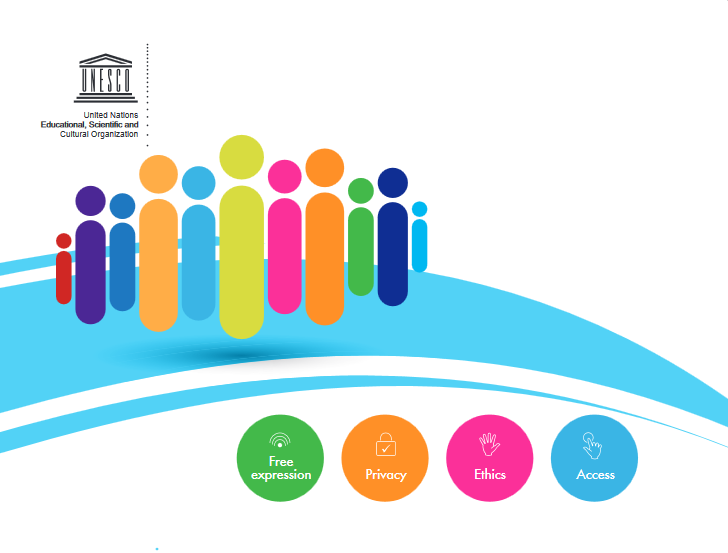
This United Nations Educational, Scientific and Cultural Organization (UNESCO) study explores global perspectives on the new and emerging trends that are shaping the internet space - indicating both positive opportunities for social and sustainable economic development and diverse challenges in the area of human rights. It promotes a comprehensive and inclusive approach organised around the 4 keystones of access to information and knowledge, freedom of expression, privacy, and ethical norms and behaviour online. This report assesses these 4 fields by viewing them as keystones for building a free and trusted global internet that will enable inclusive knowledge societies. The framework of investigation is that of Internet Universality as a concept that summarises UNESCO's positions towards the internet. The term points to 4 fundamental principles that can be captured by the acronym ROAM: that the internet should be (i) human Rights-based (ii) Open, (iii) Accessible to all, and (iv) nurtured by Multi-stakeholder participation. The report examines each of the 4 keystones and asks whether and how their development is aligned with ROAM. Based on all this, the report identifies a series of options for UNESCO.
In response to the mandate expressed in Resolution 52 of the 37th Session of UNESCO's General Conference in November 2013, UNESCO engaged in a multistakeholder consultative process that included discussions at 7 international conferences and a questionnaire that received more than 200 responses from UN bodies, governments, academia, civil society, and the private sector. A review of more than 50 existing declarations of principles, guidelines, and frameworks related to the internet was conducted. The process culminated with the CONNECTing the Dots conference, a multistakeholder event held at UNESCO Headquarters in March 2015 that convened more than 400 participants. The Keystones study was officially launched at the 10th Internet Governance Forum (IGF) in Brazil in November 2015. The General Conference resolution adopted the 38 options for action laid out in the Keystones study, which arose from the Outcome Document of the CONNECTing the dots conference.
The report notes that, by 2014, over 3 billion people had gained access to the internet from around the world; this translates to only 42% of the world's population. Even those with access are often constrained by technical constraints, language barriers, skills deficits, and many other social and policy factors. Such factors can prevent them from accessing information and knowledge in ways essential for realising knowledge societies, by which UNESCO means societies in which people have the capabilities not just to acquire information but also to transform it into knowledge and understanding that empowers them to enhance their livelihoods and contribute to the social and economic development of their societies.
The 4 keystones are broadly defined as:
- Access to information and knowledge encompasses the vision of universal access, not only to the internet, but also to the ability to seek and receive open scientific, indigenous, and traditional knowledge online, and also tp produce content in all forms. This requires initiatives for freedom of information and the building of open and preserved knowledge resources, as well as a respect for cultural and linguistic diversity that fosters local content in multiple languages, quality educational opportunities for all, including new media literacy and skills, and social inclusion online, including addressing inequalities based on income, skills, education, gender, age, race, ethnicity, or accessibility by those with disabilities.
- Freedom of expression entails the ability to safely express one's views over the internet, ranging from the right of internet users to freedom of expression online, through to press freedom and the safety of journalists, bloggers, and human rights advocates, along with policies that enhance an open exchange of views and a respect for the rights of free online expression.
- Privacy refers to internet practices and policies that respect the right of individuals to have a reasonable expectation of having a personal space and to control access to their personal information. The idea is that privacy must be protected in ways that are reconciled with the promotion of openness and transparency and a recognition that privacy and its protection underpins freedom of expression and trust in the internet, and therefore its greater use for social and economic development.
- Ethics considers whether the norms, rules, and procedures that govern online behaviour and the design of the internet and related digital media are based on ethical principles anchored in human-rights-based principles and geared to protecting the dignity and safety of individuals in cyberspace and advance accessibility, openness, and inclusiveness on the internet.
Outlined in the report are some options going forward for UNESCO, including: reinforcing UNESCO's leadership in continued implementation of the World Summit on the Information Society (WSIS) outcomes and the IGF; affirming that fundamental human rights and access to information and knowledge across society support sustainable development; and strengthening the cross-cutting role of the internet in all of UNESCO programmatic activities, including Priority Africa, Priority Gender Equality, and support to Small Islands Developing States (SIDS) and Least Developed Countries (LDCs), as well as in UNESCO's leadership of the International Decade for the Rapprochement of Cultures.
In addition to UNESCO's continued work in promoting universal access to information and knowledge, fostering freedom of expression online and offline, and building ethical principles for knowledge societies, the Organization now has a strong mandate to work on issues related to privacy. This includes supporting research and best practices on the impacts on privacy of digital interception, collection, storage, and use of data, as well as the role of anonymity and encryption in enabling privacy protection and freedom of expression. Cross-cutting issues also highlighted include media and information literacy (MIL), protection of journalistic sources, harmonisation of national laws with international human rights law, and network neutrality. The study also affirms that the same rights that people have offline must be protected online and suggests that good practices be shared between Member States and other stakeholders in order to address security and privacy concerns on the internet and in accordance with international human rights obligations.
In line with the general ROAM principles, the report proposes some specific activities UNESCO could undertake. For example, in the area of access to information and knowledge, UNESCO could continue to support initiatives that not only enable the public to get online, but also support users once they are online, such as in training, access to technical skills, and MIL programmes. Efforts could engage youth as first-order citizens, and seek to reduce inequalities in access to information and knowledge. There could be continued promotion of openness, such as to scientific, medical, and health information, and support for multilingualism, such as by creating international observatories for monitoring and promoting the availability and use of multiple languages on the internet and increasing the visibility of content in multiple languages, such as through multilingual domain names. To cite another example: UNESCO could also be a core forum on internet-related discussions from a human rights perspective, as well as creating a resource hub and observatory that could link the ROAM principles to the monitoring of global progress in achieving Sustainable Development Goals (SDGs) related to UNESCO's mandate. This implies engagement as relevant with partners outside of the UN system, such as individual governments, civil society, news media, academia, private sector, the technical community, and individual users.
Beyond UNESCO, the study notes that individuals, private and public organisations, government agencies, and members of civil society can also take up specific tasks that advance the concrete goals connected to the high-level principles that are the focus of this report their particular arenas of action. For example, individual users can consider whether their use of the internet is aligned with clear ethical principles. Internet intermediaries can engage users and authorities in discussions about terms of service. Government agencies can initiate public consultation processes to consider how to open public data for use by other agencies and organisations.
In sum, UNESCO notes that, "[c]yberspace is especially complex and sensitive because of its transnational and multidimensional character, involving multiple actors and issues that are evolving rapidly over time across diverse social and cultural traditions and legal jurisdictions. This calls for a holistic approach to address the broad range of issues relating to access, participation and use. It is important that UNESCO works with others to 'connect the dots' amongst all Internet stakeholders, as underscored by the consultation processes of the study. The consultative process illustrated extensive global demand for dialogue and sharing of insight around key issues, and UNESCO's ability to convene such engagement."
Click here in order to download the study in Arabic, Chinese, English, French, or Russian.
UNESCO website, January 27 2017. Image credit: © UNESCO
- Log in to post comments