










































Covid-19 and the Impact on Freedom of Expression, Access to Information and Freedom of the Media
International Media Support (IMS)
"[P]opular interest in Covid-19 will eventually fade as 'pandemic fatigue' is steadily spreading along with the virus. On the contrary, rights restrictions are likely to stay, and we shall need to think of creative ways to pursue advocacy initiatives in our attempt to push back..."
In the context of the COVID-19 pandemic, rights and freedoms have been restricted almost everywhere, including in established democracies. This paper from International Media Support (IMS) provides an overview of the trends and challenges to freedom of expression, freedom of the media, and access to information stemming from national governments' responses to the COVID-19 pandemic.
As author Antonina Cherevko observes, while the fear that traditionally accompanies pandemics is not new, what is novel in this case is the global communication system that helps information (and disinformation) about the virus travel globally in a matter of seconds. These circumstances facilitate standardised, unified responses to the pandemic in different contexts and under different conditions. In addition, in the framework of anti-COVID-19 measures (e.g., in quarantining or wearing masks), people are motivated not only by fear but also by the benevolent intention of "caring about others". It is the combination of these two incentives, Cherevko explains, that induced societies to accept rights restrictions without much hesitation.
First, the paper looks at general rules established under international human rights law that define requirements for legitimate rights limitations or derogations from the human rights instruments. In short, all limitations of rights should be: (i) prescribed by law; (ii) pursuing legitimate aim (including public health protection); and (iii) necessary in a democratic society.
What follows is a consideration of issues pertaining to media, including:
- Due process and timing: In many places, rights restrictions were adopted overnight, with no time allocated for public discussion. Furthermore, there has been de facto and/or de jure transfer of decision-making powers from parliaments to executive authorities, which undermines basic principles of division of powers and of checks-and-balances systems.
- Disinformation: The mere novelty of the virus lends itself to disinformation, which has been rampant in the COVID-19 context. Cherevko cautions: "Quite often disinformation laws are just a variation of defamation legislation specifically aimed at protecting the 'good name and reputation' of the governments and used selectively to target 'uncomfortable' dissenting voices."
- Hate speech: "When people are implicitly instructed to consider their fellow citizens as a potential source of infectious threat, deeply enshrined negative stereotypes and xenophobic attitudes may surface....Where it concerns IMS programme countries, hate speech laws have already been applied selectively to stifle critical voices and this tendency is not likely to vanish."
- Access to information: Although the United Nations (UN) High Commissioner on Human Rights stated that relevant information on the COVID-19 pandemic and response should reach all people, without exception and discrimination, the media have experienced "ever more impeded access to reliable data retained by public authorities" and yet heightened public demand for information.
- Media freedom: IMS staff and partners have reported cases of harassment and arrests of journalists and/or citizen-bloggers in the course of the pandemic response.
- Civic activism: Cherevko reports that surveys in Argentina and Ukraine demonstrated that people are still willing to attend physical, offline protests at high rates, even in violation of COVID-19 lockdown rules and despite fears of getting infected. "Concerns about 'disappearance' of protest culture may be misplaced."
With the trends and challenges discussed above in mind, Cherevko suggests that the following developments are highly likely:
- Intensified media regulation by states - in particular on online disinformation and hate speech;
- Intensified content regulation by and of the big tech companies as de facto "global speech moderators" and the related increase in algorithm-driven solutions;
- Emergency measures that may transform into a more permanent status quo;
- More frequent obstruction of media operations, with access to publicly important information impeded or denied; and
- Outbreaks of hate speech that may trigger violence in conflict-prone communities and undermine peace-building processes.
Prior to a concluding list of relevant publications on COVID-19 and human rights, the paper offers suggestions of possible areas of involvement and response strategies for IMS and its local partners. These may include, for example, searching for innovative policy solutions concerning hate speech and/or disinformation. IMS and/or its partners may look into the possibilities of more active interaction with Facebook, which has recently established an oversight board in charge of reviewing its content-related decisions. "Solid representation of different regions and voices on this Board could eventually improve policy-making of the company itself and hence, IMS's local partners may wish to nominate candidates to the Board."
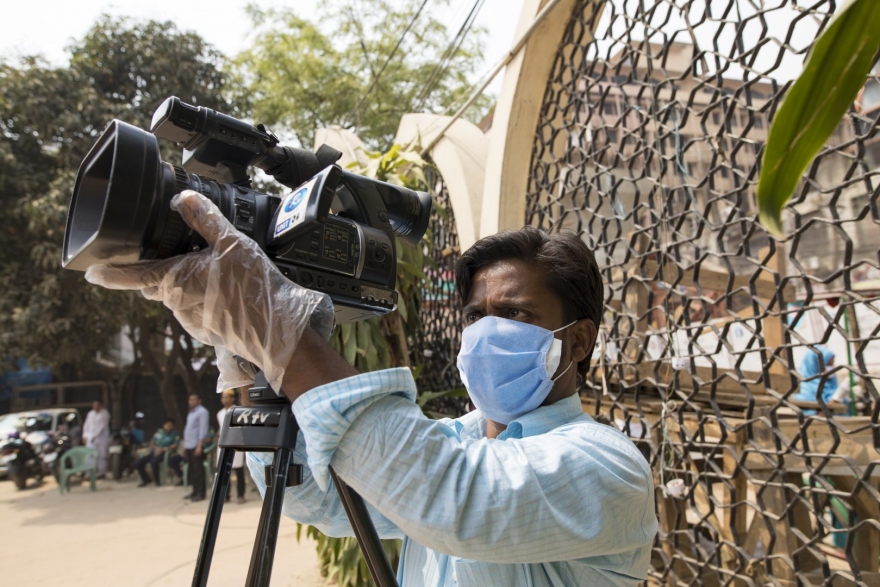
IMS website, July 3 2020. Image credit: Zakir Hossain Chowdhury/Anadolu Agency via Getty Images