










































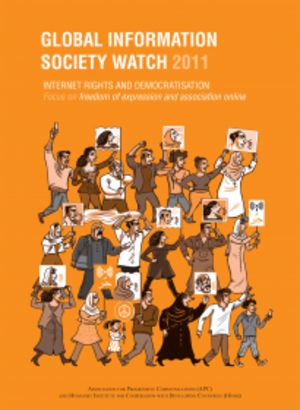
Global Information Society Watch 2011: Internet Rights and Democratisation Focus on Freedom of Expression and Association Online
"The internet boosts economic, social and political development, and contributes to the progress of humankind as a whole; but it is especially an instrument that strengthens democracy by facilitating citizen participation and transparency. The internet is a 'plaza pública' - a public place where we can all participate."
- Frank La Rue, United Nations Special Rapporteur on the Promotion and Protection of the Right to Freedom of Opinion and Expression
Published by the Association for Progressive Communications (APC) and Humanist Institute for Cooperation with Developing Countries (Hivos), this edition of Global Information Society Watch (GISWatch) - the fifth in a series of yearly reports - offers commentary on the future of the internet as an open and shared platform that everyone has the right to access - both in terms of content and connectivity and infrastructure.
The thematic reports in this resource offer, amongst other things, an analysis of how human rights are framed in the context of the internet, the progressive use of criminal law to intimidate or censor the use of the internet, the role of intermediaries facing increasing pressure to control content, and the importance of the internet to workers in the support of global rights in the workplace. Some call for a change of perspective, as in the report on cyber security, where the author argues that civil society needs to develop a security advocacy strategy for the internet.
The country reports follow. Each of these reports considers a particular "story" or event that illustrates the role of the internet in social rights and civil resistance - whether positive or negative, or both. Amongst other things, they document torture in Indonesia, candlelight vigils in South Korea, internet activism against forgetting human rights atrocities in Peru, and the rights of prisoners accessing the internet in Argentina. "While the function and role of the internet in society remains debated, and necessarily so, in many contexts these stories show that to limit it unfairly will have a harmful impact on the rights of people. These stories show that the internet has become pivotal in actions aimed at the protection of human rights."
Click here to view the table of contents online and to access individual components of the resource.
Click here to download the entire 267-page resource in English in PDF format.
Click here to access selected elements of this resource in Spanish.
English, with some content available in Spanish.
267
APC website, April 19 2012. Illustration by Matías Bervejillo
- Log in to post comments