










































Improving Environmental Outcomes Through the Media: An Evaluation of How Support for Journalism Changes Environmental and Climate-Related Policy and Practice
"We need to consider the role journalism plays in the wider ecosystem of actors and institutions concerned with reducing environmental harm and contributing to sustainable development."
This report summarises the main findings, insights, and recommendations of an evaluation of the Earth Journalism Network (EJN), a project that seeks to improve the quantity and quality of environmental coverage by empowering journalists, media outlets, and other communicators, particularly in low- and middle-income countries. Based on a survey of EJN's network of 12,000 members, the research seeks to understand how media stories contribute to changes on the ground, such as changes in public policy related to halting pollution or destructive development projects, changes in broader public discussion of environmental issues, and increased instances of collective action. Internews, who runs the EJN project, commissioned this research as part of the 25 x 25 initiative, the organisation's strategic commitment to increase robust evaluation of their work by delivering 25 research studies by 2025.
The research and the theory of change it is based on is informed by evidence that suggests journalism and the media affect environmental practice and governance through two principal pathways: "Direct influence on government or policymakers, and less direct routes that influence public debate, norms and collective action. In both instances, media actors are part of a wider accountability ecosystem involving civil society and other actors who play critical roles in mediating stories and making them more accessible to various audiences."
The study builds on the outcome harvesting (OH) methodology, using a survey-based method to collect journalists' views about possible outcomes associated with their stories. The research was implemented through interviews and desk-based research by a team of 7 local researchers who examined 12 cases in 6 countries - Bangladesh, India, Indonesia, Philippines, Uganda, and Honduras (these detailed case studies can be found at the end of the report).
The research questions that guided the study were:
- Have EJN-supported stories led to better environmental policies and practices? If so, how?
- Have EJN-supported stories led to changes in individual or collective behaviour? If so, how?
- To what extent did EJN contribute to these outcomes?
- What other factors have contributed to these outcomes?
- Which types of EJN stories support produce outcomes?
- More generally, which types of environment/climate stories and/or distribution channels produce outcomes?
- What are the key components of these stories and/or what external factors generate impact?
Key findings:
- Key findings related to impact within EJN's control: EJN's financial and mentoring support enables journalists with varied levels of experience to undertake reporting they would otherwise find difficult. As a result, they can produce newsworthy stories on environmental issues. The research also showed, for example, that stories supported by EJN are likely to achieve higher levels of engagement when published in local languages. Many stories were also republished and shared through other news outlets and social media platforms such as Facebook and Twitter.
- Findings related to EJN's spheres of influence and interest: Researchers were able to substantiate several outcomes, partly and fully, illustrating that EJN's support does influence discourse and environmental practices. Impact was shown in the following areas:
- Influencing actions of powerful actors - For example, the article "Adi Ganga Disappears in West Bengal", published by The Third Pole via EJN, was picked up by a local activist and used as evidence in a court case. This case contributed to an order by the National Green Tribunal in India for the restoration of the river. The report also highlights case studies from Indonesia and the Philippines that provide evidence of impact in this area.
- Influencing public discourse and citizen action - For example, stories about the imminent extinction of the anoa, a type of buffalo, in Southeast Sulawesi, Indonesia, prompted community education activities by environmental activists. They were keen to deter community members from killing anoa that strayed onto their land or damaged crops. In Uganda, a story describing the success of anti-poaching initiatives in a particular game reserve sparked the interest of local radio journalists, who then organised a short public debate on the beauty and economic potential of the Ajai Game Reserve. This outcome is considered notable, as this region is an area where such issues had previously received little media discussion.
The study also generated insights on how and why the stories and media outlets EJN supports contribute to shifts in public discourse, policies, and practice (or not). The following are some of the insights:
- Continuous reporting is often needed to increase awareness of slow-burn disasters. Occasionally, single stories may contribute to remarkable outcomes, but this is rare.
- If specialised or niche media outlets are not well known, this may reduce their audience and potential impact.
- Evidence-based stories with human interest angles engage readers.
- The relative strength of civil society and connectivity are important factors that contribute to a story's influence and ability to prompt actions.
- Representing marginalised people's voices in stories is necessary but not sufficient - the communities need to be able to access the information, too.
- Vested interests, local politics, and government capacity all play roles in determining whether commitments triggered by EJN-supported journalism get implemented or not.
- OH is a promising method for learning whether and how media platforms and stories influence environmental policies and practices (or not). Yet, it needs fine-tuning to ensure it is effective for EJN.
The report concludes with some recommendations for EJN in relation to its research processes. It recommends that EJN undertake further research on the implicit or explicit assumptions in EJN's theory of change. This could include considering how EJN can ensure the reporting it supports is accessible to audiences most likely to act and have impact at different levels. The report offers some questions for reflection that can assist with this. EJN could also revise its use of OH so that it is more efficient and better supports EJN's learning around its complex theory of change and the nature of its operations. Finally, findings around story accessibility to vulnerable groups, the role intermediaries play in environmental accountability ecosystems, and the possibility of normative bias in OH processes all suggest EJN might benefit from making power analysis more central to its planning, monitoring, and evaluation systems.
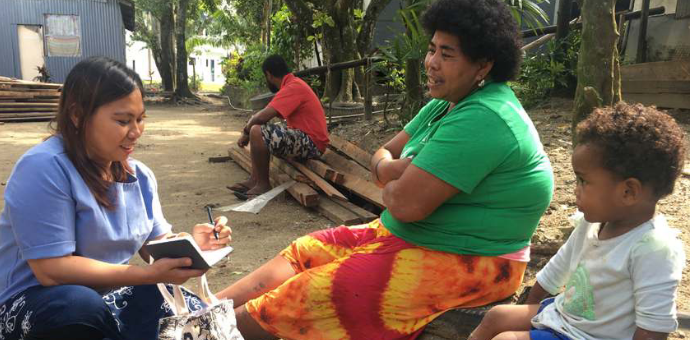
Internews website on November 4 2021. Image caption/credit: Imelda Abano, an environmental journalist and EJN staff member, conducts interviews in a village in Fiji. Internews