










































Report Shows Internews Radio Stations in Southern Sudan Most Trusted by Communities
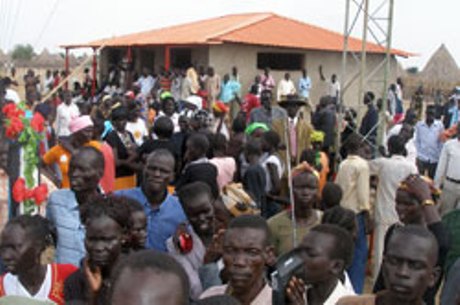
According to audience research surveys conducted by the BBC World Service Trust, three radio stations in Southern Sudan, established and supported by Internews, are the "most trusted and important sources of information in their communities". The stations include: Mayardit FM in Warrap, Naath FM in Unity, and Nhomlaau FM in Northern Bahr el Ghazal. The radio stations, staffed by local Sudanese trained by Internews, broadcast a variety of news, information, and music programming in local languages, including Dinka, Nuer and Arabic, for an average eight hours a day.
In order to reach local audiences, local interviewers were recruited who could carry out the survey in their own villages and surrounding areas. Interviewers received 2 days training on survey research methods, followed by supervised practice. To achieve a random sample, the interviewers were advised to:
- Walk in a different direction from their starting point (home) each day
- Visit every second household on the way
- Select one person at each household to be interviewed. Select someone randomly by picking a person aged 16+ whose birthday was closest to the date of the interview, and ensure that at least 3 out of 8 respondents were female.
"The report finds that Internews stations are valued by their communities as important sources of news, information, culture and entertainment. Particularly in accessing information on the Comprehensive Peace Agreement [CPA.], radio was the most popular source, with an average of 81% of respondents across all three stations tuning in for information on the CPA."
Here is an example of the detailed information available to radio stations as a result of these surveys:
- For Naath FM: "Naath FM has a large audience at these specific times of the day, and during periods when the following programmes are aired: Times: 6am-9am and 9am-12pm; Programmes: Local news and discussion, religion, health matters. These would be appropriate times to broadcast particular programmes or messages that aim to reach the largest audience. Programming and advertising targeted at specific groups could be considered during the following periods when these groups appear to be in the majority:
- Youth (16-25): 6am-9am, and before/after English education programmes
- Women: 6pm-9pm
- Urban audience: 6am-9am
- Rural audience: 9am-12pm
Naath FM’s most popular programmes are local news and discussion, religion and health matters, however interest is much lower for other important programmes such as international news and politics, and so efforts may be needed in these areas to generate more interest or make the content more relevant to the audience."
- For Mayardit FM: “As mobile phones are only used regularly by one third of the audience in Warrap state, encouraging audience participation by means of phone-ins or text messages may be challenging for Mayardit FM at present. However as mobile phone penetration increases in the state these options should be further explored....As Dinka is spoken by 99% of the audience, programming should be primarily be in this language. Producers should be aware that programmes in Arabic or English will only reach approximately half of the potential audience....Programmes on women’s issues only attract 23% of the male listeners to Mayardit FM compared to 46% of the female audience. These programmes are therefore not currently the best forum to broadcast information about issues affecting women, which aim to reach the wider population. A programme which incorporates issues affecting women into the wider topic of social and family issues might attract a wider audience....Sports programmes were much more popular among the youth age bracket (16-25 years, 55%) than older listeners (25+ years, 35%). This age difference is not common to other stations that were surveyed (e.g. Naath FM, Nhomlaau FM) and so Mayardit FM may need to explore whether current sport programming is meeting the interests of older people....”
- For Nhomlaau FM: "...[R]eliance on radio as the most used information source decreases slightly with age. This may be because those in the 45+ age group radio do not feel that radio provides as much relevant information as word-of-mouth. Finding out more about this group’s information needs could improve Nhomlaau FM’s offering....Mobile phone usage is quite high in Northern Bahr El Ghazal county, with almost half of respondents using a mobile regularly (although it is not clear whether this is through calls or text messages). Nhomlaau FM could incorporate more audience participation by providing opportunities for listeners to text or phone in to discussion shows, send in community announcements for their areas, give feedback on programmes, etc.... Nhomlaau FM’s education programmes currently attract a much smaller female than male audience, and only 5% of females surveyed were engaged in formal education as students. Nhomlaau FM could potentially improve it’s educational programmes so that they cater for, or better target, females who might benefit from informal learning through radio...."
Internews website, December 5 2011. Image credit: Deborah Ensor/Internews.
Comments

infoasaid work on media in Sudan
Thank you jlevy for this interesting article. I shared it on http://twitter.com/infoasaid and http://www.facebook.com/infoasaid since it echoes our work at infoasaid.
Regarding sources of information and trust in Sudan, 2007 Hirondelle survey “Media Access and Use in Southern Sudan”, 59% of respondents cited the radio as a source of information, but only 45% said it was their most important source. Compared to present figures, there is an important improvement in communities's trust in radio. Would you have any idea of the reason of this increase?
Also, for those interested in further insights about Media in North and South Sudan, you can download the Sudan Media and Telecommunications Landscape Guide on this page: http://infoasaid.org/media-and-telecoms-landscape-guides-0 (.pdf format). It was produced by infoasaid, written by media development consultant Robert Powell and published in February 2011.
Infoasaid publishes Media and Telecommunications Landscape Guides covering countries (9 so far, 22 soon) vulnerable to humanitarian crisis. Our mission is to help aid communities develop their knowledge and collaboration of local media so that they work together to better aid delivery and improve communications with affected populations.
Thank you and please come and join us on social networks to spread media awareness among aid workers communities.
- Log in to post comments