










































Freedom of Expression and Public Order: Fostering the Relationship Between Security Forces and Journalists
"It is...essential that security forces and journalists establish professional relationships, which is conducive to a safe and independent environment for journalists, enabling all citizens to enjoy their right to freedom of expression and access to information."
Since 2013, the United Nations Educational, Scientific and Cultural Organization (UNESCO) has been offering a training programme for security forces (i.e., the police) that is designed to provide practical and theoretical tools for them to carry out their mission of maintaining order while respecting human rights, freedom of expression, and the safety of journalists. This document emerges from that training programme and in recognition of the need to reduce possible tensions between journalists and security forces, which can lead to frustrations, errors, and misunderstandings. Addressed toward the latter group, the document compiles various communication-centred principles and recommendations agreed on in other countries.
The fundamental right to freedom of expression and the right to seek, receive, and impart information are included in both the Universal Declaration of Human Rights and the International Covenant on Civil and Political Rights. Furthermore, protecting freedom of expression contributes to promoting the attainment of Sustainable Development Goal (SDG) 16 "Peace, Justice and Strong Institutions" - in particular, target 16.10: Ensure public access to information and protect fundamental rights. Yet these freedoms are threatened when journalists' lives are. In 2017, 79 journalists were killed, which marks the lowest number of killed journalists in several years. Committee to Protect Journalists research shows that 25% of murder suspects are government or military officials. Overall, in 9 out of 10 cases, the killers go unpunished. According to UNESCO, intimidation and violence against women journalists have increased. The digital era has created new opportunities for female journalists, but it has also provided a platform for new forms of attacks against women. The online sphere is often just a reflection of the realities and hierarchies that exist offline.
Security forces exist to defend journalists against such threats, but other other obstacles to fostering freedom of expresssion can emerge in sometimes confrontational interactions between the two groups. One of the major sources of tension occurs when journalists are trying to access information. For instance, the police can doubt the legitimacy of journalists' sources, whereas journalists often find the information from the police limited or not delivered in time for their deadline. Security forces may act in ways that limit freedom of expression - for example, by refusing to let journalists enter premises where a crime is being investigated - but they may only do so where they act in accordance with a clear law that permits them to do so.
During the UNESCO training programmes, where security forces and journalists exchange experiences, they often find their jobs have many aspects in common. These shared working circumstances cultivate empathy and can serve as a foundation for establishing a good working relationship. Journalists and police officers both play an important role in society as protectors of democracy and the rule of law. (The report outlines some of these.) Although their missions and means of working are different, both overlap in terms of their areas of operation. To achieve their respective goals, they must cooperate and understand each other's responsibilities and constraints, UNESCO stresses.
"The principal approach of the police in terms of the provision of information to the public through the media should be one of openness and respect for the principle of maximum disclosure. At the same time, there are legal limits to this on the disclosure of information as well as professional requirements to exercise discretion in the divulgence of information." The document lays out what types of information security forces should provide, and when information should not be provided to journalists. UNESCO notes that, since the communication is often non-verbal, all members of security forces are continually communicating through their attitude and behaviour. "Professional journalists, as well as any member of the public, enjoy the right to record, whether for private purposes or with an eye to publishing the material. Putting a hand in front of the camera and erasing graphic material are acts of censorship."
A section of the document examines the impact of social media on police work, whether it be the dissemination of information with social media to the public or the use of social media by police officers. Tips for police organisations are provided.
Preparation needed to establish solid relations with the media is outlined here as:
- A process of internal awareness-raising on the need to involve the media in the work of the security forces;
- Reflection on what security forces want to highlight in their communications;
- A willingness to respect the public's right to know about the activities of the police, as a public body, and to subject themselves to external public scrutiny;
- Clear rules (a code of conduct or standard operating procedures) that allow journalists to report from crimes scenes, and on major or sensational trials.
Tips are offered to security forces who are faced with certain scenarios, including:
- the need to respond to inaccuracies in the press;
- how to handle crime scene access in the framework of respect for press freedom;
- journalists as fundamental during electoral processes (e.g., obstructions to coverage of what is happening at poll stations can be considered a criminal and disciplinary offence);
- good practices before and during demonstrations; and
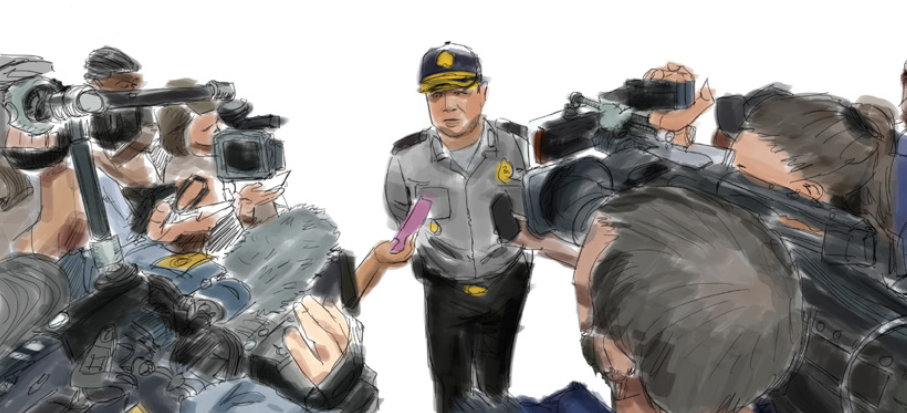
- how to approach police officers' most involved and intense form of engagement with the media: press conferences, media scrums, and interviews. Ten tips are provided (e.g., avoid jargon and acronyms in your responses).
Short case studies of good practices from around the world are offered, focusing on: Great Britain's Metropolitan Police Service (MPS) Procedural Manual, The Police Service of the Kingdom of Belgium (SPB) Code of Ethics, The South African Police Services (SAPS) Code of Conduct, and The Los Angeles Police Department (LAPD) Operational Procedure.
"It is important to ensure awareness amongst security forces of the role and work of journalists and other media workers, the legitimacy of their presence during protests and assemblies, and measures that can be taken to enhance the protection of their rights. Some examples of good practices are:
- Training security forces on how to deal with crimes against freedom of expression, by improving their relationship with the media and by making them more cognizant of their legal obligations to protect media professionals from violent actions by any group and to allow journalists to freely exercise their profession;
- Providing protection in cases in which there is a serious risk of an attack on freedom of expression, and setting up a specialized protection unit where there are ongoing and serious threats;
- Collecting and making public detailed and disaggregated statistics (for example, in terms of gender, location and suspected root causes) on attacks on freedom of expression;
- Conducting independent investigations and, where necessary, setting up special independent units (for example where the attacks may have come from within or be supported by security forces);
- Allocating sufficient resources to investigations, including for the securing of evidence."
Other good practices include establishing operational procedures and concrete actions that can be taken by security forces during tense events (e.g., demonstrations, elections, high-profile trials, crime scenes, major sporting events). For example:
- Developing a code of conduct or standard operating procedures on media relations;
- Appointing specific spokespersons for maintaining contact with the media and answering questions from journalists;
- Establishing clear media zones during an event, which play an important role in facilitating access to information and maintaining journalists' safety;
- Briefing journalists (on technical procedures) and security forces (on the role of journalists) before an event;
- Planning of procedures by security forces on how to work with journalists before, during, and after an event;
- Organising informal visits of security forces to media organisations and inviting journalists to meet security forces in their premises to exchange information on respective perspectives and constraints.
UNESCO website, March 2 2018.
- Log in to post comments