










































Multi-Donor Programme on Freedom of Expression and Safety of Journalists
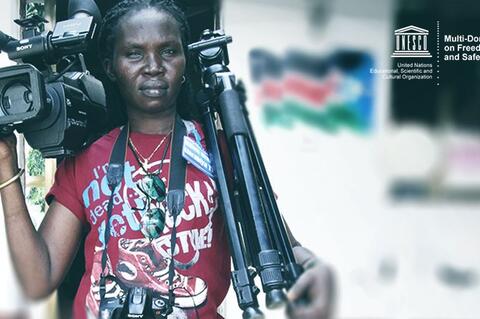
"Information, open communication, and a citizenry endowed with critical civic engagement can help build trust and co-operation between governments and citizens, allow people to exercise and claim their rights, hold duty-bearers to account, reduce corruption and make more informed choices in their daily lives."
Created in 2015, the United Nations Educational, Scientific and Cultural Organization (UNESCO)'s Multi-Donor Programme on Freedom of Expression and Safety of Journalists (MDP) supports activities in the areas of its name all over the world. The purpose is to promote the adoption and application of relevant policies and normative frameworks to strengthen the environment for freedom of expression and press freedom and to support sustainable and independent media institutions.
MDP's two-pronged approach - working with Member States and citizens - is designed to create an environment where good governance and a sustainable and human-rights-centred development agenda can flourish. UNESCO aims at empowering local partners and reaching out to beneficiaries to collaborate in addressing the challenges they face in securing (gender-sensitive) change by duty-bearers. Achieving local ownership involves strengthening shared national ownership, through a multidisciplinary, multi-institutional approach involving national governments.
UNESCO fosters freedom of expression by working on global norms and standards concerning press freedom and journalists' safety, monitoring and reporting, conducting awareness-raising activities, supporting capacity-building trainings and workshops, and research. For example, UNESCO coordinates the commemorations of World Press Freedom Day (May 3), the International Day for Universal Access to Information (September 28), and the International Day to End Impunity for Crimes against Journalists (November 2). Through global, regional, and national events, including awareness-raising campaigns and coalition-building initiatives, UNESCO works to bring together all actors involved to address challenges to press freedom and the issue of impunity.
Related to the latter, UNESCO spearheads the implementation of the UN Plan of Action on the Safety of Journalists and the Issue of Impunity, with specific focus on women journalists. For instance, freedom of expression online directly relates to issues of digital security, surveillance, the right to privacy, and access to information, all of which are pertinent to journalists working in the digital age. Actions undertaken as part of MDP are tailored to build journalists' capacities and make them digitally literate in order to be able to critically evaluate and use new information and communication technologies (ICTs), and to be knowledgeable about the advantages and disadvantages of different ICTs.
Another example of capacity-building being undertaken as part of MDP is UNESCO's work to develop the skills of media in elections reporting, conflict-sensitive reporting, and investigative journalism. This work is in support of another function of the media: enabling democracy, especially in conflict countries or those going through political transition. The nature of issues dealt with under this project are often seen as politically sensitive, especially for countries in conflict or in transition. Therefore, UNESCO claims that its neutral status enables it to lead in activities related to freedom of expression. Countries in conflict or crisis receive support mostly related to capacity-building in areas such as conflict-sensitive reporting, media crisis response, physical and digital safety of journalists, and countering hate speech. In countries in political transition, activities are focused on elections coverage, media independence, media legislation, and policy advice.
Actions build on outcomes of the World Trends in Freedom of Expression and Media Development series. This focus on data is also reflected in UNESCO's collaboration with the UNESCO Institute for Statistics (UIS) to support data collection for the World Trends Report and Sustainable Development Goal (SDG) 16, Target 10. These quantitative data are being used for evidence-based policymaking, validation, and advocacy.
Funds in the MDP also support activities aiming to facilitate pluralism and participation in media, promote gender equality in both media production and content, and empower citizens with increased media and information literacy competencies. A major area of action within this area is support for sustainable community media, especially radio, as an alternative to commercial and public media, especially for underserved and marginalised groups. Furthermore, UNESCO is implementing a 3-pronged strategy that involves engaging actively with duty bearers, media institutions, and civil society organisations to ensure media provides equal opportunities for all, regardless of gender, and that it avoids relying on narrow or harmful stereotypes for gender representation.
In a similar vein, UNESCO actively promotes greater participation of youth in media - in part through capacity-building activities based upon the toolkit Linking Generations through Radio, which provides a basis for media content created by youth, for youth. According to UNESCO, duty-bearers involved in youth development must be equipped and motivated to formulate internal policies and strategies on media information literacy (MIL) with the involvement of youth organisations themselves. Youth are thus empowered as peer-educators of MIL online and offline.
UNESCO is working to ensure visibility for the MDP itself through a tailored communication plan carried out using, in part, UNESCO's website and social media channels, with news, feature articles, photographs, infographics, and multi-media works. Some of this content is concentrated on a collection of MDP pages on the UNESCO website. To read a story about a specific MDP activity conducted in 2020 in Sudan, as profiled on the UNESCO website, click here.
Media Development, Rights
The 2030 Agenda for Sustainable Development recognises the importance of access to information, fundamental freedoms, and the safety of journalists for the creation of peaceful, just, and inclusive societies. However, according to UNESCO, the current state of freedom of expression online and offline is fragile around the world, with public trust in media eroding in many places, audiences more and more unable to separate truth from fiction, and journalists facing increasing risks in the exercise of their work.
"UNESCO supports media reform in transitional Sudan", February 11 2020; MDP pages on the UNESCO website; and MDP strategy document [PDF] - all accessed on March 4 2020. Image credit: UNESCO