










































Understanding Information and Communication Needs among IDPs in Eastern Ukraine
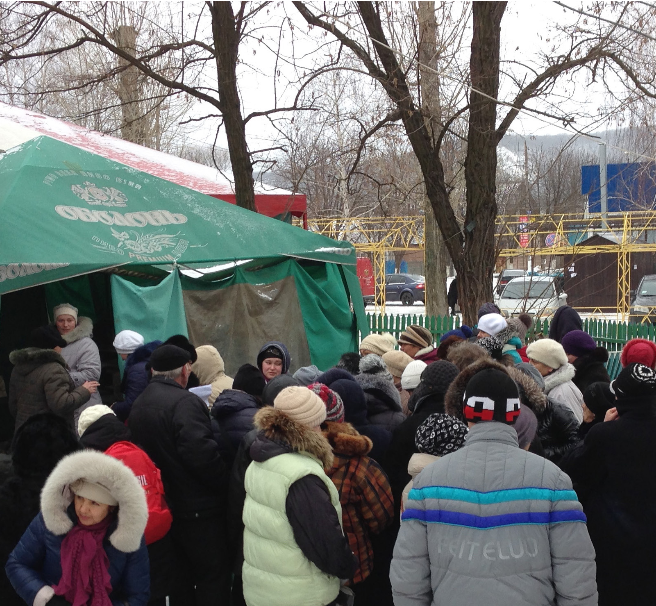
"In the immediate aftermath of a disaster, keeping communities informed about what's happening around them, how to reconnect with their families and friends or what aid services may be available for them, goes beyond saving lives. It is about restoring people's dignity and respect, it is about fulfilling people's rights and the right to know, ask questions and participate in their own relief and recovery and, very importantly, holding stakeholders to account."
This Internews report includes the results from a January 2015 rapid assessment with displaced populations and host communities in Ukraine to understand their information needs and access to communication channels. Based on over 50 interviews with internally displaced persons (IDPs) and representatives from local volunteer groups, civil society organisations, national and international humanitarian organisations and local media groups in 8 different locations in eastern Ukraine, this assessment and resulting publication provides key findings about information needs and main sources of information for IDPs as well as a set of recommendations for mutually reinforcing capacity building and support interventions.
As noted here, "Russia's swift annexation of Crimea in March 2014 and the ensuing conflict in the East have directly impacted the diverse but controlled local media landscape in Ukraine. In addition to the terrible toll of the actual fighting, eastern Ukraine has also become an ideological battlefield, an all-out propaganda war pitting Moscow against Kiev and its Western supporters. Meanwhile, local communities and international humanitarian organizations struggle in the quest for local, practical, accurate, reliable and up-to-date information. Lack of clarity about the Ukrainian government's IDP legislation and assistance mechanisms, including a newly introduced travel permit system, bureaucracy and difficulties in accessing relief and assistance creates confusion, frustration and an increasing sense of isolation among IDPs. As information among IDPs spreads mostly through word-of-mouth and social media, rumors and misinformation are rife. Citizens in eastern Ukraine have low trust in traditional media, and Ukrainian TV is largely not perceived as a credible source of information."
The priority information needs among displaced people in non-government-controlled areas relate to questions about evacuation processes, practical, life-saving information, and what aid is available. Outside non-government-controlled areas, IDPs want to know how to access aid and how to trace disappeared persons. In both areas, people want to know when the war is going to finish and what is going to happen in the future.
Key findings are divided into categories according to the group of actors:
- IDPs - Overall, IDPs feel "abandoned" by the Ukrainian government (since December 2014, areas controlled by pro-Russian rebels have seen Kiev cut all funding for state-run facilities). They report feeling trapped and confused: The introduction of new travel restrictions and the need to obtain a special pass to get in and out of non-government controlled areas is, according to local residents, not just very difficult to obtain, but also extremely dangerous. Furthermore, "They are shocked and traumatized... They have their past, they have their present, but their line of future is being destroyed," said a psychologist working with IDPs in Zaporizhzhya. Social tensions, discrimination, and stigmatisation are on the rise: IDPs are blamed by many for the casualties and destruction and perceived as separatists. At the same time, according to a local volunteer "some people [IDPs] come with a 'you owe us' attitude.” It is what a number of interviewees in Zaporizhzhya called a "blame attitude", a "soviet mentality", and a "self-learned helplessness".
- Government - The vast majority of IDPs and a number of aid groups interviewed said the Kiev government has not done enough, if anything, to reach out to the people in the East and reiterate that they are still viewed as citizens of Ukraine. There is a lack of clarity on the Government's IDP legislation and assistance mechanisms. Relevant laws and changes in those laws are not adequately understood, first and foremost, by IDPs. Equally concerning is the widely shared assumption by local volunteer groups themselves that volunteers, tasked with guiding IDPs through the process, may be in a similar situation (i.e., confused). This leads to an increase in the level of misinformation and rumours, generating more frustration and isolation.
- Humanitarian organisations - Filling the void left by the Ukrainian government, volunteer groups, churches and local non-governmental organisations (NGOs) - many driven by a patriotic, anti-Russian sentiment - crowdfund, coordinate, and lead their own local relief operations both through Facebook and/or VKontakte. Local civil society organisations, including public media initiatives, predominantly feel they have not been adequately supported in a timely manner by the government, international organisations, and donors. International humanitarian capacity and footprint is scaling up too slowly. There is a need to increase awareness of International Humanitarian Law (IHL) and promote the principles that guide humanitarian action. Further, there is a growing divide between IDPs and the host communities that needs to be addressed with more dialogue and coverage of positive examples of integration. Negative stories and rumors about IDPs spread quickly through traditional and social media, which contributes towards increasing discrimination against IDPs and stigmatisation. Many local organisations relied upon by IDPs and/or soldiers have dedicated hotlines and produce their own brochures, posters, and leaflets. However, "[n]o matter how much information is in front of them, they want to talk to a volunteer," said a volunteer from Kharkiv.
- Media - There is an urgent need for local, practical, accurate, up-to-date information about rights, entitlements, and changes in policies, eligibility criteria, and available aid services. Local media does not have the capacity to source, produce, and disseminate this information, or effectively and consistently engage with local humanitarian actors. The war dominates news coverage; the humanitarian crisis and its scale and social costs need to be adequately explained and regularly updated. Local audiences often lack access to independent, objective, and high-quality reporting and information. Journalists lack skills in conflict and humanitarian reporting and covering crisis-related topics. (For further reference, see "Overview of the media landscape").
Based on these findings, the report recommends a set of mutually reinforcing capacity building and support interventions in terms of both media support and for humanitarian organisations. For example, it is recommended that media support organisations provide financial and technical support to a selected number of local, independent, and moderate media organisations in eastern Ukraine for the production of multimedia humanitarian information, social news, and analysis on humanitarian issues. Another suggestion is to coordinate with Communication with Communities (CwC) - see Related Summaries, below. The CwC Coordinator will work closely with a Local Media Liaison (LML). While the LML will provide advice and technical assistance on media relations to the larger humanitarian community, the Humanitarian Liaison Officer (HLO) proposed by Internews will focus specifically on the production and dissemination of humanitarian content with a selected number of local media partner organisations in close collaboration with aid organisations.
CDAC Network, June 24 2016. Image credit: Jacobo Quintanilla/Internews
- Log in to post comments