










































Kagadi Kibaale Community Radio (KKCR)
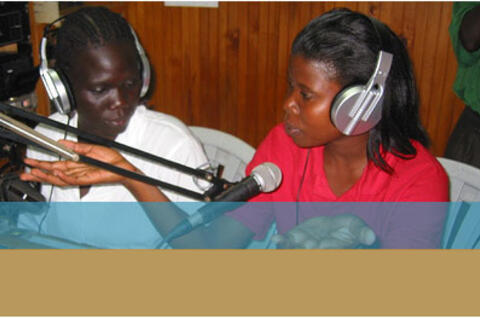
KKCR is part of Uganda Rural Development and Training (URDT), which is based on an 80-acre campus comprising a residential girls' school, a large demonstration farm teaching students and community members sustainable agricultural techniques, a vocational institute training local youth in leadership, business, and vocational skills, an all women's university (African Rural University), as well as the radio station. The community station is part of URDT's mission to promote "integrated" rural development, teaching people to address the interconnectedness of health, education, financial self-sufficiency, civic participation, and human/gender rights within their lives. The station is founded on URDT's working premise, which states that training, education, and information sharing are key ingredients in development, as the knowledge, skills, and information gained enable people to meet needs of rural life.
KKCR programmes are designed to educate the community about rural and human development and to promote civic engagement. The following are some of the topics addressed by KKCR:
- Human rights/domestic violence - According to organisers, testimonies of injustices by clients on the radio play a key role in creating awareness and positive action in the villages. In an evaluation carried out to assess the impact of the human rights programme, it was revealed that; 12% of the participants confirmed there was less domestic violence; 7% said women are more empowered; and 13% said local leaders know their rights and responsibilities around dealing with domestic violence.
- Land rights - URDT airs weekly radio programmes on land issues, and they say the absence of violence is, to some degree, attributable to information disseminated over the radio.
- HIV/AIDS and health issues - KKCR airs weekly one-hour radio broadcasts on gender and HIV/AIDS, including testimonies by people infected with HIV and AIDS who are living positively. The radio also broadcasts information about the girls' school theatre performances in villages and the discussions that follow.
- Youth health and sexuality - URDT students hold weekly programmes on health-related issues, discussing matters of sexuality, growth, and development. Participation in the Straight Talk club, a nationwide movement for adolescent health, gives geographically isolated school children the opportunity to get information from their peers over the radio.
- Governance and transparency - URDT broadcasts weekly programmes focusing on public resource accountability issues such as detention without trial, corruption, leadership, and good governance. Ministers, members of parliament, and district leaders participate in these programmes. Listeners also contribute to the discussions by phone.
- Peace-building - URDT works to contribute to peace in a region threatened by ethnic and political conflict through mass sensitisation over the radio. KKCR ran a 5-month programme by the Rwenzori Peace and Justice Forum on peace-building and reconciliation to curb tribal conflicts arising in 3 sub-counties in Kyenjojo District. Organisers say that, as a result of these programmes, various parties have settled their differences through negotiation rather than resorting to violence.
- KKCR is currently engaged in the African Farm Radio Research Initiative, a 3-year exercise that focuses on food security and soil and water conservation. The programme brings together 25 radio stations in 5 countries of Africa: Uganda, Tanzania, Malawi, Ghana, and Mali. The station is promoting a cassava-resistant variety that is quick-maturing and high-yielding.
- KKCR has facilitated the formation and nurturing of 10 listeners clubs across Kibaale district, which are engaged in savings and credit schemes, tree planting, and Functional Adult Literacy. Over 10,000 tree seedlings have been planted in collaboration with the communities.
- KKCR initiated a programme that features governance and human rights issues and, for this, the BBC World Service Trust recognised the station for the most innovative programme that engages leaders and their constituents.
- Since 2004, KKCR has participated in the International Children's Day of Broadcasting and won several prizes and recognition.
- KKCR has mentored 2 upcoming community radio stations in Mityana and Kalangala districts, and it was expected that on August 20 2010, the station would mark 10 years of partnership with the communities of Kibaale district and Bunyoro region and uninterrupted community broadcasting.
KKCR also serves as a substitution for phone service. For example, travellers may stop by to broadcast a message to their loved ones to let them know that they're almost there. Every Sunday afternoon, children line up to prerecord greetings to family and friends.
Health, Governance, Gender, HIV/AIDS, Peace-building
URDT's goal is to facilitate sustainable, self-generated development in rural communities by combining development projects with education and training.
According to the organisers, KKCR reached a listenership of 4 million people, and listeners report that the radio has made them able to make more informed choices and better able to hold their local government officials accountable. A survey conducted showed that listeners have gained information and knowledge on a variety of issues such as children and women's rights, land rights, child abuse, domestic violence, and education of the girl child. According to one respondent, "KKCR has helped improve on health in this area. Before the inception of KKCR in 2000, we used to immunise 23%-32% of the children, but now when it comes time to immunise, I tell you, my friend! We really get tired. People come in big numbers. It is not only that - we have a sensitisation programme on blood check-up for HIV/AIDS (Voluntary Counselling & Testing). People have really joined willingly, and others are even living positively with HIV but still feeling okay. You know we have been there on the radio, we have sensitised people about all these issues."
According to KKCR, the following Most Significant Changes can be reported:
- Knowing the value for information: There is now greater awareness of the value for information and communication as a tool for promoting development and social change.
- Recognition of people's rights: A large number of people believe that there is now much improved knowledge and recognition of human and people's rights.
- People's Voice: The articulation of people's voices and more effective responsiveness to local agenda is now high.
- Promotion of dialogue: As a medium for information sharing and exchange, KKCR is credited with promoting dialogue among community members especially on such sensitive issues as land, gender based violence, corruption, and abuse of office.
- Transparency and accountability: As a result of wider and more transparent sharing of information and due to the ongoing dialogue and discussion on key issues, local leaders' accountability to the communities and constituents has improved.
- A wider range of livelihood options: With improvements in the quality and range of information shared with communities and through education and improved health, communities are now better able to choose from a wider range of livelihood options.
- Gender equity and empowerment: Significant improvements have been realised in the position of women in general and observance of the rights of the girl child in particular.
- Reduced crime: KKCR has made it a lot easier for communities or households affected by crime to report these with minimum hassle. As a result the rate of crime has declined in most communities as radio also serves to alert community members about possible misdemeanours.
In all, organisers say that KKCR has led to improved knowledge and recognition of people's rights and voice, increased awareness of values and access to information, and increased mobilisation capacity - leading to increased livelihood options.
Uganda Rural Development and Training (URDT), Mangelete Integrated Community Development Programme (MICDP), Institute for Orkonerei Pastoralist Advancement (IOPA), African Farm Radio Research Initiative (AFRRI), BBC World Service Trust, EcoNews Africa, and PANOS Eastern Africa.
URDT website on June 18 2010 and October 27 2010.
- Log in to post comments