










































Media Action Plan (MAP) on HIV/AIDS and Gender

The strategy was designed to provide tools and support in a semi-uniform and sustainable way that also allows for flexibility and local ownership. The MAP project's seven main components were designed to facilitate the development and roll-out of HIV/AIDS and gender policies in newsrooms across Southern Africa:
- Development of a handbook through the gathering of best practices - The first step was to gather best practices on HIV/AIDS and gender workplace policies and identify possible tools or resources to be used in the process. These were used to develop a handbook to guide the policy-making process.
- Desktop needs assessment - While the handbook was being developed, a researcher, working with the national chapters of SAEF and GEMSA, was tasked with gathering information on existing newsroom HIV/AIDS and/or gender policies to help guide the roll-out process.
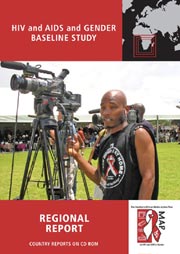
- Baseline study on coverage of HIV/AIDS and gender by the media - This component served two objectives. According to the organisers, this kind of study is essential for persuading media houses of the need for policies and for pointing to gaps in coverage. It also forms part of the monitoring and evaluation of the project overall.
- Training of in-country facilitators - The fourth phase sought to train a core team of facilitators from each country in the use of the handbook so that they could drive the process within their country, bearing in mind the need for consistent follow-up. Two facilitators from each country were selected and resource teams from each country were trained in the use of the MAP HIV/AIDS and Gender Policy Handbook.
- Getting buy-in at country level - To ensure buy-in at country level, the project manager and/or members of the reference group, accompanied by local facilitators and SAEF country chapters, visited media houses. According to the organisers, this one-on-one consultation, as well as understanding the dynamics of individual newsrooms, was key to the success of the overall programme.
- Workshops in each country to start the process - Country-level workshops, attended by at least one member of the reference group, and convened in each country by SAEF/GEMSA, brought together decision-makers from media houses interested in joining the process.
- Roll-out in each country within media houses - This phase involved the actual roll-out of the policies in media houses in each country. The roll-out involved local facilitators working with the media houses that had committed themselves to developing and implementing policies through a flexible process that included:
- a situation analysis using checklists that covered internal issues (human resource and work place) as well as external issues (editorial content, market considerations);
- a sensitisation workshop for senior management;
- a workshop involving all key departments to devise the draft policy;
- development of a task team to implement immediate actions;
- formal adoption of the policy; and
- implementation.
As an ongoing part of this process, the project appointed a senior, experienced project manager to guide the project, train the trainers, bolster them, monitor the quality of work in each country, facilitate the exchange of information, and step in to assist where problems arose.
Gender, HIV/AIDS.
Southern African Editors' Forum (SAEF), Gender Links, Gender and Media Southern Africa (GEMSA) Network, Media Institute of Southern Africa (MISA), The Joint United Nations Programme on HIV/AIDS (UNAIDS), Southern Africa HIV and AIDS Information Dissemination Service (SAfAIDS), PANOS Southern Africa.
Gender Links website on May 29 2008 and September 11 2009.

- Log in to post comments