










































Initiative for Media Freedom (IMF)
The Initiative for Media Freedom (IMF) is a five-year programme implemented in the Philippines by Internews and a range of partners to support an independent and free press that is able to counter disinformation, promote political inclusion, and enhance democratic governance. To achieve this, project partners are working together to implement a number of evidence-based, mutually reinforcing activities that are designed to improve the environment for a free press, bolster the capacity of media and other organisations to address disinformation, and strengthen self-regulation of the media. The IMF is funded by the United States Agency for International Development (USAID).
The project has the following three objectives, which are being achieved through a range of activities:
- Improve the environment for a free press - this involves strengthening media stakeholders' understanding of the laws that protect freedom of expression and building coalition capacity to support enabling environments. Activities also seek to:
- Build community ownership and trust in media, and
- Promote the safety of journalists.
- Bolster capacity of media and other organisations to address disinformation - this involves confronting information disorder at critical points on both the supply and demand sides of information dissemination. Activities include:
- Mapping disinformation ecosystems,
- Building awareness and reporting disinformation,
- Holding media outlets and platforms accountable, and
- Improving access to quality content.
- Strengthen self-regulation of the media - this involves mobilising media stakeholders to update the industry code of ethics and design an auditable accounting mechanism, with targeted capacity-building to increase awareness of and adherence to the code of ethics. Activities include:
- Developing agreed-on standards and reporting mechanisms for ethical violations, and
- Empowering the community on digital rights.
Specific disinformation-related activities include: building the fact-check capacity for media, teachers, students, and civil society members; building youth coalitions; working with so-called social media "influencers" and content creators; developing a disinformation reporting platform and a malign actor tracking platform; and coordinating with Facebook to encourage the removal of toxic operators. The programme will also conduct media literacy and disinformation awareness campaigns to reduce the vulnerability of the Philippine citizenry to influence operations.
In addition, the project is engaging with the private sector through the establishment of a Trusted Media Index that will be shared with advertising companies. It will encourage them to focus a larger part of the Philippine digital advertising market - estimated at US$700 million per year - on trustworthy information sources. Other activities relate to investigative and data journalism capacity building, with a focus on elections and political financing.
The project also focuses on research and analysis, as it is considered essential to better understand the disinformation dynamics - whose actors, networks, sources of funding, and motivations are often obscure - in order to address them.
Each of the following project partners works to contribute to the above objectives and activities:
- Foundation for Media Alternatives (FMA) - As part of the IMF project, FMA will collect and create content pieces and resources with the consortium partners to help strengthen critical thinking and improve the capacity to report and fight disinformation. These online resources will aim to inform and educate the public on the importance of critical thinking in media consumption, as well as to increase community awareness of disinformation and reduce its spread.
- National Union of Journalists of the Philippines (NUJP) - NUJP has been training and helping journalists on welfare and safety issues; for the IMF project, they produced a Philippine Journalists' Safety Guide (a video from which is viewable below).
- Lyf Solutions Inc. - This is a multimedia production, campaigns, and events company that produces content for the digital community. For the IMF, they conducted a community engagement campaign that engaged local content producers, journalists, and students to raise awareness on the impact of social media and the importance of verified information.
- EngageMedia.org - This organisation uses the power of video, the internet, and open technologies to create social and environmental change.
- Peace and Conflict Journalism Network (PECOJON) - This international group of journalists mainstreams conflict-sensitive journalism and promotes high-quality reporting.
- Philippine Center for Investigative Journalism (PCIJ) - PCIJ specialises and promotes investigative reporting and data journalism on current and public interest issues.
- Rappler - This social news network seeks to combine journalism, technology, and civic engagement to produce multimedia content and tell stories in ways that build communities of action.
- RIWI Corp. - This global survey technology firm gathers citizen opinion data and accelerates engagement initiatives using its patented technology. For the IMF, they conducted a mass online survey to better understand the Philippines' current media landscape and information disorder.
- University of the Philippines College of Mass Communication Foundation, Inc. (UPCMCFI) - UPCMCFI provides continuing training, coaching, and mentoring to mass communication educators and practitioners.
- VERA Files - This group produces research-intensive and in-depth reports in multiple formats and trains and mentors journalists, students, and civil society organisations. Together with Internews, they developed a three-part video series for social media to help address disinformation around the COVID-19 crisis. The short videos covered the "infodemic" around #COVID19, exposed specific cases of disinformation, and shared ways by which people can fact-check and protect themselves from false information.
Media Development
Context (as per the IMF brochure):
"Enshrined in the Philippine Constitution, freedom of expression and the press have underpinned the development of a largely independent media capable of conducting high quality investigative and public interest reporting on controversial social and political subjects.
In its re-emergence following the collapse of the repressive Marcos regime, the media sector thrived while establishing a healthy tension with subsequent governments as it performed its watchdog role and cemented itself as a critical democratic institution in Philippine society.
In 2020, the Philippines slipped to 136th out of 180 countries in the Reporters Without Borders World Press Freedom Index (down from its 2019 ranking of 134) due to a number of challenges: increasingly dangerous environment for journalists, information disorder, regulatory obstacles and exceptions, and weak self-governance.
Despite the myriad of challenges confronting the media sector, Internews and its partners note a number of opportunities that exist to preserve and widen the space for healthy, pluralistic, democratic discourse in the Philippines: history of holding the line, diverse coalitions in place, youth potential, and openings on self-regulation."
Internews, Foundation for Media Alternatives (FMA), Lyf Solutions Inc, EngageMedia.org, National Union of Journalists of the Philippines (NUJP), Peace and Conflict Journalism Network (PECOJON), Philippine Center for Investigative Journalism (PCIJ), Rappler RIWI Corp. University of the Philippines College of Mass Communication Foundation, Inc. (UPCMCFI), and VERA Files. Funded by USAID.
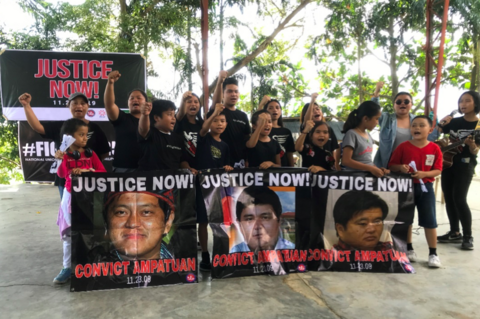
IMF Brochure [PDF], Internews website, Information Dystopia and Philippine Democracy: Protecting the Public Sphere from Disinformation [PDF], and Philippine Journalists' Safety Guide - all accessed on February 19 2021. Image caption/credit: Families of the victims of the November 23 2009 Ampatuan, Maguindanao massacre gather to commemorate the 10th anniversary of this bloody attack against the media and to demand justice for the 58 people, including 32 journalists and media workers, who were murdered that day. Internews
- Log in to post comments