










































Flying solo after training with BBC Question Time
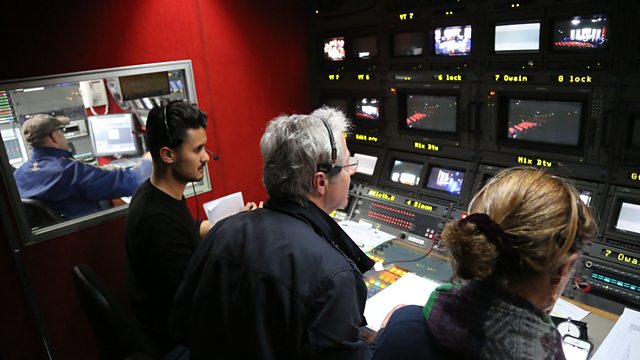
Authors: Ali Sharif and Rob Hopkin, originally posted October 4 2017 - Ali Sharif, 27, wanted to be an airline pilot but after joining BBC Media Action’s training programme in North Africa - and with help from BBC Question Time director Rob Hopkin - he is now the director of Hiwar Mushtarak, a TV debate show increasing people’s knowledge of current affairs and holding power to account in Libya.
Ali:
When I was growing up I really wanted to be an airline pilot like my Dad. Flying fascinates me – so I gravitated towards studying aviation. But it just wasn’t meant to be. Money was tight and I couldn’t afford to complete my private pilot’s licence.
In high school I taught myself camera angles from movies and during the revolution I started working as a host on the first English language radio station in Benghazi. That was my first experience in media. I then joined BBC Media Action three years ago as a trainee – doing everything from script writing to translation but I aspired to be a director.
It paid off. Now instead of a cockpit, I have a gallery.
Learning from well-known directors, who help train young Libyan journalists made all the difference.
Shadowing Rob Hopkin on a Question Time recording in the UK helped me understand production from A-Z. He gave me training and directed episodes of Hiwar Musharak so I could learn from his methods and style of directing.
Whilst I worked as the vision mixer for the programme under another experienced director, I continued to study. And in 2016, I took the big step - directing my first episode.
It was nerve-wracking, but it was a lot of fun and I think it went well!
Now I’m very chilled when I direct, I don’t think I could be strict. I listen a lot. I learnt that being a director is not about controlling people; it’s just leading the team and trying to bring out the best in them.
We don’t record every day but I love it when we do. What I like about Hiwar Mushtarak is that it is an audience show, not a panel show. All of the questions come from the audience - really they are the stars - not the panelists.
I try to pick up every reaction, every clap, every facial expression from the audience. It’s a challenge. With about 70 people in the audience, it can be difficult to capture everything with just seven cameras.
But seeing the audience ask whatever they like and that we’re able to give them that freedom makes me proud. Just to watch Libyans debating normally with other Libyans is something - it’s a very special format.
What’s next? I do training myself now. I like mentoring people so I’m thinking of giving directing classes in Libya. But I haven’t given up on aviation. I met a professional camera operator who came to give us a class in Tunis and he is also a co-pilot with British Airways.
So maybe I can manage to do both, why not?
Rob:
Hiwar Mushtarak is based on the tried and tested formula of the BBC's own Question Time and as such it is dependent on the power of the audience to confidently confront people with power and ask searching and difficult questions. It has a crucial role to play in the evolution of a democratic system where free speech can prosper.
In my day to day work I am usually working with a team of people who know as much about TV, if not more, than me so there are lots of things that you expect to be done that are just done without having to ask or explain. Working with trainees you have to explain everything and take nothing for granted and presume nothing.
So I began with the basics. Not so much the technical details but more about team management and motivation; how long things take to organise, the importance of planning and the communication across the whole team - it’s imperative that everyone knows what is expected and required and when. The teams were enthusiastic and keen to learn.
Ali was an excellent pupil and understood why things were being asked of him and when he began to have faith in his ability, he was able to step up and lead the team confidently.
He is an able leader and it is satisfying to see Ali directing the show and now being a trainer himself.
Click here to access this BBC Media Action blog and related links on their work in Libya.
Image credit: BBC Media Action
Contact:
BBC Media Action
BBC Media Centre, MC3A, 201 Wood Lane
London
W12 7TQ
United Kingdom (UK)
Phone: 44 (0) 20 8008 0001
Fax: 44 (0) 20 8008 5970
Media.action@bbc.co.uk
- Log in to post comments