
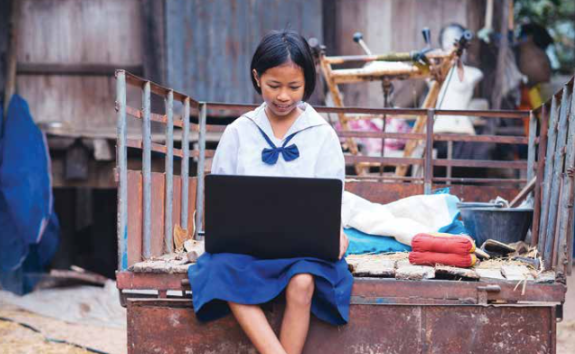
"UNESCO regards Media and Information Literacy (MIL) education as one of the central domains in fostering critical thinking, respect for cultural diversity, and open dialogue."
This booklet critically reviews the media and information literacy (MIL) education policies and practices in formal, informal, and non-formal settings in five Asian countries (Indonesia, Japan, Malaysia, the Philippines, and Thailand) and explores how MIL education could address emerging and pressing issues such as political extremism, false news, online harassment, and discrimination.
Published by United Nations Educational, Scientific and Cultural Organization (UNESCO) Bangkok, the booklet is designed to support Member States in formulating education policies and strategies on MIL that respond to the current MIL trends and challenges identified in the research. In particular, it seeks to shed light on the factors affecting the overall policies and practices of each country by looking into the environment in which educators, practitioners, and other relevant parties make decisions about their approaches to MIL in each country.
As stated in the handbook, UNESCO sees inclusive MIL education "as sustainable mitigation strategies to pervasive misinformation, hate speech and other divisive socio-political issues. These social challenges become more widespread with more people having access to digital technologies and online communication. The information disorder in the 'post-truth' era affects everyone, especially vulnerable groups and minorities; MIL is believed to address this challenge of modern societies that are prone to public sentiment manipulation and opinion polarization."
A synthesis of the findings shows that the region comprises countries with diverse political mechanisms, media landscapes, religious beliefs, languages, ideologies, and educational systems. They also show that what MIL education entails in each country is not aligned. Even inside one country, there are sometimes contradicting ideas about what needs to be taught - and how - by different parties. This fragmented approach to how MIL is treated is one of the obstacles to growth and country take-up in this field. The UNESCO strategy, therefore, calls for harmonisation of information, media, and digital technology competencies, under the umbrella term MIL.
With this in mind, the editors of the handbook hope that it can contribute to broader international conversations on MIL education to advance ongoing efforts for harmonisation of MIL education, as well as to prompt new and more sustainable initiatives. They also envisage that the publication can draw the attention of more stakeholders in the Asia-Pacific region to a more holistic approach to empowering people with information, digital, and media competencies - one that is less fragmented and that has a greater overall impact on people's lives.
The booklet comprises five chapters, one for each country report (all written by different authors). Each report is structured according to the following sections:
- Overview: This brief summary of the report describes overall trends in the country and its core findings.
- Key stakeholders: This section discusses the MIL education landscape in relation to issues arising from information disorder. It explains who the key stakeholders are and what they do - from governmental agencies to academics to civil society. It also describes and analyses their policies, projects, and activities.
- Definition: MIL education covers a wide range of competencies - from cognitive proficiency to practical digital skills. It is necessary to scope competencies while considering a common core when putting MIL training into practice. According to Law 5 of UNESCO's Five Laws of MIL, MIL "is not acquired at once. It is a lived and dynamic experience and process. It is complete when it includes knowledge, skills and attitudes, when it covers access, evaluation/assessment, use, production and communication of information, media and technology content." In this section, each author looks into how various stakeholders define MIL and explores what is actually being taught under varying circumstances. Some country reports also review existing research in the country and describe the main socio-political issues and concerns expressed by MIL educators.
- Challenges: This section outlines the main challenges faced by the country. It examines the problems and difficulties that particular initiatives and teachers have encountered. The section also dovetails the micro-level challenges with the macro-level - structural and socio-political context in the country that are affecting the ways in which MIL teaching and learning is taking place.
- Discussion: Each author concludes the report with a discussion on the possible courses of actions each country can take, based on the findings. These ideas and recommendations are country-specific, as some of them could be deemed controversial or unrealistic in other countries.
The report notes that the five countries examined here are by no means representative of the entire Asian region, but the authors believe it is a worthwhile first step to form a basis to facilitate dialogues among MIL stakeholders beyond national boundaries.
77
UNESCO website on March 29 2021. Image credit: Arrowsmith2/Shutterstock.com