










































Communicating the Sustainable Development Goals: A Toolkit for Community Radio
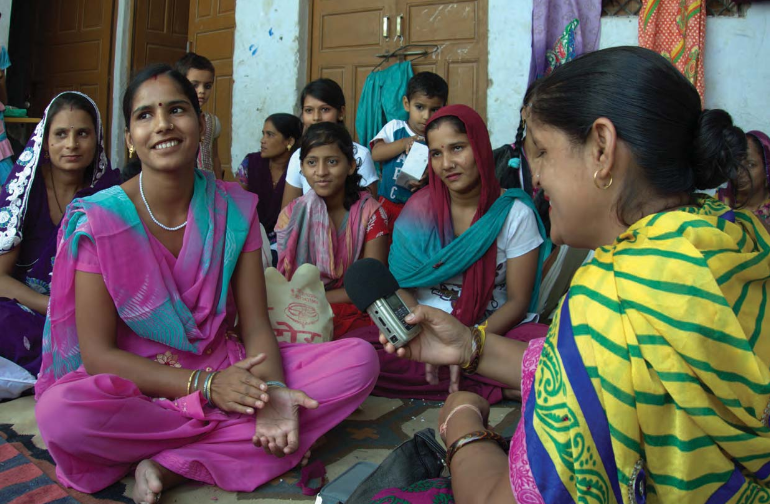
"Community radios can contribute effectively in furthering the SDGs, as they play a crucial role in creating awareness in terms of access to information and knowledge, enabling community participation and facilitating an active development process through governance, civic participation and dialogue."
This toolkit has been developed in an effort to demystify and simplify the 17 Sustainable Development Goals (SDGs) and their 169 targets for community radio (CR) stations in order to ensure their contribution in meeting the Agenda 2030. Designed for CR reporters, practitioners, volunteers, and independent community media practitioners in India, the toolkit contains information, tips, recommendations, and guidelines for undertaking community engagement activities and developing radio programmes that encourage local action in relation to the SDGs. It was developed by the Indian non-governmental organisation (NGO) Seeking Modern Applications for Real Transformation (SMART), with support from the United Nations Educational, Scientific and Cultural Organization (UNESCO) and the United Nations Children's Fund (UNICEF).
As stated in the guide, "The importance of citizen engagement and community empowerment in policy processes and development projects has been widely discussed by academics, educators, economists, scholars and activists. There is enough research based evidence to state that community-driven approaches lead to sustainable impact and local empowerment. Thus the key to the success in achieving the SDGs is to engage with citizens and to work with organisations that actually work on the ground with citizens, marginalised groups and women for promoting community engagement." CR stations are seen as significant partners in this process, as they work with communities and marginalised and vulnerable groups that include women, children, and lesbian, gay, bisexual, transgender, and queer/questioning (LGBTQ) communities. CR stations also work in small geographies of 10-15 km and reach out to around 100,000-300,000 people. depending on the density of that area. They are therefore best placed to reach out to communities.
The toolkit seeks to assist CR stations to understand each of the 17 Goals, engage with different actors and stakeholders, map policies and initiatives at the level of both central and state governments in India, and provide ideas for the design of content and outreach campaigns. According to the guide, after reading this manual and completing the exercises, CR station representatives will be able to:
- Understand and appreciate the SDGs;
- Identify stakeholders within the geographical area of the station's broadcast; and
- Create discussion points with community members and actively engage with other key stakeholders to produce relevant content and outreach activities.
The toolkit is structured according to the 17 SDGs, with each chapter including the following:
- An energiser section with questions and notes on responses to the questions - designed to get the users thinking about the goal.
- Background information and some fast facts that relate to the Indian context.
- A brief on the role of CR in enabling the goal.
- Unpacking the targets - addresses the specific targets for each goal. For each target, the handbook offers: a warm-up activity that includes questions and detailed hints for discussion, as well as the Global and Indian indicators (for reference only). For each target, it also offers suggested activities for CR stations, as well as suggested content ideas for radio programmes and ideas for CR station outreach activities. A section on key government schemes related to the target seeks to enable the users of the toolkit to link their radio programmes to government initiatives.
464
CAMECO Media Development Publications, January - June 2020 [PDF] on October 16 2020.
- Log in to post comments