











































Dashed Hopes: The Criminalization of Peaceful Expression in Myanmar
Human Rights Watch (HRW)
"...[F]reedom of expression in Myanmar is deteriorating....Domestic journalists are particularly at risk."
The National League for Democracy (NLD) took office in March 2016 as the first democratically elected, civilian-led government in Myanmar since 1962, sparking hope that the country would see a significant shift toward openness. As this report from Human Rights Watch (HRW) argues, the NLD government's record on freedom of expression and assembly after 2 years in power has shown that optimism to be unfounded.
The report is based on interviews conducted in Myanmar and by telephone in March and April 2018 and in July and August 2018 with 38 lawyers, journalists, students, activists, members of non-governmental organisations (NGOs), and individuals or family members of individuals prosecuted for speech or assembly. Information from interviews was supplemented by an analysis of Myanmar's laws used to restrict freedom of expression and assembly, as well as court judgments and news reports concerning criminal proceedings in relevant cases and public statements by government spokespersons and officials.
HRW found that, in the wake of the transition to NLD, "Even as privately owned media organizations proliferated and some old restrictions were lifted, the process of liberalization was uneven". Stronger, the government in decades has prosecuted large numbers of peaceful critics in violation of basic human rights, according to the analysis. Human Rights Watch said in a report released today. In short, while discussion of a wide range of topics now flourishes in the media and online, those speaking critically of the government, military, or their officials, as well as abuses in Rakhine or Kachin States, are frequently subject to arrest and prosecution. Journalists, activists, and ordinary citizens have been imprisoned using laws such as the Telecommunications Law, the Peaceful Assembly and Peaceful Procession Law, the Official Secrets Act, and provisions of the Penal Code criminalising defamation, sedition, and offenses against religion.
For example, the NLD has increasingly made use of section 66(d) of the Telecommunications Law. In April 2018, 8 high school students were convicted of defaming the military in a satirical anti-war play, while the man who live-streamed the play was convicted of violating section 66(d). And in December 2018, 3 peace activists were convicted of defaming the military after urging protection for people displaced by renewed fighting in Kachin State.
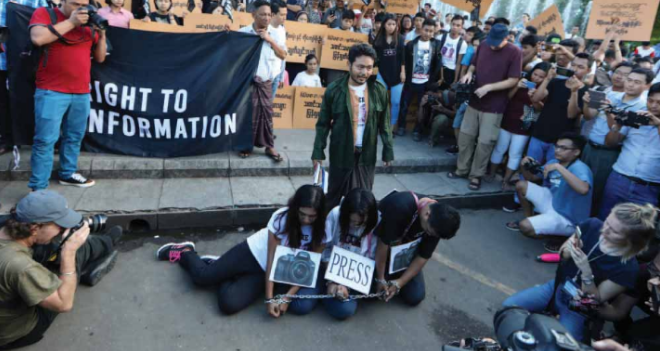
Furthermore, HRW reports that journalists have been arrested under the Telecommunications Law, Unlawful Associations Act, Official Secrets Act, News Media Law, and Aircraft Act of 1934. In a case that gained global attention, 2 Reuters journalists were sentenced to 7 years in prison for violating the colonial-era Official Secrets Act in apparent retaliation after they uncovered a massacre of ethnic Rohingya in the village of Inn Din. Prosecutions for organising or participating in assemblies reportedly jumped in 2018 after a series of anti-war protests around the country. As of the time of this writing, more than 45 protesters had arrested, with most facing charges under the Peaceful Assembly and Peaceful Procession Law. Journalists have also been denied access to conflict areas and to information about government policies and programmes, HRW notes. In short, the examples offered in the report indicate that these laws are undermining rather than enhanced protection of speech.
The analysis indicates that the criminal charges against journalists, online commentators, and activists are facilitated by broad and vaguely worded laws that, according to HRW, violate internationally protected rights to free expression and assembly. With only a few exceptions, NLD leaders have failed to use their majority in parliament to make substantive changes to laws restricting free speech and assembly, and, HRW finds, have made some existing laws even worse.
In light of these findings, the report offers a series of recommendations. Excerpts follow:
To the Government of Myanmar
- "Amend Myanmar's criminal laws to conform to international human rights standards for freedom of expression, association, and peaceful assembly.
- Sign and ratify the International Covenant on Civil and Political Rights and other core international human rights treaties.
- Develop a clear plan and timetable for the repeal or amendment of the laws [reviewed in the report]...; where legislation is to be amended, consult fully and transparently with the Myanmar National Human Rights Commission and civil society groups, leaving ample time for public review and consultation.
- Seek technical assistance from the Office of the United Nations High Commissioner for Human Rights (OHCHR) on international human rights standards, and ensure proposed legal revisions comply with those standards..."
To the Office of the Attorney General
- "Drop all pending investigations and charges against those being prosecuted for exercising their right to peacefully assemble and their right to freedom of expression.
- Work to strengthen the rule of law in Myanmar in accordance with international human rights standards, as set forth in the Strategic Plan for the office launched in January 2016..."
To the Myanmar police force and Ministry of Home Affairs
- "Direct all police departments to facilitate, not hinder, peaceful assemblies, and appropriately protect the safety of all participants...
- Instruct all police departments that participation in peaceful assemblies should never be the basis for charges...
- Provide training for the police focusing on how to manage assemblies....Training should emphasize de-escalation tactics based on communication, negotiation, and engagement.
- Provide training on international standards on the use of force, including the principles of legality, legitimacy, necessity, and proportionality."
To the Ministry of Foreign Affairs
- "Extend a standing invitation to all UN Special Procedures and promptly approve requests to visit from all special rapporteurs, working groups, and independent experts.
- Immediately extend an official invitation to the UN special rapporteur on the promotion and protection of the right to freedom of opinion and expression and the UN special rapporteur on the rights to freedom of peaceful assembly and of association.
- Fully cooperate with...the UN special rapporteur on the situation of human rights in Myanmar, and permit her to enter the country to pursue her mandate.
- Implement recommendations on the rights to freedom of expression, association, and peaceful assembly, among other fundamental rights, made by UN member states to Myanmar...
- Appoint an independent and impartial human rights expert...
- Restart negotiations with the Office of the UN High Commissioner for Human Rights [OHCHR]..."
To the Myanmar National Human Rights Commission
- Recommend that Myanmar's government sign and ratify the International Covenant on Civil and Political Rights and other core international human rights treaties.
- Initiate an investigation into the use of criminal laws to harass and arrest civil society activists, members of the media, and ordinary citizens in violation of their rights to freedom of expression, association, and peaceful assembly.
- Provide policy memos and advice to the government on important steps that should be taken in law and policy to address issues raised in this report, and urge the government to ensure that it complies with international standards for the protection of freedom of expression, association, and peaceful assembly.
- Issue prompt public statements criticizing harassment, threats, and arbitrary arrests and detention of individuals exercising their rights to freedom of expression, association, and peaceful assembly.
- Systematically engage with human rights groups, trade unions, and other civil society organizations to investigate and report on violations of human rights, and seek justice for the victims of these abuses."
To the United Nations Country Team and Resident Coordinator
- "Engage with Myanmar's government at all levels...to urge compliance with international human rights standards on freedom of expression, association, and peaceful assembly.
- Urge the government to extend a standing invitation to the UN Special Procedures and to promptly approve requests to visit from all special rapporteurs, working groups, and independent experts.
- Encourage high-level engagement and visits by OHCHR to engage with the government on promoting respect for the rights to freedom of expression, association, and assembly, and to offer technical assistance as needed...
- Establish a human rights working group...to jointly develop and implement plans and advocacy to promote human rights in Myanmar."
To concerned governments
- "Publicly and privately urge Myanmar to protect the rights to peaceful expression and assembly...
- Raise freedom of speech and freedom of assembly concerns outlined in this report during Myanmar's next Universal Periodic Review.
- Offer assistance to train judges at all levels of court in international law on the rights to freedom of expression and assembly and on the technical aspects of handling cases involving material posted on the internet and social media.
- Provide assistance to human rights groups and other civil society organizations in Myanmar working on freedom of expression and media freedom issues."
Click here to download the summary and recommendations in Burmese in PDF format.
CAMECO Media Development Literature, July 2018 – June 2019; and HRW website, January 31 2019 - accessed on February 25 2020. Image caption/credit: "Myanmar press freedom advocates and youth activists hold a demonstration calling for jailed Reuters journalists Wa Lone and Kyaw Soe Oo to be freed, Yangon, September 16, 2018." © 2018 Ann Wang/Reuters
- Log in to post comments