











































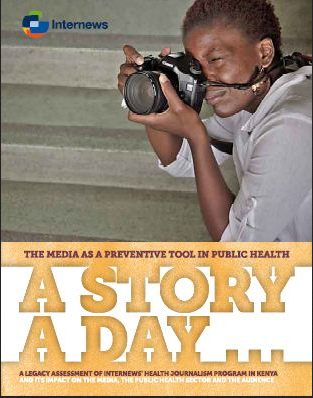
A Story a Day: The Media as a Preventive Tool in Public Health
Internews
This 70-page report shares findings of an assessment conducted by Internews of their Voices in Health project (earlier known as Local Voices) in Kenya, launched in 2003 to create a more supportive social environment for preventing and mitigating the impact of HIV/AIDS, by working with media to ensure better quality coverage of HIV and other health concerns. Funded by the United States Agency for International Development, the programme’s objectives were to secure the commitment of news media managers and owners in the response to HIV and AIDS, while strengthening the skills of journalists and providing them with on-going resources to expand and improve their reporting on this critical health issue. In general, the assessment found that the media are a key factor in improving the lives of Kenyans by providing more, better, and deeper coverage of complex health issues that matter to them.
Intrenews held in-depth meetings with 16 journalists and surveyed 89 journalists who had participated in more than one Internews training. Researchers also surveyed 61 partners and key stakeholders and interviewed 12 individuals from partner institutions. To better understand why and how people access health news, and its impact on the communities where Internews has been most active, the survey also included eight focus group discussions with 89 participants and surveys with 626 community members in Korogocho and Kisumu. Finally, researchers mined existing data, such as quarterly reports, previous evaluations, annual donor reports, and other relevant information.
The key findings suggest that:
- Public demand for health news is high. The media is a critical element in the response to HIV and AIDS and associated stigma.
- Training journalists to cover health is critical – it changes lives.
- Internews' approach to health journalism is incredibly effective and has had a deep impact on trainees, newsrooms, partners, and audiences.
- The media, and in particular radio, is a trusted source of health information.
- The overall scope and quality of health media coverage still needs improvement; there is a seeming disconnect between what people want and what they believe is available.
The following are specific findings from the three groups surveyed: Journalists
- 84% of those surveyed strongly agreed that Internews support was instrumental in their professional development, indicating that they had either been promoted or offered a job as a result of their training.
- 75% stated that Internews training was more useful than their diploma courses.
- 98% felt more recognised and respected in their profession.
- 88% stated they have had more stories published after Internews training.
Partners and key stakeholders
- 93% of health-focused partners stated working with Internews had been beneficial for their organisation's work.
- 88% reported that since working with Internews, their relationship with the media had improved.
- 85% responded that they engaged more often with the media.
Community members
- 87% of those surveyed rated heath news as very important.
- 90% of focus group participants stated that they find news stories about health issues more useful and compelling than public service announcements.
- 95% of all respondents said that after visiting a doctor or community health center that they were likely to listen to a radio station for health information.
- Radio is by far the most common source of general information, with 74% of people reporting using it every day; 66% of all respondents used radio as their primary source of health information – at best every day, or at least once a week.
However, despite these gains, the report notes that the majority of people interviewed or surveyed indicated that health news was not covered as well or as often as it could be. The researchers found that some of the barriers to a more integrated approach to making health news part of the daily news agenda include: health comes second to political, finance, and sport news; a lack of resources in newsrooms translates into a perception of a lack of interest in reporters specialising in health news; and that health news stories which are not usually event-driven often take a backseat to more sensational news and on the-spot reporting.
Recommendations include that Internews:
- considers increasing its training footprint in the newsrooms through its training of trainers approach;
- works more closely with educational institutions in the field of journalism;
- trains journalists to focus analytically on the policies that inform public health;
- involves the seniour level structure of the media houses more strategically; and
- leverages and maximises new technologies.
The report concludes that interviewees consistently placed a high premium on health news. From a health seeking behavioral perspective, one factor was identified as a major stumbling block: a systemic societal lack of awareness of health matters beyond HIV. However, from a media-related perspective, journalists and partners indicated that Internews does address awareness of health through its work with the media and its partners and other key stakeholders. Many remarked that as an organisation, Internews had brought great value to the media profession, in part through its collegial and participatory approaches; its in-depth, long-term training methodology; and for identifying a critical gap in news coverage in Kenya, vis-à-vis HIV and health journalism.
According to the report, the hope is that every newsroom commits to one health story a day, ensuring more enlightened and informed media coverage of HIV and other health areas that Kenyans grapple with daily. “Like an apple a day, one such story, every day, has the potential to not only increase awareness of critical health issues such as HIV and others, but also position the media to play a critical preventive role in public health, keep ignorance at bay, and ultimately ensure that health news finds its rightful place on the news agenda.”
Internews website on January 9 2013.
- Log in to post comments