










































Fataki Campaign

The campaign's call to action is: Protect your loved ones from a "Fataki". This call to action is being used to:
- create a taboo against cross-generational sex;
- provide a language of opposition; and
- model and encourage appropriate behaviours for community members.
The development of the campaign began with a one-week workshop which involved actors, radio producers, script writers, and illustrators. During the workshop, participants learned about the characteristics of successful communication campaigns based on an analysis of numerous communication campaigns and stories. One of the areas the workshop participants identified as needing a communication intervention was cross-generational sex. They then worked on developing concepts and messages for a media campaign which addressed cross-generational sex.
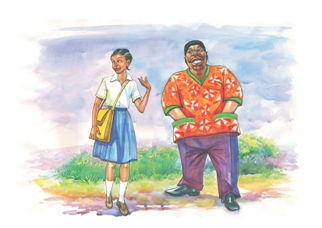
The strategy of the campaign is to stigmatise cross-generational sex, which has been somewhat tolerated in Tanzania. According to the organisers, the first step was to find a common word to describe "a man who preyed on younger girls". The group decided on Fataki, which means explosion and implies that people in such relationships are "playing with dynamite". Next, a Fataki cartoon character was created. The development process included a number of pre-tests, which resulted in the development of one visual depicting Fataki being dismissed by a schoolgirl. Fataki is made to look very ordinary and typical. He is not wearing western dress and does not look rich. There was some ambiguity in the schoolgirl's rejection, which was noted in the pilot phase, and was corrected when launching the campaign at national scale. According to the organisers, the visuals leave room for some dramatic tension, are not confrontational, and are in keeping with social norms.
According to STRADCOM project leaders, the HIV/AIDS message is mentioned in a subtle way, as they realised that after years of almost daily talk about HIV/AIDS, explicit messages often fall on deaf ears.
Ten radio spots were developed by STRADCOM and produced by Media for Development International. In each story, Fataki repeatedly preys on young women, offering them money, gifts, and promises for sex. But with each plot, Fataki is unexpectedly thwarted by the young girl's family, friends, and her community members. The radio spots were produced and aired in three blocks. The first block had four spots: Automatic Teller Machine or ATM (this is a very recent slang expression used by young girls to describe older men dispensing cash for sex), Fataki with a School Girl, Fataki and his Wife, and Fataki with his Friend's Daughter-in-law. The second block of four was Juma Nature, Chicken and Chips, Brother Intervenes, and Fataki and a Police Woman. The third block was Fataki visits his Rural Cousin and Fataki and his Boss.
The campaign was run as a pilot for 120 days starting in February 2008 with the two main local radio stations in Morogoro City, and later with a small community-owned radio station in Kilosa District. STRADCOM also mounted a billboard on the main highway and distributed 170 banners throughout four districts. During this pilot, STRADCOM conducted five rounds of surveys as well as focus groups. Based on what the organisers call the success of the pilot campaign, the campaign expanded to other regions in Tanzania. In November 2008, the campaign went national, and Fataki spots were regularly broadcast on 15 radio stations across Tanzania - four of the stations had national coverage, while the rest were regional stations. In addition, 1,000 banners were distributed in 10 regions with high HIV prevalence rates. Phase one of the national scale campaign continued to run through to the end of October 2009. The second phase of the Fataki national campaign was expected to start in December 2009.
HIV/AIDS, Reproductive Health
According to statistics released by the Ministry of Education and Vocational Training in 2007, 4,362 primary school students dropped out due to pregnancy, compared to 2,550 in 2003. In secondary schools, the increase was even more dramatic, with 3,965 pregnancy dropouts in 2007 compared to 668 in 2003. According to research, girls are being impregnated by men who are not of their age group but by older men. It is for this reason that the campaign was developed.
Findings from an initial survey showed that, by the end of Fataki's pilot run in the Morogoro region, 88% of adult residents said that, as a result of Fataki, they felt they could now do something to help solve the problem of cross-generational sex. Community members said that by ridiculing Fataki's behaviour, they were able to develop a language they could use to help actively intervene in potential cross-generational sex situations. Forty-four percent of Morogoro adults also said they now call sugar daddies "Fataki".
STRADCOM is a United States Agency for International Development (USAID) initiative based in Tanzania that seeks to promote radio programming on the subject of HIV/AIDS. The project is headed by Johns Hopkins University Center for Communications Programs (JHUCCP), with technical support from Media for Development International - Tanzania (MFDI-TZ).
Ministry of Health & Social Welfare National Aids Control Program, TACAIDS, Ministry of Education & Vocational Training, USAID, U.S. President's Emergency Plan for AIDS Relief (PEPFAR), JHUCCP, Media for Development International, Family Health International, T-Marc, and Femina Hip.
Daily News website; STRADCOM website; and Engaging Tanzanian Families and Communities in Prevention of Cross Generation Sex [PDF], presented at HIV Implementers Conference in Windhoek, Namibia on June 11 2009 - all accessed on November 20 2009.
- Log in to post comments