Media in Conflict Prevention and Peacebuilding: An Opportunity for EU Leadership

Search for Common Ground (SFCG)
This opinion piece emerges from a conference on conflict prevention and media hosted by the Folke Bernadotte Academy and the Madariaga Foundation in Brussels, Belgium, on April 2 2009. In it, Bernardo Monzani of the non-governmental organisation (NGO) the Search for Common Ground (SFCG) seeks to raise awareness among European Union (EU) officials and policy-makers about the positive impact of media activities before, during, and after violent conflict. His conviction is that EU institutions and Member States "could benefit immensely from the experience of NGOs and media organisations, and such collaboration could easily lead to the definition of more efficient media strategies to complement and strengthen the EU's development and security policies."
In Monzani's estimation, there is a dilution of responsibility that is at the heart of the debate over what role the media has, and should have, in conflict. The media landscape in conflict-affected countries is often varied, going beyond trained and certified journalists and media outlets operating in the context of well-defined legal frameworks. Instead, there are:
- international media outlets, such as the Associated Press, Reuters, and CNN, which seek out stories for a global audience;
- local media outlets which cover national and local affairs and provide entertainment for national and local audiences;
- NGOs with different mandates (humanitarian relief, human rights protection, etc.), some of which support local media outlets through technical trainings and content development;
- community-based media organisations, which may act as watchdogs vis-à-vis the government at the grassroots level; and
- international organisations, such as the United Nations (UN) or the EU, directly responsible for providing information and/or supporting local media outlets.
"In conflict-affected countries where local media organisations lack sufficient resources and national governments do not have the capacity or incentives to promote the development of free and fair media, NGOs and international organisations such as the UN often become the main information providers." In such situations, Monzani argues, it is not enough to enforce principles of "good journalism"; patterns in media consumption and literacy, and people's consequential influence in shaping their country's media landscape mean that the media will not automatically act as a positive force.
Thus, in order to map out the media's role, Monzani suggests shifting the focus from the media itself to the conflict-prevention and peacebuilding field. An analysis of the conflict cycle reveals that a pre-conflict phase demands effective early-warning systems, which rely heavily on the availability and quality of information. During active conflict, when "violent rhetoric has become the norm, a neutral and objective media can act as a bridge between communities, provide information about essential services and events, and allow for international attention not to wane." In post-conflict settings, "a free and fair media ensures accountability vis-à-vis newly installed politicians and promotes unity by filling the gap between civil society and governments."
Monzani reflects on the way the EU intervenes in conflict-affected countries, describing a mix of self-promotion through the media and support to local press and media technology. A clearer division of tasks among the various EU agencies and instruments, would, he argues, "help to conceptualise more systematically the media dimension of the EU's development and security policies and to raise awareness about the positive role that media can play in pre- and post-conflict settings, which is presently low."
To help bolster this case, Monzani next presents several specific examples of best practices:
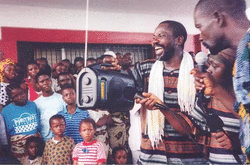
- Radio Okapi, Democratic Republic of Congo (DRC) - a radio station jointly managed by the UN Mission to Congo (MONUC) and the Fondation Hirondelle, a Swiss NGO. Operating since 2002, Radio Okapi "seeks to contribute to peace in the DRC through objective, credible and non-discriminatory programming." Radio Okapi works also to explain to Congolese people the mandate and responsibilities of the UN mission and highlights the successes related to the country's ongoing peace process. This serves to counter the spread of rumours. "Finally, Radio Okapi is a clear example of the positive results that can be achieved through cooperation between international organisations and NGOs in the sphere of media."
- SFCG, Former Yugoslav Republic of Macedonia (FYROM) - Produced between 1998 and 2003, Nashe Maalo ('Our Neighbourhood') was a children's television programme created to promote intercultural understanding, to encourage conflict prevention in a multicultural society, and to impart specific conflict-resolution skills. The series "proved wildly popular and succeeded in influencing an entire generation of children in the direction of mutual tolerance and respect. An independent evaluation further found that Nashe Maalo had 'become a recognised and appreciated point of reference for adults as well as for children.'"
- Media development in Afghanistan - Monzani cites a report by the US [United States] Institute of Peace indicating successful efforts in the years immediately following the end of Taliban rule. In Monzani's words, "These early efforts were characterised by the birth of vibrant and truly independent local media; high levels of coordination between international media outlets and their local counterparts; and a government that prioritised communication with its citizens and looked favourably at the development of free and fair media." The drying up of resources for media development and shifts in the attitudes of both the Afghan government and the international community left those accomplishments incomplete, he concedes, but "the significance and success of media development in Afghanistan should not be diminished..."
Monzani also provides several examples of how the new media - from text messages and mobile-to-mobile communication to blogs and online social networking tools - have impacted communication in the conflict cycle. He points to examples such as anti-FARC [Revolutionary Armed Forces of Colombia] protests in 2008, organised through Facebook, and Ushahidi, a website that was developed to map reports of violence in Kenya after the 2008 post-election fallout. These examples illustrate the sense in which we are facing a "seachange moment" characterised by the democratisation of mass media, the rise of citizen journalism, and enhanced representation of traditionally underrepresented groups, including women. Yet, he cautions, the advent of new media "threatens to dilute standards of journalism in countries where they are already low. New media also present added risks of misuse, as for example by terrorist groups....Finally, the increased volume of information from the new media risks creating a layer of 'noise' that will hinder early warning efforts by international actors instead of facilitating them."
In moving forward, the following challenges stand out for Monzani:
- The absence of adequate legal frameworks in conflict-affected countries, which impedes the development of a free and fair media capable of acting as a neutral watchdog.
- The logic of development assistance, which underestimates the importance of the media for stability and democratisation.
- Insufficient capacity of local media organisations and the low level of media literacy of local communities.
- Weak coordination among the many actors involved in media activities, often compounded by confusion between public relations activities and support to local media outlets.
- Insufficient analysis of the impact and role of the media in specific conflicts, which fuels fears that media activities will incite conflict instead of contributing to peace.
Efforts to address these challenges can be shaped by recommendations that emerged from the April conference, Monzani asserts. Namely,
- Improve cooperation between EU institutions and representatives of the media, in particular focusing efforts on interaction with media that are influential in the most vulnerable and unstable countries.
- Improve coordination among EU institutions and Member States in conflict-affected countries to improve the legal, economic, and social framework for the development of free and fair media.
- Conduct regular media assessments to identify the role and needs of local journalists as well as new media technology users and suppliers, and tailor context-specific interventions to support their development.
- Develop national press and new media strategies in conflict-affected countries that are based on EU best practices, that are tailored to local needs, and that include specific support for local media development projects with rapid effect from the perspective of conflict prevention.
"In conclusion, EU officials and policy-makers should not underestimate the need to keep up with the latest advances in communications and information technology, including the rise of new media....Regular exchanges between specialised agencies and EU institutions, including formal training opportunities, could constitute an easy starting point to seize this opportunity."
Email from Susan Koscis to The Communication Initiative on May 1 2009.