










































Youth-to-Youth
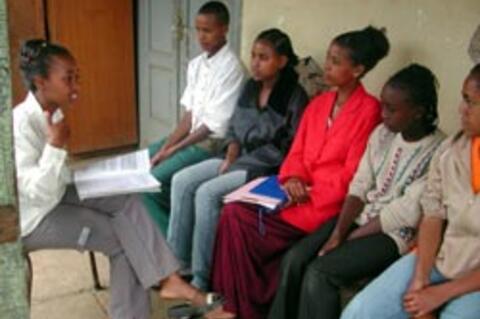
The Youth-to-Youth programme was developed based on the premise that awareness-raising works best when young people are informed by their peers. DSW trains young people as peer educators, who then pass on their knowledge to their peers and act as role models. High-quality learning resources are provided in the form of educational materials and intensive training. In order to reach as many young people as possible, DSW supports the establishment of youth clubs where adolescents receive information on sexuality and contraception. Here, they also have the opportunity to play an active role as peer educators, as club leaders, or in music and theatre groups.
Y2Y is built on principles of active participation, gender equity, respect of local cultural, traditional and religious values, dynamism, the utilisation of existing resources, and flexibility. According to the project, this programme is unique as young people take the lead in all stages of programme design, implementation and monitoring. Although the specific implementation of activities varies from country to country and region to region, the activities themselves are uniformly designed. They include:
- Peer Education - Y2Y has adopted the peer leadership model of identifying one member of the peer group who receives special training in order to better facilitate a desired change within the group. The young people form youth clubs, which are designed to retain the dynamism of peer groups while giving members a greater sense of ownership. The club members elect their club leadership, who then receive training on club management, draft a constitution, establish club rules, identify a range of activities the club will undertake, and select for themselves the young people who will be trained as peer educators. They then receive training on both facilitation skills and sexual and reproductive health.
- Hotline - As part of the Y2Y programme, DSW Ethiopia has piloted the use of a youth telephone hotline.
- Information & Referrals - peer-provided information is always linked to DSW partner organisations, which offer more comprehensive counselling and youth-friendly medical services, including diagnosis and treatment of sexually transmitted infections (STIs), pregnancy tests, and voluntary counselling and testing (VCT). To cater to the sexual and reproductive health needs of young people, health care workers are specifically trained on how to provide youth-friendly services.
- Income-Generating Activities - youth clubs are given assistance in identifying viable income-generating activities (IGAs). Young people receive training on the development and management of IGAs, as well as specialised skills training (if necessary). They are then provided with a small amount of start-up funding, as a no-interest loan.
- Mass Edutainment - firmly rooted within the oral traditions of the cultures in which they live, youth clubs are using folk media methods, including music, dance, and drama, to promote social values, raise awareness, disseminate information, provide role models, and encourage positive attitude and behaviour change. According to the organisers, this draws on old traditions of using cultural performances as the primary ways of educating the young and of promoting beliefs and values among adults. In addition, these performances are social events where folk media methods bring the village together and promote collective problem solving.
- Social Marketing - The Y2Y programme aims to help make condoms more accessible and affordable. Through its social marketing component, which adapts the commercial marketing approach to achieve social goals, condoms are not only promoted as an HIV prevention strategy, but also distributed to young people at low cost by specifically trained peer educators.
- IEC Materials - Information, education, and communication (IEC) materials comprise a wide range of media, including newspapers, brochures, posters, information leaflets, and radio programmes, as well as audio and video tapes. Youth clubs and young people in general play an important role in the production and dissemination of these IEC materials. The Y2Y programme facilitates their full involvement in the design, development, pre- and post-testing, evaluation, and communication of all materials. In Ethiopia, DSW maintains an Info Centre where IEC materials are produced centrally and disseminated to partner organisations and youth clubs on a monthly basis. One example of the publications produced by this Info Centre is the "Youth-to-Youth" newspaper, which is intended for young people aged 16-24 and pre-adolescent youth aged 10-15, and currently has a print run of 40,000 and 20,000 copies, respectively.
- Advocacy - Dialogue with national decision-makers and advocacy to improve the legal and policy environment is directly linked to other Y2Y activities, specifically behaviour change communication (BCC) and youth-friendly services.
Please visit the Youth-to-Youth page on the DSW website for more extensive and up-to-date details on these activities.
The Youth-to-Youth Project website houses background materials and publications produced through the programme. According to the organisers, equipping young people with accurate and age-appropriate information materials can help them understand sexual changes as positive and natural changes of their development. The Y2Y programme has produced a wide range of publications on a number of adolescent sexual and reproductive health issues. Aimed at informing and educating young people about adolescence, sexuality, and health, these publications serve to supplement the IEC activities implemented by the youth clubs. To ensure all publications are in line with young people's needs, young people themselves are fully involved in the design, development, pre- and post-testing, evaluation, and communication of these materials.
Reproductive Health, Youth.
According to organisers, half of the world's population is younger than 25. Young people in developing countries are particularly vulnerable. Boys and girls living in these conditions often have little access to a full education. An estimated 115 million children currently do not attend primary school. The majority (57%) are girls. This leaves young people lacking in the skills and knowledge they need in the future. This age group is more at risk of becoming infected with HIV, and early unwanted pregnancy is the leading cause of death among young women aged 15-19. For both physiological and social reasons, girls aged 15 to 19 are twice as likely to die in childbirth as those in their twenties. Girls under age 15 are five times as likely to die as those in their twenties. A youth is infected with HIV every 14 seconds, and youth (increasingly young women) account for nearly half of the new cases of HIV infection world-wide. In order to combat these problems, the German Foundation for World Population (DSW) has developed its "Youth-to-Youth", or Y2Y, initiative, in which young people become agents of change.
German Foundation for World Population (DSW), The World Bank Group.
Youth-to-Youth Project website, February 26 2007; and emails from Sabine Weber to The Communication Initiative on September 18 2008 and September 18 2009.