










































Women's Property Rights, HIV and AIDS, and Domestic Violence: Research Findings from Two Rural Districts in South Africa and Uganda
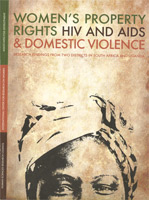
International Centre for Research on Women (ICRW) (Swaminathan/Ashburn/Kes/Duvvury), Human Sciences Research Council, South Africa (Walker/Aliber/Nkosi), and Associates for Development, Uganda (Rugadya/Herbert)
This 187-page report, published by the International Centre for Research on Women (ICRW) in collaboration with the Human Sciences Research Council in South Africa and Associates for Development in Uganda, explores the links between women's ownership of housing and land and their vulnerability to domestic violence and HIV and AIDS. Based on in-depth interviews with 120 women from sites in Uganda and South Africa, the report argues that while property ownership is not easily linked to women's ability to prevent HIV infection, it may help mitigate HIV/AIDS' social impacts by allowing women to leave violent or unpleasant situations. Researchers also noted that, to a lesser extent, land access allowed women to weather some of HIV's negative economic impacts such as decreased food security and household income.
Researchers reported that many of the women in the study were at risk of HIV infection - both because of both the prevalence of multiple concurrent partnerships (MCPs) in communities and the involvement of many women in serial marriages throughout their lifetimes. Data gathered by the study revealed that access to land mitigated some of the negative social impacts, allowing women to leave living situations characterised by violence (meted out by both intimate partners as well as family members), overcrowding, and an inability to control sexual relationships, which women cited as a form of abuse.
According to the report, women also said that land ownership gave them a sense of the independence and self-reliance they saw as important. Women also cited an additional impetus for land acquisition: their children. While not all women who acquired land chose to live on the property or rent it out, many reported that they wanted to ensure that the land would be inherited by their children in the event of their deaths as a social and economic protection measure for these children.
To a lesser extent, women reported the benefits of land acquisition in mitigating the economic impacts of HIV/AIDS. This was especially true for rural women. Researchers noted that women who owned land reported that they were better able to ensure food security within their households through subsistence farming and gained additional income from selling surplus agricultural outputs. In the event that women became too sick to farm the land themselves, they reported being able to rent out their land as tenant farmland or as housing accommodation - with varying success. Owing to the importance placed on land inheritance in reference to their children or family members, the actual sale of the land itself was infrequent.
While the study does not make specific recommendations, it does conclude by reiterating that securing women's land rights is not enough to protect women or mitigate the hardships they face in terms of HIV/AIDS. Researchers argue that while land rights are themselves important, the benefits of land tenure are diminished if women remain economically excluded. Also, they point out that social networks and the quality of women's relationships with partners and family members may also affect the degree to which they benefit from the land they own.
ICRW website on September 25 2009.
- Log in to post comments