











































What Message Appeal and Messenger Are Most Persuasive for COVID-19 Vaccine Uptake: Results from a 5-country Survey in India, Indonesia, Kenya, Nigeria, and Ukraine
Johns Hopkins Bloomberg School of Public Health
"To increase vaccine acceptance, identifying preferences for appeals and messengers is paramount."
The COVID-19 vaccine has faced significant hesitancy and low uptake globally. There are common threads of why so many people are hesitant about COVID-19 vaccination, including: distrust in government and health authorities, concerns regarding vaccine safety and efficacy, and false information about effects of the vaccine. Despite these shared concerns, communication strategies to encourage COVID-19 vaccination uptake should be tailored to specific contexts. To that end, this study aimed to evaluate the influence of 3 specific messaging appeals - COVID-19 disease health outcomes, social norms related to vaccination, and economic impact of COVID-19 - from 2 kinds of messengers - healthcare providers (HCPs) and peers - on COVID-19 vaccine acceptance in a diverse set of low- and middle-income countries (LMICs).
The researchers surveyed 953 online participants in 5 countries (India, Indonesia, Kenya, Nigeria, and Ukraine), showing each of them 6 ads. The messengers in these ads included a HCP image, which depicted a medical provider talking to a patient, and a peer image, which depicted 2 people speaking to each other. The ads included the following appeals: health outcome, which focused on the risk of COVID-19 and the protective effect of vaccination; economic benefit, which focused on loss of work time and income due to COVID-19 infection and the protective effect of vaccination against economic loss; and social norms, which focused on how most people have received the COVID-19 vaccine and the protective effect of vaccination for the community.
The majority of participants in each country expressed high levels of vaccine hesitancy. Overall, more than a quarter of participants (n = 288, 31.8%) reported having ever delayed or refused a recommended vaccination. Most participants were at least slightly concerned that the vaccine might not prevent COVID-19 disease (n = 512, 53.7%) or might not be safe (n = 595, 62.43%). However, in a final logistic regression model, participant characteristics were not significantly related to vaccine hesitancy.
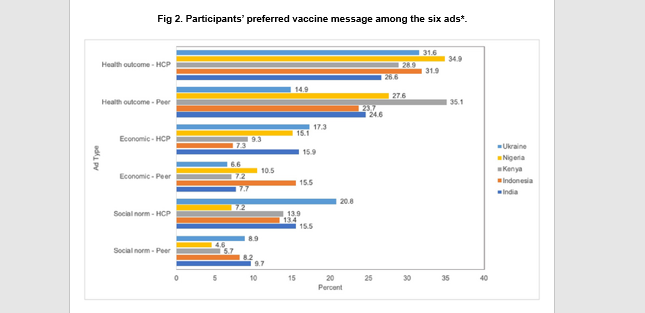
In general, participants agreed with the message (level of agreement > 90%) across all 6 ads. Participants in India (26.6%), Indonesia (31.9%), Nigeria (34.9%), and Ukraine (31.6%) reported the health outcome/HCP ad as the ad most likely to motivate them to get the COVID-19 vaccine, while participants in Kenya reported a preference for the health outcome/peer ad. Across-country pooled descriptive analysis indicated participants reported the health outcome/peer ad (92.3%) as the ad that would prompt them the most to tell someone about the COVID-19 vaccination. Participants found the health outcome/HCP ad to be relevant to them (92.3%), motivated parents to vaccinate their children (67.5%), and motivated them to get the COVID-19 vaccine (91.9%).
This study has several key implications for informing persuasive messaging to improve vaccine uptake:
- Across all 5 countries, almost one-third of participants reported having ever delayed or refused a recommended vaccine. This finding indicates a need to continue to identify specific concerns across populations to develop and implement approaches to overcome such concerns. "When COVID-19 vaccine rollout began, there was a missed opportunity to frame these vaccines as a means in which to prevent severe disease or hospitalization rather than prevention of illness altogether. With refined messaging, these perceptions and concerns can be addressed. Correcting this misperception will also help manage expectations related to vaccine effectiveness."
- All 6 ads were received favourably across all 5 countries. These findings suggest that appeals related to health outcomes, economic benefit, and social norms are all acceptable to diverse general populations, though tailored approaches, or approaches that are developed with the intended audience's concerns and preferences in mind will be more effective than broad-based or mass appeals, the researchers stress. Along with identifying additional trusted messengers, new appeals for vaccination should be tested in these countries to further aid effective audience segmentation.
- While this work identifies promising communication strategies that appeal to diverse, multi-national audiences, it also identifies country- and audience-specific differences that may aid the effectiveness of immunisation appeals in LMIC settings. For example, pregnant individuals across all 5 countries tended to prefer the peer messenger. This finding is noteworthy, given the literature that suggests that pregnant women rely on their HCP for vaccine recommendations to inform their own vaccine behaviour. It would be prudent to test additional peer messengers as potential channels for promoting vaccination among this group.
In conclusion: "To ensure global vaccine uptake remains adequate, it is important to meet people where they are and to respond to their concerns through trusted messengers relevant to specific audiences and appeals that are salient and relevant."
PLoS ONE 17(9): e0274966. https://doi.org/10.1371/journal.pone.0274966.
- Log in to post comments