










































What are the Barriers to Community Involvement in Local Level Disaster Preparedness Measures in Bangladesh?
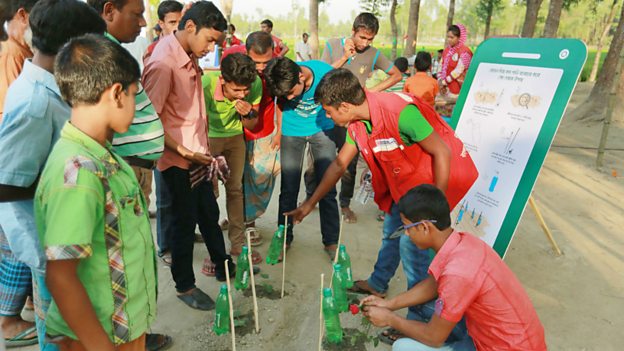
"Amrai Pari (Together We Can Do It)...a reality TV programme...visits communities in the areas of the country most susceptible to environmental hazards and challenges them to work together with their neighbours and local traders to make their infrastructure more weather resistant and learn new resilience-enhancing techniques."
Reality television show Amrai Pari, broadcast in Bangladesh through BBC Media Action, reaches 15.8 million people with messaging on climate risk and resilience. This research was intended to investigate what prevents communities from engaging in local level disaster preparedness measures in Bangladesh. It follows on earlier research intended to measure how target communities worked together to address environmental hazards and explored the influence of Amrai Pari in communities.
BBC Media Action's Climate Asia Survey showed low involvement in local disaster management planning as well as low awareness. Thus, the "third series of Amrai Pari, funded through the European Commission’s Humanitarian Aid Office aimed to address these issues and showcase to audiences how they could get involved in preparing for disasters with local government officials and existing local preparedness plans and committees."
"Qualitative research was conducted in three communities in Barisal, Khulna and Rangpur divisions in September and October 2015. The team collected data from focus group discussions and in depth interviews with community members and leaders. The findings were used to shape the development of content for the third series of Amrai Pari, which aimed to address this issue."
Key findings
- "Lack of knowledge was preventing people from becoming involved in local level disaster preparedness plans. Community members felt that they didn’t have enough access to information and/or did not know how decisions were made about local disaster preparedness in their communities.
- Community members lacked awareness of who was responsible for these plans more broadly. They were generally unable to identify local government officials who could become members of the Disaster Management Committee (DMC) with responsibility for certain disaster preparedness issues.
- There was a lack of motivation to be involved in the community as well as a perception that participating in collective/community initiatives would not benefit community members individually.
- Sometimes, incentives such as “food for work” or “cash for work” encouraged people to step forward to participate in local preparation activities such as road or dam repairing.
- In the instances when communities did work with local government, it was typically in an emergency when a disaster hit their communal property directly, and required a prompt response to save lives and livelihoods.
- Local government members noted that there barriers to getting community members involved in local disaster preparedness, such as a lack of resources needed to launch community-level discussion groups and regular committee meetings with community representation."
The study informed the production of the third series to include community stories, information on the committee process and planning in practice, and stories on alternative livelihoods in climate-affected areas. Outreach included community radio training at local stations - technical knowledge and editorial skills to produce engaging programmes on preparedness and on how to focus on the intended audiences' needs.
BBC Media Action website, November 17 2016.
- Log in to post comments