











































Weight-of-Evidence Strategies to Mitigate the Influence of Messages of Science Denialism in Public Discussions
University of Erfurt
"...new insights into how editors and journalists can support the evidence-based voice of science when they invite science advocates and deniers to a public discussion."
Journalism frequently seeks to achieve objectivity by balancing media reports: contrasting 2 opposing positions on the same issue, leaving it to the audience to draw conclusions. An example of this is the presentation in TV or radio discussions of science deniers' views and scientific-consensus advocates - e.g., in the case of vaccination - in a balanced fashion. In these instances, journalists ignore the greater weight of evidence on the side of scientific consensus. Due to their concern that this "false balance" increases the spread of misinformation under the guise of objectivity, these researchers discuss several weighting strategies that journalists could use to support the voice of science while maintaining democratic discourse. They do so by sharing the results of 3 laboratory experiments that focused on public discussions about vaccination as a content domain.
Prior to discussing the experiments, the researchers explore various weight-of-evidence strategies, in which journalists provide each position in a public discussion with a weight corresponding to the amount of evidence that supports the position. Some examples of these strategies are:
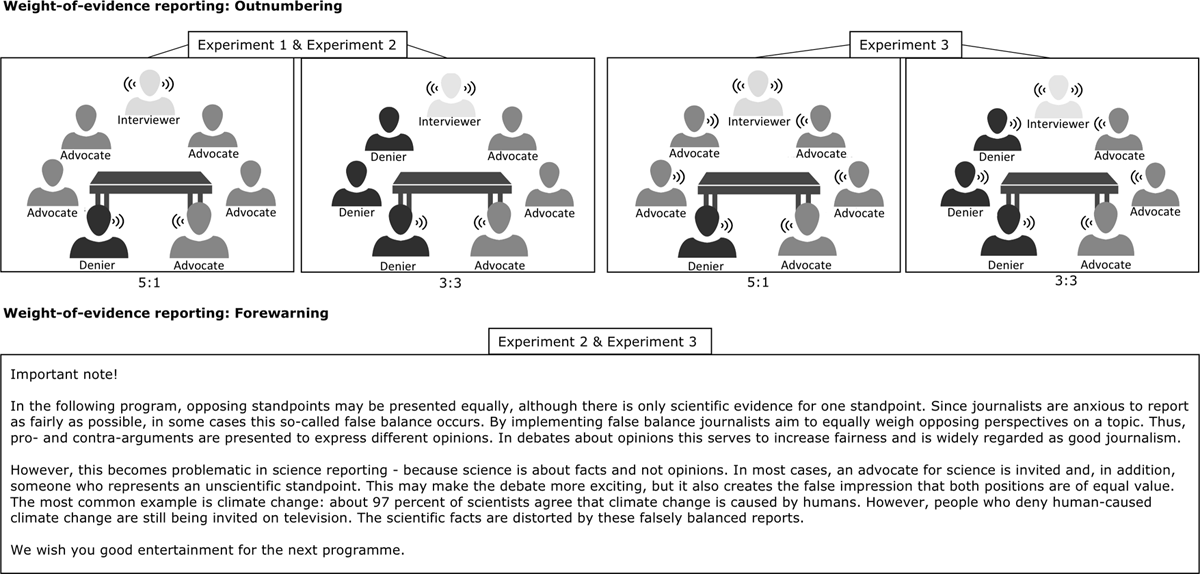
- Outnumbering: For instance, a journalist can counter false balance at a public forum by inviting more advocates for science than deniers. The idea is that this social cue (as tested in Experiments 1-3) can have an additional multiple-source effect, with the idea that arguments are more persuasive when presented by multiple sources rather than a single source (as tested in Experiment 3).
- Forewarning: Journalists can employ warnings about the false-balance effect prior to the discussions, with the idea that being warned about a source's persuasive intent before it is accessed can decrease the weight of the information that the source provides, thereby reducing its influence.
The researchers tested the efficacy of these strategies - outnumbering and forewarning - to mitigate science deniers' influence on individuals' attitudes towards vaccination and their intention to vaccinate. They explored whether advocates' responses to science deniers (rebuttal) and individual audience members' involvement with the issue moderate the efficacy of these strategies.
To do so, they asked 887 psychology students at the University of Erfurt, in Germany, to read information about a fictitious disease for which vaccination was available and recommended. The students then watched a mock TV discussion between vaccine deniers and advocates for science, in which the presence and absence of forewarning, outnumbering, and rebuttal were manipulated between subjects; participants also indicated their individual issue involvement. They were then asked to outline their attitudes towards vaccination and the intention to get vaccinated against the fictitious disease before and after the discussion. The strategies' efficacy was judged based on how strongly deniers changed previous attitudes and intention.
In brief:
- Experiment 1 found no evidence that inviting a greater number of advocates (outnumbering) significantly mitigates science denialism's influence on the audience. However, the researchers found tentative evidence that outnumbering may be an effective weight-of-evidence strategy after all, but only if the advocate successfully delivers a rebuttal.
- Experiment 2 found no evidence that a higher proportion of advocates present in the debate mitigated deniers' influence on individuals' attitude towards vaccination, intention to get vaccinated, or confidence in vaccination - not even when analysed as a function of whether or not a rebuttal was delivered. However, analyses revealed promising results on the forewarning hypothesis.
- Experiment 3 tested the mechanism of outnumbering by delivering multiple rebuttal sources. (In the previous experiments, only one denier and one advocate spoke during the discussion, regardless of the relative number of guests present during the debate. Thus, outnumbering was expected to work as a social cue.) Here, there was no evidence that outnumbering mitigates damage from denialism, even when advocates served as multiple sources. However, forewarning about the false-balance effect mitigated the damage from vaccine denialism messages on the audience's specific attitudinal beliefs (vaccination safety and trust in institutions). Moreover, it mitigated the damage to the audience's intention to vaccinate. Furthermore, the protective effect was independent of rebuttal and issue involvement.
Notably, in all 3 experiments, the science denier damaged study participants' vaccination-related attitudes and intention, and reduced their confidence in vaccines' safety and efficacy. This means that those setting up public discussions on these issues should be aware that rebuttal may not always succeed, so care must be taken.
Another consideration: The forewarning applied in this study simply explained false balance and mentioned the possibility of exposure to it, though it did not specifically mention whether false balance was actually an issue in the subsequent discussion. This implies that a generic forewarning "can be used for multiple shows, for example, on an online media platform, and does not need to be revised for every single public discussion that is broadcast."
The conclusion, then, is that editors, journalists, and other mass media outlets can use forewarnings as "...a theory-driven strategy to counter science denialism in public discussions, at least for highly educated individuals such as university students." The researchers indicate that these results are "consistent with an increasing body of evidence showing that using prior information as a prebunking is an effective strategy against damage from misinformation..."
Journal of Cognition, 3(1): 36, pp. 1-17. DOI: https://doi.org/10.5334/joc.125.
- Log in to post comments