










































SBCC Summit 2016 CommTalk: Free, On-Demand SBCC
“500 million dumb phones sounds like a smart place to start”. This CommTalk took place at the First International SBCC (Social and Behaviour Change Communication) Summit in February 2016 in Addis Ababa, Ethiopia. The CommTalks at the Summit were 10-minute "TED Talk" like presentations that focused on experiences from the field, and presented an opportunity for organisations to share their innovations, successes, challenges, and lessons learned. In this recording of one of the CommTalks, Kellen Eilerts, Regional Director East & Southern Africa at Human Network International (HNI), talks about the 3-2-1 Service, an innovative mobile phone information service that works with the simplest or “dumbest” mobile phones.
Eilerts starts by making the point that mass media and many mobile phone information services work according to the push method - pushing information out to large audiences. There is no interaction and people cannot determine the information they receive. In addition, many mobile phone initiatives that have used push methods have resulted in misdirected messages, message fatigue, and they have not really been able to engage people with low literacy levels.
Overall, there are limited options for people to use to get answers to questions when they have them. For example, there is not always a clinic or health worker around, or they may not always have the answers. Other channels such as the internet have limited reach in many developing countries due to low internet access and low literacy rates.
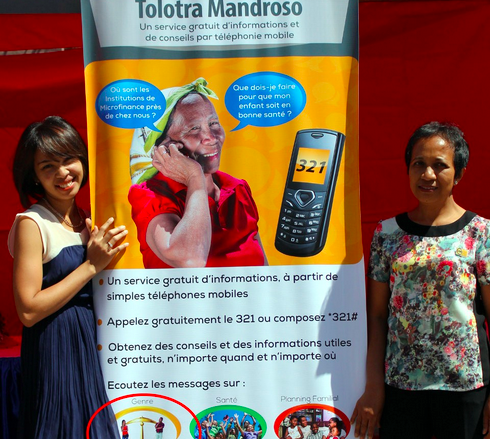
To response to this, in 2010, HNI developed the 3-2-1 Service which allows people to pull information in voice recording or text messages in local languages any time, anywhere, and free of change. The service is also available on all devices from “dumb” phones to smart phones. The service provides answers to a variety of questions related to a wide range of topics such as health, education, nutrition, weather forecasts, as well as referrals to local services. It is also anonymous, so users can access information about sensitive topics.
The programme was first rolled out in Madagascar where more than 4 million people have made more than 50 million queries to the 3-2-1 Service. The service is now also expanding and being made available by telecommunication partners across Africa and Asia.
In terms of impact, Eilerts explains that, unlike with mass media, this mobile phone service allows HRI to show direct results as they can track call information and follow up with specific callers for more in-depth research. It offers the benefit of being able to engage with and respond to caller needs based on messages that they listen to.
He goes on to explain that mobile network operators in each country agree to provide the 3-2-1 Service to their subscribers free of charge. The reason is simple - it is good for their bottom line. Research has shown that people who use the 3-2-1 Service remain more loyal to the provider and spend more money on their other phone use. In addition, the service provides something of value to phone operators - content that their subscribers want. To develop the content, the service forms topic specific content committees of NGO and government experts. These committees develop messages that are accurate, adapted to the local context, and aligned to national priorities.
Eilert concludes that the end result of this public-private partnership is a “trusted, sustainable, cost effective intervention, driven by user interests, provided for free, and delivered at scale without donor dependency”.
The programme was first rolled out in Madagascar where more than 4 million people have made more than 50 million queries to the 3-2-1 Service. The service is now also expanding and being made available by telecommunication partners across Africa and Asia.
In terms of impact, Eilerts explains that, unlike with mass media, this mobile phone service allows HRI to show direct results as they can track call information and follow up with specific callers for more in-depth research. It offers the benefit of being able to engage with and respond to caller needs based on messages that they listen to.
He goes on to explain that mobile network operators in each country agree to provide the 3-2-1 Service to their subscribers free of charge. The reason is simple - it is good for their bottom line. Research has shown that people who use the 3-2-1 Service remain more loyal to the provider and spend more money on their other phone use. In addition, the service provides something of value to phone operators - content that their subscribers want. To develop the content, the service forms topic specific content committees of NGO and government experts. These committees develop messages that are accurate, adapted to the local context, and aligned to national priorities.
Eilert concludes that the end result of this public-private partnership is a “trusted, sustainable, cost effective intervention, driven by user interests, provided for free, and delivered at scale without donor dependency”.
Length
10’38”
Date Year of Production
Not specified
Source
Youtube on May 6 2016.
- Log in to post comments