










































Safer Together? Considerations for Cooperation to Address Safety in the Media Support, Humanitarian and Human Rights Sectors
"Forging new partnerships, including multi-stakeholder initiatives, will strengthen the current efforts at addressing the challenging issues of prevention, protection and prosecution be addressed effectively."
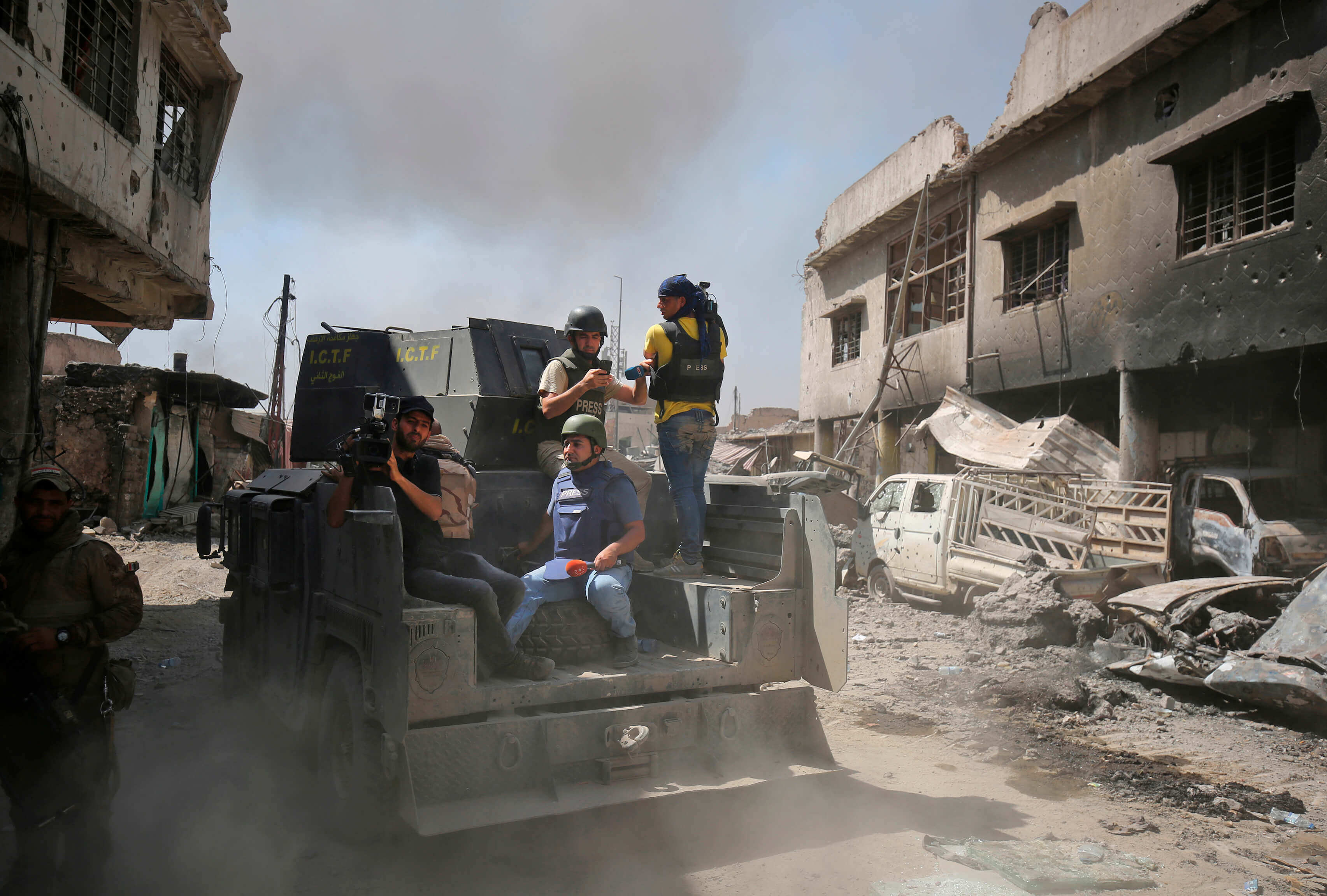
Every year, hundreds of journalists and media workers (JMWs), human rights defenders (HRDs), and humanitarian workers (HAWs) around the world are killed, threatened, sexually harassed, kidnapped, arrested, imprisoned, or otherwise targeted (including online) for their commitment to human rights and the information they provide. This International Media Support (IMS) briefing paper shares research undertaken in an effort to inform or inspire action among the media support, human rights, and humanitarian sectors to address issues of safety and impunity. The paper seeks to identify commonalities between these 3 sectors and to identify possible areas for future collaboration and cooperation.
Despite the different roles of the 3 sectors, there are commonalities, author Michelle Betz explains. The risks individual JMWs, HRDs, and HAWs face are usually the same, and the offices of media outlets and human rights organisations share a vulnerability to attacks in which files are stolen and material destroyed. Furthermore, all 3 sectors often operate in difficult contexts. JMWs and HRDs are caught in the cross hairs of conflicts, with more and more local JMWs and HRDs subject to violence and protection issues; these complexities also provide a challenge for journalists and HRDs reporting on such conflicts.
Betz examines the international and national legal frameworks for all 3 sectors, though they primarily exist for HRDS and JMWs. These frameworks include the Charter of the United Nations (UN Charter), international humanitarian law (IHL), international human rights law (IHRL), and "special procedures" of the UN Human Rights Council (HRC), as well as sector-specific frameworks, such as the UN Plan of Action on the Safety of Journalists and the Issue of Impunity. Meanwhile, the Declaration to Protect Human Rights Defenders "recognizes the importance of legal and administrative frameworks in the creation of safe and enabling environments" for HRDs. There is also an emerging body of laws, the international disaster response laws, rules, and principles (IDRL), whose scope is those states and humanitarian agencies operating in disaster areas not subject to IHL.
Regional human rights conventions or charters have been adopted by the Organization of American States (OAS), the Council of Europe (CoE), the Inter-American Commission on Human Rights (IACHR), the Organization for Security and Cooperation in Europe (OSCE), the Commonwealth, and the African Union. While all include freedom of expression, not all address HRDs, HAWs, or safety and protection issues. National human rights institutions also play an important role in ensuring the safety of those who operate in these sectors; other non-state affiliated institutions also play a similar role.
A case study out of Colombia, a deadly country for HRDs, illustrates the work of IMS partner Fundación para la Libertad de Prensa (FLIP) in concert with human rights groups, including intergovernmental bodies such as the IACHR and the Office of the United Nations High Commissioner for Human Rights (OHCHR). To cite one activity: Civil society organisations (CSOs) monitor threats against journalists and present cases to the Risk Evaluation and Regulation Committee, an inter-institutional committee that determines the protection measures to be implemented.
Duty of Care refers to the responsibility of humanitarian (and other) organisations to ensure protection of their workers in the field and upon their return. Betz describes 2 landmark cases could set the way forward in this regard. In addition to normative frameworks, there is increasing recognition of the role international organisations, including international, regional, and national civil society, could play in defending JMWs, HRDs, and HAWs. For instance, the CSO Coalition on the Safety of Journalists, a group of 20 media support and press freedom organisations, seeks to strengthen coordination among leading CSOs in addressing the issue of safety and impunity among JMWs.
In light of this analysis, Betz argues that there are a number of thematic areas with promise for coordination of these sectors, including: the global issue of mis-, dis-, and mal-information; surveillance, privacy, and data issues; and connecting to achieve the Sustainable Development Goals (SDGs). These can be addressed in a variety of ways, and Betz presents a collaborative framework that includes:
- Dialogue and peer exchange, especially around 4 issues that all 3 sectors increasingly face: information disorder, strategic lawsuits against public participation (SLAPP) to sue journalists and HRDs, restrictive legislation of non-governmental organisations (NGOs), and issues surrounding operating in conflict zones and negotiating with armed groups.
- Multi-stakeholder initiatives (MSIs) to address issues like misinformation through partnership - for instance, between media support organisations and humanitarian organisations. In Myanmar, for example, the International Organization for Migration (IOM) partnered with BBC Media Action to address misinformation about Rohingya, while in 2014, IMS worked with humanitarian organisations in the Kurdistan Region of Iraq (KRI) to respond to the information and communication needs of Iraqi internally displaced persons (IDPs) and Syrian refugees.
- Efforts to address gender-based violence (GBV), which affects all 3 sectors and could provide an entry point for the sectors to work together. However, under-reporting is a serious challenge to measure the problem of violence against female JMWs, HRDs, and HAWs, and data on sexual violence and gender-differentiated analysis is weak.
- Emergency assistance, where efforts have been made in this area around the International CSO Coalition on Safety and Impunity, to cite only one example.
- National human rights institutes (NHRIs), which could provide a framework or institutional home for cooperation on such issues as impunity and safety as well as serving as host institutions for efforts to address SDGs, for example.
- Working with private enterprise and tech companies, which control social networks, chat software, news sites, and payment providers, and thus determine what can be done, how, and by whom.
- Research on a number of contextual factors that are impacting JMWs, HRDs, and HAWs, as it would seem that these three sectors face very similar problems for very similar reasons. Answering these types of questions could inform more effective protection strategies.
Betz concludes that there are a variety of ways the issues of safety and impunity across these 3 sectors "can be addressed and be addressed from a position of strength. What is required is political and organisational will combined with coordination and collaboration." Solidarity among national, regional, and international actors can reinforce actions to enable human rights and democratic space and ensure the safety of JMWs, HRDs, and HAWs.
IMS website, December 13 2019. Image credit: IMS