










































Radios in the Post-Pandemic World - Tools and Strategies to Confront the New Normal
"The choice of digital tools will condition how radios communicate, and this, necessarily, will lead to an in-depth debate about the power of community communication to improve people's living conditions."
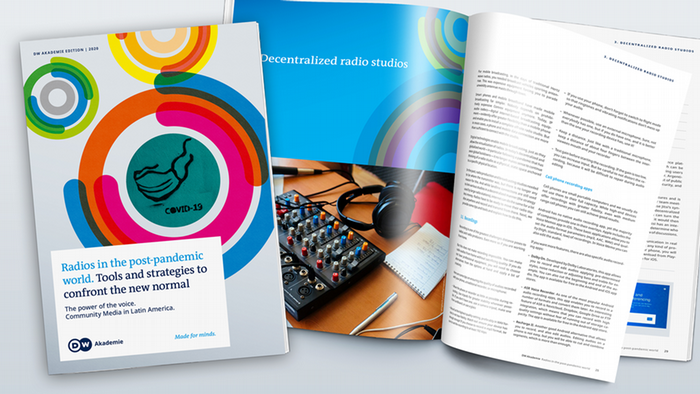
This manual from DW Akademie is designed to offer community media outlets practical digital tools and strategies to allow them to continue to serve their audiences, as well as to navigate future challenges, in an uncertain post-coronavirus environment. The tools and strategies are meant to facilitate better and safer use of the internet for broadcasting and offer new opportunities for decentralised and collaborative forms of working - all in an effort to meet the information and communication needs of the communities they serve.
As DW Akademie explains, in the context of COVID-19 and in "the new normal", radio stations face challenges they haven't encountered before. During the pandemic's most intense phases, many local media outlets with limited resources had to shut down or cancel programming. They have also needed to adapt and expand their use of the internet. "Social distancing rules have forced them to take advantage of digital tools and technologies, collaboratively produce programs in decentralized studios from home, broadcast programs from multiple locations and increase audience participation." The intensified use of new technologies has, however, also increased the risks for radio stations, such as the security risks posed by large corporate online communication platforms. DW Akademie argues that the need to support community media with the most appropriate and safe technology is therefore imperative - and even more so given the increasing spread of disinformation through social networks.
The first section of the manual introduces a set of tools for creating virtual and cooperative offices for content production, equipping decentralised radio studios, and developing online broadcasting. Nearly all the software presented is free, as free software guarantees radio stations' autonomy, privacy, and security, and allows community media to freely adapt it to the needs of specific contexts. The tools cover the following areas:
- Free platforms - offers a list of free software solutions and the different communication services (email, streaming, chat, cloud, etc.) they offer.
- Virtual and cooperative radio studios - offers a range of secure online tools that are designed to allow radio production teams to generate collaborative environments where everybody on the team feels at ease and can develop workflows that boost creativity and productivity. Tools include file sharing and collaborative online writing and production software.
- Decentralised radio studios - provides tips and tools to explain how radio stations should prepare themselves to move their studios anywhere and record and transmit from there.
- Streaming broadcasts online and remote connections - includes guidance and examples on streaming equipment, streaming servers, broadcasting software, web streaming players, and video broadcasts for online conferences.
- Dissemination and promotion - offers an autonomous alternative to commercial social media called Mastodon (created as an alternative to Twitter in 2016), which is meant to allow community media more control and freedom to adapt the social media platform to their needs.
The second section of the manual identifies a number of strategic challenges and solutions for community radio stations and media that DW Akademie considers to be worth exploring to remain relevant in the post-pandemic information environment. Ideas are offered through examples from community media or technology companies (in brackets below) in Latin America, including:
- Promoting communication rights in a digital world (Red de Radios Comunitarias y Software Libre)
- Opting for autonomous telecommunication infrastructures (autonomous cellphone networks)
- Strengthening quality journalism to confront information disorder (Colombiacheck)
- Encouraging open access to information and data (Tierra de Resistentes)
- Stimulating a grassroots agenda (Vokaribe Radio)
- Expanding audiences and increasing participation (Hammam Radio)
- Adopting innovation as a daily practice (CoLaboratorio by the Centro de Producción Radiofónica, or CEPRA)
- Using the expressive potential of sound (Domestic Noise at Radio ANTIVIRUS)
- Enhancing open-source-based collaborative forms of working through networks (Cadenazo Radial)
- Exploring new models of sustainability (Coordinadora de Medios Comunitarios, Populares y Educativos del Ecuador (CORAPE) network)
This the first publication in DW Akademie's series "The Power of the Voice: Community Media in Latin America", which seeks to reflect how DW Akademie's work around the world contributes to democratising information ecosystems and fosters critical and informed societies.
English and Spanish
64
DW Akademie website on January 19 2021; and email from Gerwin de Roy to The Communication Initiative on February 9 2021. Image credit: DW Akademie
- Log in to post comments