










































Protecting Independent Media for Effective Development (PRIMED): Policy and Learning Strategy
"A major focus of the programme is to understand and capture which media support strategies are most effective in these kinds of settings which can inform the policies of policy makers, donors, governments and investors so that future media support strategies can be more coherent and impactful."
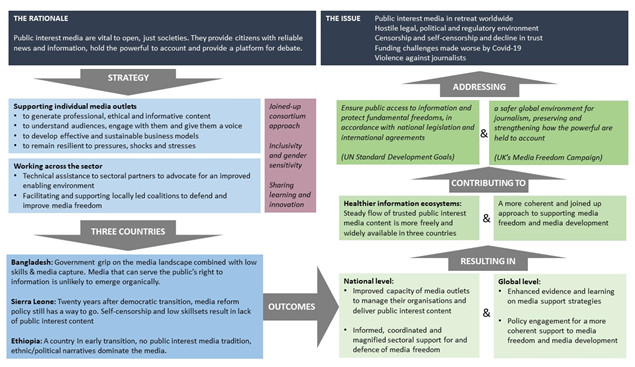
Protecting Independent Media for Effective Development (PRIMED) is a 3-year programme that has been established to enable more trusted, inclusive, free, and pluralistic media in Bangladesh, Ethiopia, and Sierra Leone. Launched in October 2020, it is being implemented by a consortium of media support organisations with expertise in different aspects of media and development. Core consortium members are BBC Media Action (lead organisation), Article 19, Free Press Unlimited, International Media Support (IMS), and Media Development Investment Fund (MDIF). Other specialist organisations provide support in specific areas and include DW Akademie, Global Forum for Media Development (GFMD), Global Voices, and The Communication Initiative (The CI). (See Related Summaries below for more information - in particular, the programme objectives, overall strategy, and choice of countries).
The objectives of the PRIMED programme are: (i) to improve the capacity of participating media outlets to manage their organisations and deliver public interest content, (ii) to support efforts to secure increased media freedoms in the three countries, and (iii) to create and share learning about what media support works and what doesn't in different country contexts - specifically, which strategies are most effective and which factors are most important in contributing to improved media viability and resilience in the settings covered by the programme. It is this third objective that is the focus of the strategy being outlined here.
This objective is based on the fact that there is a shortage of evidence of what types of media support are most effective in different environments. PRIMED will therefore seek to generate and disseminate learnings from its interventions in the three target countries and communicate these lessons to those in the best position - policymakers, donors, governments, and investors - to act on these to benefit public interest media both within and beyond the PRIMED Programme.
As outlined in PRIMED's Policy and Learning Strategy, the learning agenda for PRIMED will be rooted in the following:
Learning questions: The PRIMED Consortium have collectively identified a set of policy, research, and practice relevant learning questions to answer through the lifetime of PRIMED (see below for list of questions).
Monitoring and evaluation (M&E): To track the effectiveness of PRIMED and collate learning and insight from the M&E activities across the programme, there will be analysis of continuous research activities, project monitoring, and local reflection to ensure the programme learns through implementation to adapt its strategies and share insights on what has worked best and why with the broader sector.
Responsive learning: PRIMED will work to ensure the programming is both reactive to changes in national and international policy and country context and reflects the findings emerging from the data. Engagement with stakeholders at a global and local level and feedback on learning from practitioners using the media monitoring system will inform priorities for analysis - e.g., impact of COVID-19 on the media sector and changes in audience perceptions of media as a result of the protests in Ethiopia.
The strategic backbone of the Policy and Learning Strategy is provided by the following learning questions, which have been prioritised to date but may change as the programme progresses:
- Under what conditions and to what extent does an improved understanding of audiences translate into improved media viability?
- What constitutes a resilient media organisation, and what support strategies are most effective in building media viability and resilience to shocks and stresses in PRIMED settings?
- What are the key constituents of an enabling economic environment for public interest media in the current context in these settings, and what options are there for supporting the creation of such an environment?
- What is the demand amongst audiences for public interest content, and which factors most drive that demand? Has the COVID 19 pandemic increased the public demand for public interest media (that provides voice, is engaging, relevant, and trustworthy) and, to the extent that it has, has this translated into improved prospects for media viability - or not?
- Under what conditions are approaches to public subsidy worth exploring and developing in the countries this programme operates in and elsewhere in the global south? What political and socioeconomic conditions need to exist to explore it?
- What types of intervention are effective in supporting the viability of public interest media in fragile contexts? What impact do they have on outlets in areas such as revenues, engagement, reach, and business processes? What have we learned from these interventions?
- Which factors are most effective in enabling locally driven coalitions for change to emerge and thrive through externally supported media development efforts?
- What business and management models/organisational and team structures, competencies, and processes have the potential to improve gender equality in the workplace?
- What changes in the legal and regulatory framework are necessary and feasible in supporting the various dimensions of PRIMED?
- How do we define public interest media in PRIMED settings beyond ownership status, business model, and newsroom structure?
- How do we analyse and incorporate the influence of international social media platforms and other external forces shaping domestic media development prospects?
- What are the long-term learnings of types of intervention most likely to achieve media viability and resilience (drawing on learning countries and applied to PRIMED contexts)?
The insights against each of the questions are designed to inform policy, donor engagement, and practice over the lifetime of the programme. Questions will be answered through varying means: existing data and experience (from PRIMED and outside), learning from practice, policy analysis, and discrete pieces of carefully designed research to inform the evidence base. The process of and strategy for answering the learning questions will be facilitated by different Consortium partners, who will design the final question and facilitate the learnings on this question throughout the programme.
In order to share learnings, the programme has developed a strategy for engaging and communicating with international donors, governments, other media support actors, media institutions, and other external stakeholders. This strategy includes building on existing relationships, developing learning groups (such as a Donor-Practitioner Learning Group), and using existing platforms and structures that allow for the sharing of learnings, such as IMPACT (International Media and Policy Advisory Centre) developed by the GFMD, to mention just one example.
Programme learnings will also be shared through a series of outputs that will seek to summarise and articulate the conclusions of the learning questions process and highlight the research and learning generated through the programme. Outputs are expected to take the form of briefings, research summaries, policy reports, blogs, and podcasts. Each PRIMED partner will lead on how the outputs and findings of the programme will be communicated, using existing mechanisms where possible. Findings will also be disseminated through the extensive The CI network, which includes a global network of 11,000 individuals and organisations working in media development, as well as by Global Voices, GFMD, and, where appropriate, other PRIMED partners.
While specific learning outputs will depend on how the programme progresses in each country and what learnings emerge, in the case of policy briefings, a series of topics has been provisionally identified to offer direction for research:
- Policy Briefing example 1: When Does Building Online Audiences Translate into a Sustainable Business Model?
- Policy Briefing example 2: Baking a Bigger Pie: Is There Potential for Increasing Advertising and Other Revenue Market Size, Not Just Share?
- Policy Briefing example 3: State Broadcast Reform Strategies When Reform Windows Open
- Policy Briefing example 4: Public Subsidy for Public Interest Media in Low-Income Settings: Political and Operational Feasibility
- Policy Briefing example 5: The External Factors Shaping Media Development in Low-Income Countries - and How Media in These Countries Can Shape Their Own Strategies
- Policy Briefing example 6: Which Strategic Approaches to Media Development and Media Viability Work Best?
As with all PRIMED programme objectives, measurement of performance of outcomes will be ongoing. The principal measures of performance of the learning and policy-related outcome will include the number of questions answered, the lessons learnt, outputs generated, and the demand articulated for the programme.
For more information, please contact Maha Taki (see above).
Draft: PRIMED's Policy and Learning Strategy on January 29 2021. Image credit: BBC Media Action