










































The Potential and Limitations of Citizen Journalism Initiatives
Merrill College of Journalism, University of Maryland
"CGNet Swara's failure to 'bridge' the citizen–professional divide and to position the experiment in terms of the larger public sphere suggests continuing challenges for citizen journalism, potentially undercutting confidence that it currently operates a transformative force for democracy."
Noting that the challenges faced by rural communities in India in both access to mainstream media and coverage by it have major implications for democracy and civic participation, this research paper explores CGNet Swara. Operating in Chhattisgarh in central India, this citizen journalism initiative (see also Related Summaries, below) attempts to address this problem by enabling rural or tribal communities to obtain and report news, as well as to facilitate coverage of their concerns, by acting as "a bridge" between those communities and professional news outlets. However, the research reported here on the project's relationship with mainstream news outlets in central India finds that, while at least some professional journalists endorse the ideals of citizen journalism, they reject the idea that CGNet Swara can assist them. These findings lead the researchers to re-evaluate the potential of citizen journalism as a transformative and democratising force.
As explained here, CGNet Swara is accessed via mobile phones, which were introduced in India in 1995-96 and are becoming a dominant medium throughout Asia for accessing information. The service allows villagers to send and receive cell phone messages through interactive voice response (IVR) technology. What is distinctive about this free, voice-based service is that even people with low levels of writing literacy can contribute and share information: With its design and development team handling the complicated technology, anyone with a phone can call CGNet to report local issues. Stories verified and approved by moderators are available for playback (audio and text versions) online as well as over the phone. (Approximately 30 students, community leaders, and activists learned the technology during a 2-day training programme.) The researchers observe that enabling the largely oral communities of central India to share news is significant: These tribal peoples - predominantly rural and impoverished - cannot access news in their own languages. Mainstream print and broadcast media available in the region publish exclusively in Hindi or English and devote very little space to rural issues (and most rural coverage focuses on violence, crime, disasters, suicides, and malnutrition).
One analysis found that since its inception in 2004, CGNet Swara has logged close to 100,000 calls; 98% of callers listen, and only 2% call in to report. Staffers occasionally try to spur action on the reports by sharing them with mainstream journalists or government officials, a sharing that presumes CGNet will be properly credited. CGNet's founder claims that professional journalists use Swara stories without acknowledgment. The researchers observe that "journalists' objections to citizen participation, objections that may reflect globally inflected claims about their professional authority and role in democracy, appear to keep news organizations from cultivating effective relationships with CGNet and from developing or using their stories." Considering that "[p]rofessional outlets seem unlikely to regard CGNet as 'competition'", the researchers move on within the paper to examine the source of conflict. Having outlined the history of the news industry in India, including problems such as "[w]idespread - and substantiated - accusations of corruption in mainstream journalism", the researchers explore the history and state of citizen journalism globally and in India. After briefly discussing citizen journalism experiments in India, they discuss responses to CGNet and to citizen journalism from 10 professional journalists (8 men and 2 women) working in the area to figure out the basis of the antagonism and to explain professionals' reluctance to use CGNet Swara more often.
Their interviews revealed that "[a]ll the journalists expressed their impressions of citizen journalism in adamant, vivid language. They typically defined citizen journalism as involving 'ordinary' people without formal journalism training who focus on important local issues. They largely agreed that citizen journalism can bring news from rural areas, where mainstream media do not reach and have no reporters. Having begun with a reasonably supportive definition, however, most of them soon became more negative; ...they challenged citizen journalism for its activist agenda and lack of fact checking or verification....Journalists' evaluations of citizen journalism strongly tracked with their evaluations of CGNet Swara. All but one of the journalists had heard about CGNet directly from Subhranshu Choudhary, its founder. Some had known Choudhary when he was a BBC journalist and had followed his work. A few had checked out the website, either because they were curious, or, less often, wanted information on some project." One NDTV journalist said CGNet shared citizen journalism's problems, that is, not operating within professional parameters. She conceded that CGNet may highlight issues important to local communities but doubted its impact. "Ultimately, problematic as it is, it is the mainstream media which has the potential to raise awareness on a meaningful scale that might lead to some action or change." She called the initiative "interesting" but unworkable, at best it is an unverifiable form of data collection focused on "very, very local" problems. "Personal testimony alone cannot be the mainstay of the whole thing", she insisted. "No matter how powerful a story is, in the end you have to verify....So you can't just report on something because someone called it in."
The researchers reflect on these findings, noting: "Given that both CGNet and professional journalists acknowledged that mainstream media have little presence or interest in India’s interior, partly because of language, and partly because of the profit basis of increasingly corporatized media, citizens might seem to help address the shortage of qualified professionals and CGNet would appear to be an accessible, cheap source of local news. But critics saw using the website as potentially more work for them, given their anxieties about ethics and professionalism. Given the deadline pressures on journalists, one editor said, they have no time to monitor something whose information is raw and unverified....Merely training participants to distinguish facts from opinions and to provide both sides of the story does not seem sufficient. More importantly, professionals- not despite but apparently because of their defensiveness about the ethical reputation of mainstream news organizations - are unwilling to chance citizens' integrity."
Choudhary says: "Our mission is to democratize journalism so that it is not limited to journalists." According to the researchers, this suggests that CGNet's "democratising" refers to a broadened, shared sensibility of participation. "That is, the point is participation in (not production of) journalism, making the institution of journalism more horizontal, less top down. If the goal were to produce or enhance direct participation in democracy per se, however, the initiative's impact would seem far smaller....CGNet remains unconnected to civil society. Even 'the bridge between these communities and the media' that Choudhary hoped to build has not developed. Moreover, these findings raise deeper questions about contemporary journalism in India, which, as we show, is negotiated in the context of several interacting factors ranging from globally pervasive but nonetheless fragile professional ideologies to localized economic and political pressures. Such interactions, we argue, have major consequences for journalism and democratic processes."
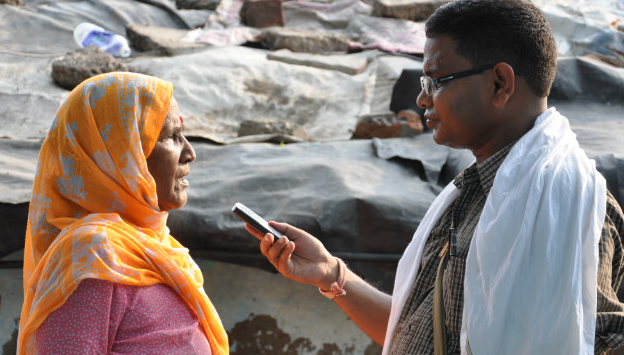
Journalism Studies, 16:5, 706-718, DOI: 10.1080/1461670X.2015.1054179. Image caption/credit: "A woman is interviewed by a citizen journalist for for CGNet Swara." From 2eyeswatching.com