










































No Place for Criticism: Bangladesh Crackdown on Social Media
"The internet and social media give individuals unprecedented ability to communicate and access information across borders....Instead of fearing such communication will amplify dissatisfaction, Bangladesh should take steps to protect freedom of expression, and welcome peaceful dissent and criticism."
Based on analysis by Human Rights Watch (HRW), Bangladesh has a history of efforts to limit freedom of expression, particularly in relation to media. However, according to the organisation, the ruling Awami League government is particularly harsh on critics, using a range of laws to prosecute dissent. In particular, this report looks at section 57 of the Information and Communication Technology Act (ICT Act), which has led to the arrest of people for criticising the government, political leaders, and others on Facebook and other social media and in blogs and online newspapers. Such treatment may chill free speech. The report is based on investigation of police and court documents and interviews with people accused under the law.
Section 57 of the ICT Act authorises the prosecution of any person who publishes, in electronic form, material that is: fake and obscene; defamatory; "tends to deprave and corrupt" its audience; causes, or may cause, "deterioration in law and order"; prejudices the image of the state or a person; or "causes or may cause hurt to religious belief".
The HRW report includes examples of many cases since authorities amended the act in 2013 to add harsher penalties and allow the police to make arrests without warrant. Those targeted have included, for example, journalists and editors arrested for articles that are critical of government officials that expose corruption or maladministration. Individuals have been arrested for allegedly offending religious sentiment or for criticising the prime minister. For instance, in April 2018, after a student protest at Dhaka university, a police officer filed a complaint referring to 43 "provocative" Facebook posts, which "many have liked and commented on" and that "created a situation which could potentially harm society and create chaos". Yet, HRW notes, "apart from a few lewd characterizations, these posts contained legitimate commentary about an ongoing political protest."
As of April 2018, the police had submitted 1,271 charge sheets to the Cyber Tribunal (dedicated to dealing with offences under the ICT Act), claiming sufficient evidence to prosecute under section 57 of the ICT Act. Anecdotal evidence suggests few people have been convicted to date. However, the mere fact that people are being arrested and detained for online speech may discourage people from speaking out online, regardless of whether those individuals are ultimately convicted. HRW reports that many detainees have been held for months without trial.
Acknowledging that section 57 has been misused, the government has proposed to replace the law with a new Digital Security Act that they claim places some checks and balances on arrests over speech. However, HRW is concerned that the bill being considered by parliament is in some respects broader and more open to abuse than the law it seeks to replace, and it violates the country's international obligation to protect freedom of speech. For example, Bangladesh's journalists point to provisions in the proposed law that would treat the use of secret recordings to expose corruption and other crimes as espionage, arguing that this would restrict investigative journalism and muzzle media freedom. The bill sets out prison terms for vague offenses like publishing "aggressive or frightening" information and would also impose sentences of up to 10 years in prison for posting information that "ruins communal harmony, or creates instability or disorder, or disturbs or is about to disturb the law and order situation".
Also concerning is a provision in the proposed law that would impose life imprisonment for those convicted of "negative propaganda and campaign against liberation war of Bangladesh or spirit of the liberation war or Father of the Nation". The United Nations Human Rights Committee, the independent body that monitors compliance with the International Covenant on Civil and Political Rights (ICCPR), to which Bangladesh is a party, has said laws that penalise opinions about historical facts are incompatible with a country's obligations to respect freedom of opinion and expression.
The report concludes with recommendations meant to ensure that any new law does not open the door to further violations. Excerpts from the document include:
Recommendations for the Government of Bangladesh:
- "Publicly uphold the right to free speech including criticism and dissent.
- ...[A]ct on the government's pledge to repeal section 57 of the ICT Act.
- Ensure the proposed Digital Security Act...conforms to international standards for the protection of freedom of expression...
- Establish policies and procedures to counter hate speech through public campaigns and measures tailored to specific threats...
- Instruct police and other law enforcement departments...to uphold their duty to protect individuals threatened for their speech, and hold them accountable when they fail to do so.
- Pending repeal or amendment of the ICT Act, call upon the attorney general to inform prosecutors that...prosecutions should be limited to speech intended to and likely to incite violence, discrimination, or hostility against an individual, or clearly defined group of persons in circumstances in which such violence, discrimination, or hostility is imminent and alternative measures to prevent such conduct are not reasonably available.
- Issue clear guidelines to the police and prosecutors that criticism or insult of the government or government policies or state institutions cannot be the basis of arrest or prosecution.
- Instruct all police departments that decisions on whether to arrest someone for speech...should be based solely on an evidentiary assessment of whether incitement to violence or other harms has occurred, consistent with applicable international freedom of expression law and standards.
- Instruct prosecutors that...detention should be the exception not the rule. All detainees should be brought promptly before a judge to review the legality and necessity of their detention.
- Introduce education programs for all prosecutors to ensure that they are fully aware of international freedom of expression law and standards..."
Recommendations for donors and key influential governments:
- "Urge Bangladesh to protect the rights to peaceful expression and assembly...
- Regularly and publicly raise concerns about the arrests of bloggers, writers, journalists, and members of the public for exercising their right to freedom of expression; urge that all charges against them to be dropped; and call for the immediate release of those already imprisoned for doing so.
- Encourage Bangladesh to invite the UN special rapporteur on the promotion and protection of the right to freedom of opinion and expression on a fact-finding visit.
- Offer assistance to train police, prosecutors, and judges in international law and standards on freedom of expression and assembly."
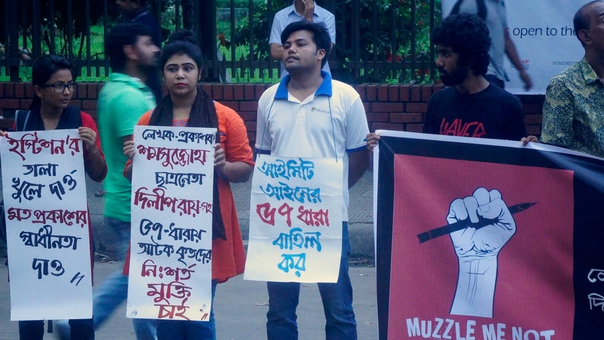
CAMECO Media Development Literature, July 2018 - June 2019; and HRW website, May 9 2018 - accessed on February 27 2020. Image caption/credit (via IREX): "Bangladeshi activists protest for freedom of speech in front of the National Museum, while calling for the removal of section 57 of the ICT law, in Dhaka, 4 October 2016, Md. Mehedi Hasan/Pacific Press/LightRocket via Getty Images"
- Log in to post comments