










































Mobilizing Ethiopian Idirs: Capitalizing on Traditional Burial Societies to Serve the Living
Catholic Relief Services
This 4-page brief shares the experience of Catholic Relief Services (CRS) to mobilise Idirs, traditional Ethiopian burial societies, to become community change agents to care for and support orphans and vulnerable children (OVC), as well as reach communities with HIV prevention messages. Recognising the prominent position of idirs in Ethiopian society, CRS, with funding from the President Emergency Plan for AIDS Relief (PEPFAR), worked with the societies to send behaviour change messages designed to decrease HIV prevalence and mobilise care and support for OVC. According to the brief, the idirs are helping to dramatically reduce the expense of prevention, palliative care, and OVC programmes. Though traditionally formed to assist with burials, idirs now help prevent disease and serve the living.
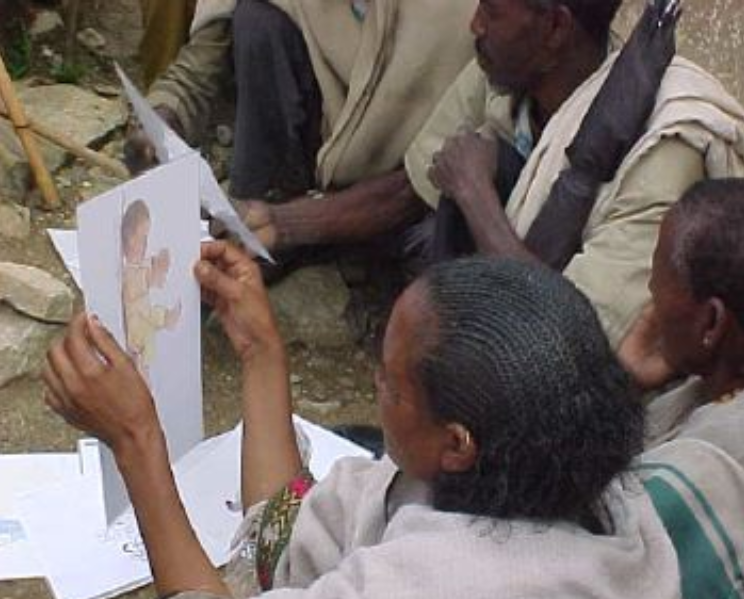
CRS' Healthy Choices "Avoiding Risk, Affirming Life" programme in Ethiopia works with a broad range of faith- and community-based partners to equip youth and young adults with the values, attitudes, and skills to abstain from sex prior to marriage, adopt secondary abstinence, and remain faithful in marriage. The programme uses a participatory methodology called "We Stop AIDS" (WSA) to facilitate in-depth discussion around HIV and AIDS and stimulate community groups and individuals to take action against the epidemic. The curriculum uses simple pictures to provoke discussion. The eight sessions present pictures sequentially; participants are then divided into groups to discuss issues about each picture. Topics covered include basic facts about HIV and AIDS, prevention, care and support of People living with HIV (PLHIV), and reduction of stigma. The group thinks through the problems and solutions. Individuals are encouraged to develop an action plan for personal behaviour change and groups develop actions plans for their communities.
According to the brief, We Stop AIDS has been used to mobilise 180 idirs comprised of 5400 members in five diocese. The members contribute 10 birr per month as their usual idir fee and an additional two birr for care and support activities. In one idir, members created five teams for home visiting and by increasing and pooling their monthly financial contribution have provided food, clothing, shelter, and educational and medical support to 29 OVC, 4 PLHIV, and elderly. Achievements from the idirs include:
- HIV prevention: they are passing prevention message on through various formal and informal forums with individuals and groups.
- Reduction of stigma: through their example of reaching out to PLHIV and OVC, they are addressing discrimination against these groups.
- Local solutions to local problems: they are helping OVC and PLHIV individually and as a group.
According to the brief, the programme has been successful in mobilising idirs to expand their vision to include service. With an adult literacy rate of 36%, Ethiopia is an appropriate context for the use of WSA because this tool is effective with illiterate communities and requires few resources. WSA stimulates discussion which leads to local problem analysis and solutions. Through WSA, CBOs have the ability and the opportunity to solve local socioeconomic challenges. Mobilisation of the idirs has been particularly successful because the members have built-in team spirit that is well-suited to a participatory curriculum. In developing their action plan together, the groups work with a sense of urgency, thus building their trust and efficacy.
CRS would like to scale up this activity by recognising the accomplishments of successful idirs and training leaders and members to share their success with other idirs. Through June 2010, CRS planned to train an additional 90 WSA facilitators to lead other idirs through the participatory curriculum to the creation of a local community action plan. However, CRS recognised that as the idirs develop their own action plans, there is no mechanism in place for recording the activities they carry out. A successful monitoring and evaluation mechanism needs to be put into place to gather information about group and individual actions taken after completing the WSA curriculum. In addition to scaling up by training new idirs, CRS-Ethiopia plans to work with existing idirs to build their capacity. This will be done through training in income generating activities, M&E, or by assisting with development of actions plans and sustainability strategies.