










































Media, Participation and Healing: Community-Led Content to Overcome the Trauma of Conflict
University of New South Wales
"[E]nabling community members to be the drivers of local peacebuilding processes using their knowledge, experience, communication and media skills can be a more effective avenue for groups to uncover a healing practice that comes from within rather than without, and which can ultimately transform trauma."
In order to explore the potential that involving local community members in media production has to foster healing and reconciliation, this article reviews four media projects carried out in Sierra Leone in the aftermath of the 1991-2002 civil war. This is framed through an introduction of the literature on trauma and healing and a discussion of the main critiques advanced towards current approaches in this field; selected media theories that bring to light the impact that these types of media can have on both their producers and their audience in this context are also examined.
Previously, the author, Valentina Baú (2014, 2015a, 2015b), has demonstrated how participatory media can be effective at transforming conflict between communities within a framework of communication for development (C4D). In looking at media interventions for cohesion, her focus is on changing the complex networks of relationships and power at the grassroots that can both hinder and facilitate peace. Thus, the premise of the current investigation is that communication is important to help people make sense of their realities and engage in a dialogue, both within their social network and with other communities. By either directly or indirectly involving people in the production process, individuals are given the opportunity to tell their stories and express their feelings. At the same time, those who are exposed to these types of productions can gain understanding of others' experiences. All these elements enable individuals to begin healing.
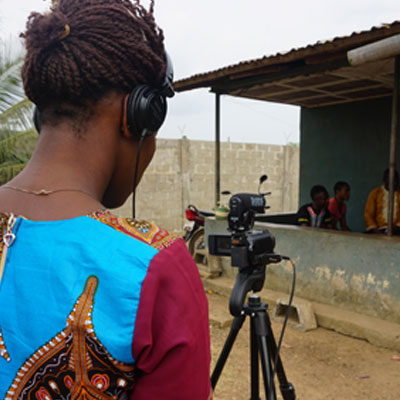
A literature review is presented to help the reader contextualise participation in peacebuilding, including through participatory media. Through the work and reflections of various authors, participation has been represented by means of different "ladders". The media production forms reviewed herein are characterised by different levels of participation, all of which make their content led by communities' views and voices. To clarify further, Baú distinguishes two ways in which participation of local communities in media production can occur:
- directly: people have worked on and achieved the production of certain media outputs, both through their technical skills and as main informants of the editorial content;
- indirectly: local people have been the main source of information and have been consulted in a participatory way to produce the content of the different outputs.
Baú discusses's Bandura (2002) model, which explains how the media can trigger social learning. She points especially to the benefits of the media's ability to enhance individuals' self-efficacy, particularly in a post-conflict scenario, where people have experienced traumatic losses and are engaging in the effort of re-building their lives. When dealing with experiences of trauma, she notes, it is particularly important to go beyond verbal communication and to facilitate emotional and mental communication as well. The idea is that reflecting, analysing, and openly discussing sensitive issues in a structured environment - managed by the community itself - can help people communicate more effectively and can be empowering by allowing those whose voices remain usually unheard to speak up. Giving communities the opportunity to participate in the creation of media content can offer the right space for this to happen.
To provide context for her analysis, Baú discusses the Sierra Leonean conflict and its impact on the population, which inspired these projects:
- Reel Peace - Following a competitive scriptwriting contest, six of the most promising scripts that could demonstrate some of the human stories of war, peace, and reconciliation were selected as a basis for a directing and technical training course. At the end of the course, production grants were given to the producer/director teams to make their short films were then screened in an exhibition at the British Council in Sierra Leone and subsequently distributed both at a national and international level. Implemented by non-governmental organisation (NGO) ScriptNet with support from United Nations Educational, Scientific and Cultural Organization (UNESCO), the Commonwealth Media Development Fund, and the British Council in Freetown.
- Never Again - Following a comprehensive needs assessment, Action Aid contracted a team of performing artists who worked with victims as well as ex-fighters and traditional social institutions to develop peacebuilding messages that were then recorded on both audio and video and disseminated nationwide.
- Heeding the Voiceless - Panos Institute West Africa (PIWA) held several oral testimony training workshops, after which three of the independent private stations developed, produced, and broadcast oral testimony radio documentary programmes for a period of 18 months.
- Development Through Radio Project (DTRP) - In collaboration with the Forum for African Media Women, the Forum of Conscience (FOC), a human rights NGO, used radio listening clubs to provide a channel for women to discuss issues that were important to them.
With a qualitative approach, the secondary data gathering involved the review of a number of publications connected to each case. (A limitation of this study lies in the fact that the effects of the projects on their beneficiaries is primarily based on the perceptions of those who played a part in the development and implementation of these initiatives, rather than on the views of the recipients.) The analysis is built around two key questions that aim to ascertain the projects' perceived ability to create dialogue and initiate healing:
- Question 1. How did the production of the different media formats presented in the case studies engage people in a communication/dialogic process?
- Question 2. How did this type of communication set in motion the process of healing from the trauma that was caused as a result of the war?
Considering her application of each of the case studies to each question, Baú indicates that "a positive indication on the role that community participation in media plays in a post-conflict country seems to emerge....The mode of communication built into the projects' design involves a dialogic component that encourages people to share their traumatic experiences. This process does not necessarily initiate direct conversation, but it rather develops an exchange by way of various conduits represented, in the instances reviewed here, by the different media formats."
Specifically, she finds, the cases appear to suggest that theatre as well as video and radio outputs "have provided a platform to share stories and ventilate feelings. Moreover, thanks to the community-led content characterising each medium, the beneficiaries were not only those directly involved in the productions but also their audiences. The stories told in a mediated way became part of communities' discussions and set in motion a broader debate. It is worth highlighting the focus that most of the projects placed on working with participants in attempting to identify and understand the causes of the war and how its consequences had affected different groups in different ways. Emphasis was also on offering solutions to the problems that had arisen."
For Baú, "the participatory methodologies that characterise each media format allowed people to choose the subjects that were important to them and communicate them to their peers. Moreover, thanks to the wide reach offered by the media, messages were received also by other communities and created a link between those who were on opposite sides at the time of the conflict. By listening to each other's experience, people were able to make sense of both realities."
In conclusion: "Overall, the discussion presented here suggests that through the application of direct and indirect community participation in the content development process, media productions can serve as an important communication channel. Where communities have been divided by violence and destruction, facilitating communication through the introduction and use of community-led content on diverse media platforms can contribute to creating a shared understanding of the conflict, re-establishing human relationships and rebuilding peace."
Online Journal of Art and Design, Volume 6, Issue 2, April 2018 - sent via email from Valentina Baú to The Communication Initiative on June 13 2018. Image credit: InsightShare
- Log in to post comments