










































Media Capture in Europe
Center for Media, Data and Society (CMDS)
"[T]he impact of media capture has a much broader effect that goes beyond media: it reduces the space for civil society voices, increases the cost of doing business (as the space for critical reporting, essential for a diverse and competitive free market, is shrunk to almost zero) and completely eliminates any form of government accountability."
From the Media Development Investment Fund (MDIF), this report explores "media capture", defined by author Marius Dragomir as "a situation where most or all of the news media institutions are operating as part of a government-business cartel that controls and manipulates the flow of information with the aim of protecting their unrestricted and exclusive access to public resources." It examines the extent of this phenomenon in Europe, specifically, looking at how it is undermining democracy in many parts of East and Southeast Europe.
Citing Anya Schiffrin, Dragomir notes that what distinguishes media capture from other forms of government control of the media is the involvement of the private sector. The first evidence of media capture appeared in Eastern Europe in the late 2000s, where there were cases of extensive participation of the government in the market, directly or through clusters of private owners. A present-day example is that of Bulgaria, where New Bulgarian Media Group (NBMG), co-owned by the Minister of Parliament (MP) Delyan Peevski and his mother, controls 6 newspapers and nearly 80% of the print media distribution network. A key media capture manifestation that has emerged in the past decade is the exodus of foreign media owners, particularly in the publishing business and especially in Bulgaria, the Czech Republic, and Slovakia.
Dragomir stresses that media capture is not an exclusively European phenomenon. For example, in the mid-2000s, Thailand experienced a situation where both political factions and businesses denied media the ability to act independently. And the London School of Economics (LSE) in 2017 documented cases of media capture in South Sudan, Tanzania, Bangladesh, and South Africa, identifying 4 drivers: media capacity, and socio-economic, demographic, and institutional factors.
The issue is that buying a publisher or even all publishers is a way to kill stories or silence criticism, according to the report. The failed reform of the public service media coupled with unchecked concentration of media ownership has damaged free journalism, as dominant media groups controlled by a handful of moguls and government-financed media channels proliferate. This can mean that government policies and laws no longer receive critical scrutiny in the public sphere.
Beyond concern about media capture's implications for democracy, Dragomir suggests that the concept has practical (and corrective) uses, including:
- The media capture concept can be used to design indicators that can help guide industry players.
- Journalists investigating corruption can use media capture as a conceptual base to identify the companies and individuals at the heart of the capture and plan their reporting accordingly.
- The concept can (and, Dragomir adds, should) be used by media regulators as a tool to assess the level of competition, unwarranted influence in public service media, or illegal or non-transparent funding schemes used to finance media.
The Center for Media, Data and Society (CMDS), which Dragomir directs, used ongoing research conducted in over 30 countries to create a 4-component model that can be used to identify the intensity of media capture in a given national context. In brief, they include:
- Regulatory capture, which happens when the government takes control of the regulatory process. (This is usually the first step governments take in capturing media.)
- Control of public service media: "With a few exceptions such as Czech Television(CT)...or Slovak Television (STV)...,the public service media in Eastern Europe have remained mere government mouthpieces."
- Use of state financing as a control tool, which can take the form of: (i) public funding for state-administered media; (ii) state advertising; (iii) state subsidies; or (iv) market-disruption measures.
- Ownership takeover, which tends to intensify around elections.
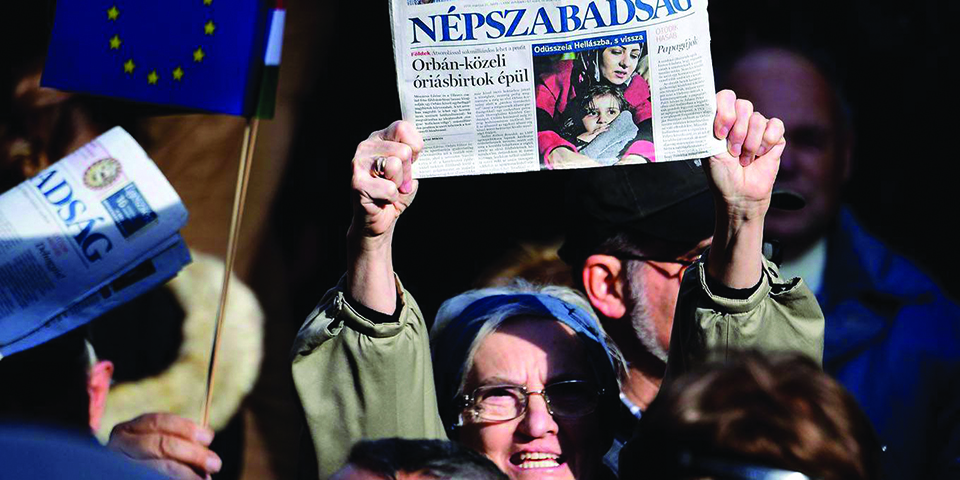
Two case studies illustrate the steps taken in media capture in Hungary and in the Czech Republic. One major trend is the cross-border expansion of the oligarchic structures.
Dragomir concludes that the only solution to the problem of media capture is "direct intervention: renewed and much larger investments in independent news outlets, with a focus on new, more disruptive forms and formats of critical journalism able to better reach and engage large audiences."
CMDS website and MDIF website - both accessed on December 11 2019. Image credit: MyRepublica