











































Media and Agriculture: Linking Towns and Villages
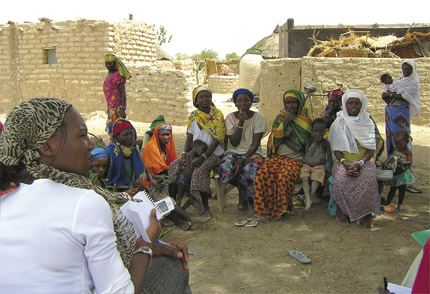
This article from the Spore Newsletter is on the need for accurate agriculture news reporting in African, Caribbean, and Pacific (ACP) countries, particularly Africa, to bridge the information gap between the rural sector of developing countries and their population centres. It discusses the Technical Centre for Agricultural and Rural Cooperation ACP-EU (CTA) perspective of the effects of lack of journalistic training in the field of agriculture reporting and what the training needs might be.
As stated here: "A clear understanding of what life is really like in the rural world is essential for improving conditions there. Investors, traders, decision-makers - all those who are based in the towns and have dealings with farmers need to be well informed." For example, in the sub-Saharan African economy, accounting for an average 34% of gross domestic product, 40% of exports, and 70% of jobs, agriculture is reported in about 4% of news stories, according to the International Women's Media Foundation (IWMF). As indicated here, media organisations tend to be based in capital cities and choose to talk with officials rather than gather eyewitness stories on agriculture; and they are dependent, often due to budget constraints, on reworking official stories and statistics rather than fact checking or gathering data.
The lack of coverage of agricultural issues is apparent in internet news aggregation sites. Those aggregating African news do not have enough stories to create an agriculture section to list them. Blogsites are trying to fill this gap by compiling locally generated stories. A lack of journalists trained in reporting on agriculture contributes to the lack of stories. "Knowledge of agronomy, economics, nutrition and the environment are prerequisites for journalists who want to understand agricultural issues. Unlike other sectors such as human health, there is virtually no complete agricultural journalism programme available in ACP countries that takes all these different aspects into account....An informal system backed by CTA promotes 'apprenticeship through experience' by organising study visits for journalists, lasting several days out in the field. In June 2008, members of the West African journalists' network RJAO took part in a study visit to investigate 'administrative and transport red tape in Bamako-Dakar agricultural trade'."
However, seminar-style training is occasional and often focused topically on one dimension of agriculture; in contrast, training sessions that are regular and longer-term could address broader journalistic training needs. Some possibilities include the following:
- "The IWFM seeks to address some of these shortcomings: a 4-year programme aims to train journalists to deal with rural development issues, mainly through special reports. In each of the three countries (Mali, Uganda and Zambia), the project will work hand in hand with a newspaper and a radio station. The goal is to improve both the quantity and the quality of coverage of these issues."
- "The Canadian project African Farm Radio Research Initiative (AFFRI Training) has launched a training programme for journalists from Ghana, Malawi, Tanzania and Ghana. After six days of intensive coaching by experienced journalists from national radio, communication experts and members of the rural community, the reporters continue their training in the long term using distance learning techniques via Internet."
In addition, to encourage journalists, the Consultative Group for International Agricultural Research (CGIAR) and the Forum for Agricultural Research in Africa (FARA) set up an annual prize in 2008 for the best agricultural articles and broadcasts in Africa.
Spore CTA Newsletter, No. 140, April 2009.

- Log in to post comments