
























Media development action with informed and engaged societies

After nearly 28 years, The Communication Initiative (The CI) Global is entering a new chapter. 

Following a period of transition, the global website has been transferred to the University of the Witwatersrand (Wits) in South Africa, where it will be administered by the Social and Behaviour Change Communication Division. Wits' commitment to social change and justice makes it a trusted steward for The CI's legacy and future. 

On the transfer, co-founder Victoria Martin expressed her pleasure to see this work continue under Wits' leadership, knowing that co-founder Warren Feek (1953–2024) would have felt deep pride in The CI Global's Africa-led direction. 

As Wits, we honour the team and partners who sustained The CI for decades and look forward building from that strong base. This includes co-founders Warren Feek (1953-2024) and Victoria Martin as well as La Iniciativa de Comunicación (CILA), which continues independently at lainiciativadecomunicacion.com with links to The CI Global site. We are also eager to forge new partnerships and entertain new ideas as we consider how best to contribute to social and behaviour change in our rapidly evolving environment.

If you are joining the International Social and Behaviour Change Communication (SBCC) Summit in Panama, please join Wits and CILA on Monday, 22 June, to share your thoughts and suggestion for the relaunch of the Communication Initiative. We will be in Pacifica 5 from 12-1:25 for the Refuel, Reflect, and Renew Lunch Series: The Communication Initiative: celebrating a driving force for Communication for Social Change and the way forward. We will reflect on the legacy of Warren Feek and family in creating the Communication Initiative, consider the contributions of CI over the years and then turn our attention towards the future in this dynamic session. 

If you are unable to join us in Panama, we still want to hear from you. Please contribute your thoughts by following this link: https://redcap.link/CommunicationInitiative2026 or reaching out to ci_surveys@commint.com

You can also follow the QR Code:

 https://redcap.link/CommunicationInitiative2026

Time to read
1 minute
Read so far

Malaria Control Patrols
0 comments
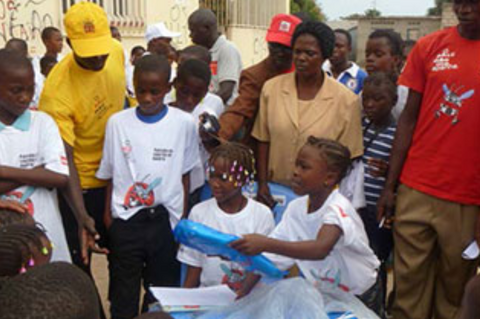
The Malaria Control Patrols is a school-based malaria control programme in Zaire Province in Angola which uses groups of students who learn about, and then communicate to their peers, families, and communities, malaria prevention information. The three-year programme was launched in 2011 by Ajuda de Desenvolvimento de Povo para Povo (ADPP), with support from the President's Malaria Initiative (PMI) Malaria Communities Program, in cooperation with the Ministry of Education. The patrols use information campaigns, open days, games, theatre, and song to pass along malaria messages.
Communication Strategies

The strategy of the Malaria Control Patrols is to establish a network of 200 trained teachers, who each organise 3 malaria control patrols consisting of 20 students, as well a as a malaria control committee. At each participating school, the Malaria Control Teacher and Malaria Control Committee organise lessons and activities with the patrols. The students, who are in third to ninth grades, learn key messages about malaria: recognise the symptoms, seek treatment early, and sleep under an insecticide treated net (ITN).

The patrols then pass these messages on to the wider community. An annual competition rewards the best students, teachers, and schools for their efforts to promote community control of malaria. As part of the project ITNs are distributed to families. A Malaria Control Patrol member visits the families to offer assistance and information on malaria, including how to use and care for the nets properly.

Development Issues

Malaria

Key Points

The project is working to reach 20,000 families in rural and suburban areas, including 5,000 pregnant women and 20,000 children under 5 years. As of 2011, 12,000 school children from 200 schools across the province are organised into Malaria Control Patrols who have distributed 40,000 ITNs, primarily for use by pregnant women and children under the age of five.

Sources