










































Liberia Media Development (LMD) Programme
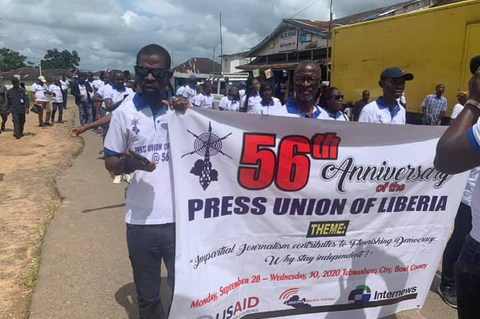
Launched in 2015, the Liberia Media Development (LMD) programme is an effort to increase citizens' access to independent and reliable information and empower them to engage in well-informed public discussions on issues of national importance. A particular focus of the project has been on supporting elections in Liberia to ensure effective citizen engagement and peaceful and democratic processes. Overall, the programme seeks to:
- Increase the sustainability of media houses;
- Increase the plurality of voices represented in Liberian media;
- Improve professional standards of journalism and the overall quality of the media;
- Strengthen the normative-legal enabling environment for freer media; and
- Strengthen freedom of information (FOI) laws to respond to requests from citizens and media establishments.
The programme is being implemented by Internews with support from the United States Agency for International Development (USAID).
Activities of the LMD programme focus on supporting journalists and media managers (including those working for community radio stations), improving the government's information services to provide more balanced and accurate information to the public, and developing a more enabling media regulatory environment. Specifically:
- Journalism training and in-house mentoring has focused on improving the quality of reporting on national issues such as elections, public financing, government transparency, and accountability. Journalists were, for example, trained to report on County Social Development Fund (CSDF) stories and corresponding legislative reform to improve citizen engagement in the allocation of funds and to improve transparency and accountability in the implementation of CSDF-funded projects. Training also included business management mentoring and training to media outlets to develop alternative revenue streams and sustainable business models.
- Twenty-one community radio stations in all 15 counties of Liberia received capacity-building interventions, business management training, and station upgrades - with the goal of supporting effective, balanced coverage of the 2017 elections and other important local and national issues.
- The Ganta Media Resource Center (MRC) was established by the Young Men's Christian Association (YMCA) to offer computer and internet access and training to journalists and young people from rural Liberia. Training was also offered in basic information and communication technology (ICT) skills and more advanced journalism production.
- Through the project, Geopoll conducted Annual Media Ratings Surveys to enable media and business to better understand the audience reach of local media so as to increase advertising income and improved media viability. A Media Market Forum was also established to circulate the audience rating data.
- Liberia's FOI act was strengthened by training government information officers and journalists to use the legislation as a tool in their investigative reporting.
- To improve access to information, the project launched the Center for Transparency and Accountability in Liberia (CENTAL) online budget portal to enable journalists and citizens access to government budget information.
- An online platform, Local Voices Liberia, was established to increase content sharing between rural journalists and rural media outlets across the nation, enhancing the representation of rural citizens and communities in national dialogue.
- The Business of Online Media was established to enable media agencies to transition to online media platforms sustainably ahead of the exponential growth of internet access through smartphones across Liberia in the wake of Liberia's growing telecommunications sector.
A number of activities have focused on creating an enabling media regulatory environment:
- With LMD support, the Press Union of Liberia (PUL) revised the Journalist Code of Conduct, which includes special conduct requirements for the press during the elections and outlines the actions journalists need to take to conduct themselves in an ethical manner.
- The National Media Council was established to improve the mediation of disputes. They received technical advice and training together with other key stakeholders, including the legal fraternity, to enforce the PUL Code of Conduct and to mitigate intractable disputes arising during and after the election period and when reporting on corruption and government accountability.
- Media law moot court activities were delivered through support to the bar association and Law School of Liberia. Support included the development of a curriculum and the training of a team of students to represent Liberia in the Oxford Price Regional Moot Court Competition in South Africa. Two media law moot courts were performed by newly trained Liberian lawyers at the annual bar association retreats in 2016 and 2017, the latter being broadcast on KMTV and watched by over 6,000 people.
- Media law reform advocacy was also undertaken through conferences, training, professional mentoring, technical advice, meetings, and high-level engagement. For example, the decriminalisation of defamation was introduced through revisions in the criminal code through an act in Parliament that was passed in the lower house in 2018.
Media Development, Democracy and Governance
Much of the work of the LMD has focused around the elections in 2017 and 2020, and some of the evidence of the project's reach and impact is related to those experiences. For example, in the lead-up to the 2017 elections, the project supported election media debates and journalism reporting on elections in order to increase citizen engagement. LMD conducted journalism training, developed codes of practice, established community media forums, and organised lower house elections media debates. In total, 126 media election debates were staged in partnership with 50 media agencies in all 73 districts, with 584 candidates attending. CSDF accountability at a local level was also foregrounded in these nationwide debates by including this issue as the first question to all candidates. The debates were broadcast on 43 radio stations, and 25% of eligible voters listened to the debates. A Harvard study and Internews focus group research found a significant increase in voter engagement, trust, and turnout on election day as an outcome of the debates. Six percent of listeners reported changing their voting preference as a result of information gleaned from debates. Internews also developed an elections handbook to guide editors, publishers, and reporters to prepare for the coverage of elections in 2020 (see Related Summaries, below).
Internews, USAID
USAID website and Internews website, November 27 2020.