










































Journalistic Ethics and Practices in Conflict Societies
University of Hamburg
This paper provides a critical review of literature on journalism in conflict societies ("conflict journalism") by investigating principal theories, concepts, and arguments, as well as empirical research findings concerning journalism and its role in democratisation processes and conflicts. It has been published as part of the Media Conflict and DEMocratisation (MeCoDEM) project, which investigates the role of traditional media and information and communication technologies (ICTs) in conflicts that accompany and follow transitions from authoritarian rule to more democratic forms of government. The project is focusing its research on 4 countries: Serbia, Egypt, Kenya, and South Africa. As a starting point for the MeCoDEM project, this working paper is a report on the state of current research in journalism studies, with a focus on journalistic actors and their journalistic work practices, role perceptions, ethical orientations, and structural conditions.
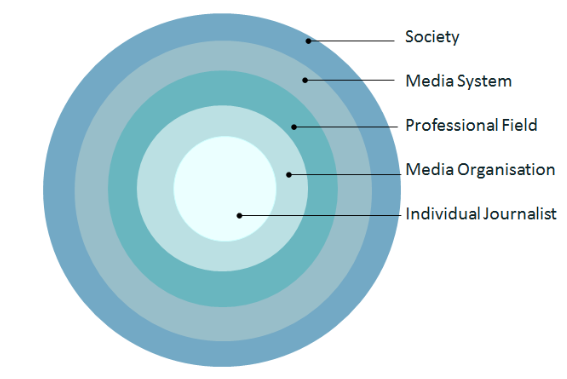
Based on the constructivist approach, the researchers conceptualise journalism here as a social institution that does not "mirror" reality but constructs reality. On this view, journalists are not merely observers of society (and societal processes of democratisation and democratisation conflicts) but as communicators and actors in their own right - e.g., in the ways in which they select and provide topics for debate and decision-making by the wider public. Furthermore, core journalistic practices are more or less under the influence of normative values as well as objective structures and constraints. Against the conceptual background of a multiple layer model (see image above), the researchers define and critically evaluate existing literature.
Following this overview, they look at:
- Comparative studies on journalism (cultures) in different countries - In sum, the national political and economic systems, country-based ideological factors such as degree of media freedom, democratic institutionalisation and private ownership, and the historical development of professional cultures appear to have significant impact on journalists' ethical ideologies, role perceptions, and work practices.
- Empirical research on journalism on/in "conflicts" - In sum, the state of research on media and journalism in conflicts, be it with regard to war, terrorism, peace-building processes and non-violent conflicts such as popular protest, manifests the need for more specific case studies focusing on journalistic actors. These would specify journalistic practices and ethics in conflict situations and the conditions under which news media could play a constructive role in societal conflict communication, conflict resolution, peace building and democratisation.
- Journalism in democratisation processes and transitional countries - Sample finding from Eastern Europe: In a region with so much ethnic diversity and a history of suppression, the media and especially ICTs are recognised as needing to play the role of easing cultural tensions and promoting intercultural understanding, dialogue, and sensitivity in a bid to motivate democratic civic participation. In sum, journalism is always embedded in a societal context - which is not only the region but also more specifically, the respective country and its history.
- Studies on journalism in the 4 MeCoDEM countries.
Existing (comparative) research shows that journalistic practices, roles, ethical orientations, and structural conditions are neither static nor globally uniform. Rather, the cultural, political, and historical and economic contexts relevant to specific regions and countries have significant impact on journalists' ethical orientations, role perceptions, and work practices. Therefore, journalism should be understood as one component in relation to many other societal components - as a relevant institution with a particular identity, logic of practices, and ethics, but still embedded, dependent, and limited within the societal context.
The researchers also find that, despite the rich findings in the research field on journalism, there is a lack of conceptualisation and empirical investigations concerning the specific role of journalism and journalistic actors in democratisation conflicts. So far, there is no elaborated theory on journalism in the context of conflict societies and transitional democracies. Only few empirical studies have focused on journalistic ethics and practices in democratisation processes and transitional countries. Furthermore, due to a Western bias in journalism studies some areas of the world and non-western democracies remain either ignored or occupy a marginal position in comparative studies, and normative assumptions rooted in Western traditions, like the equation of journalism and liberal democracy, remain largely unquestioned. Therefore, what is needed, say the researchers, is a "dialogic" or "global" approach to journalism studies that would develop non-Western-biased concepts of journalism that incorporate valuable ideas and norms from both Western and non-Western traditions.
With regard to methodological consequences of this investigation, the researchers call for innovative and sensitive empirical designs that are explorative and qualitative rather than standardised and quantitative. Journalism research so far has developed a basic theoretical model. However, a model of conflict journalism (of non-Western societies) requires further empirical findings. Analyses should therefore not be situated purely in grounded theory, but built on a basic theoretical understanding, while remaining open enough to varieties and deviances in terms of contextualisation and practices. A second methodological consequence refers to the units of analysis and comparison. As the researchers point out in various sections of the paper, most empirical studies in journalism research are related to the nation state or to comparisons of nation states. Instead, media should be seen as "translocal", especially in some of the MeCoDEM regions, such as Sub-Saharan Africa and the Arab countries. There, as the researchers point out, due to historical political developments as well as cultural and linguistic similarities, the surrounding (trans-national) regions are an important source of influence on media and journalism, evident in the emergence of transnational media outlets and transnational audiences as well as diffusion of journalism models. As democratisation is a dynamic, non-linear and rather meandering process, what the researchers feel is needed are methods that allow capturing historical developments of journalism cultures across time.
Media Conflict and DEMocratisation (MeCoDEM) website, August 11 2016 - sourced from Slimline C4D Network Twitter Trawl: 1 - 7 August 2016.
- Log in to post comments