










































Journalism Education in Bangladesh: From Aspiring Journalists to Career Professionals
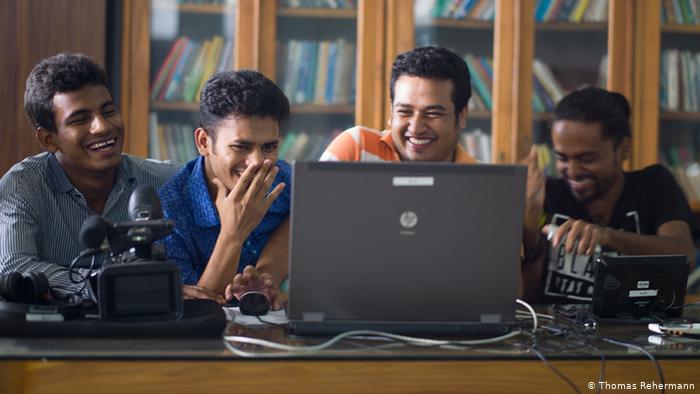
"What obstacles do Bangladeshis face when they want to become journalists? What enables or restricts them from acquiring the necessary skills to succeed in professional journalism?"
Since 2014, DW Akademie has run a project called "Media development in Bangladesh: Support for journalism education at Bangladeshi universities" that involves parterning with regional universities, Rajshahi and Chittagong, and supporting a network of Bangladeshi universities, whose members provide each other with information on trends and best practice examples in journalism training. This study identifies the needs of key actors (new and aspiring journalists, journalism education institutions, and media houses) in the context of these endeavours. It also explores what contribution these players could make to DW Akademie's long-term project and to improving the job market for journalists.
There are 18 journalism and media-related programmes at different public and private universities in Bangladesh. All 18 universities offer undergraduate degrees in journalism or journalism-related degrees, and 12 of them offer master's degrees. Journalism is not taught as a separate degree programme at any of the universities, but there are vocational or training institutes that offer professional training in journalism, media, and communication. Mainstream media outlets (both traditional and online) are potential employers of the graduates of journalism schools.
Examining Bangladesh's changing media landscape, the report explains that the growth of journalism education in Bangladesh has gone hand in hand with a significant growth of the media industries since the 1990s. However, DW Akademie notes that news coverage in Bangladesh is very politically charged and that independent, unbiased journalism is rare. The choice of topics is based on the economic interests of corporate groups that support various media outlets, while state radio stations are still under the direct control of the Ministry of Information. Critical reporting is under threat, and many journalists now censor themselves. Media representatives, opposition politicians, and Transparency International say that a media law passed in August 2014 has restricted press freedom even more.
The conceptual framework of this study is based on Berryman's (1983) leaky pipeline metaphor, which shows the points where individuals fail to reach their destination - either because they leave the pipeline (leak) or because they are prevented from moving to the next stage (block or narrowing). In addition, some individuals may experience challenges where they cannot progress smoothly (clog) or just progress slowly (vertical segregation). The leaky pipeline model is used to examine when and why aspiring journalism students decide against a career in journalism.
This study used a mixed method research technique: 327 journalism students from different universities and training institutes took part in a survey; 12 educational institutions (6 public universities, 3 private universities, 2 public journalism institutes (diploma and vocational), and 1 private vocational journalism institute) were analysed; and 9 senior journalists and media managers were interviewed.
The survey results show that there is a large interest among young people to study journalism; their primary motivation is to make societal impacts. However, only half of the students are actually interested in a career in journalism, and around 70% of the students see the prospects of a career in journalism in Bangladesh as poor or fair. This research attempted to answer the question of just why the highly motivated and inspired young people were demotivated from seeking out a career in journalism.
The research shows that these factors affect new and aspiring journalists as they enter and go through journalism schools:
- Income group: Aspiring journalists from low-income groups who enter public universities may find that the fight for limited seats is highly competitive. Those who cannot make it to public universities may opt to study in private universities, where the tuition fees are high.
- Family support: Journalism is not among the professions supported by most parents and guardians. Among university respondents, 67.89% have the support of their families, but only 38.84% are given financial support.
- Gender bias: The profile of university respondents clearly indicates a gender imbalance, with 72.48% male and 27.52% female. Four-fifths of university respondents believed that women face greater obstacles than men in pursuing a journalism career in the country.
These factors affect new and aspiring journalists as they enter the job market:
- Lack of personal connections: Smaller to medium-sized media companies rely more on personal connections rather than formal recruitment procedures. Aspiring journalists without the proper connections are at a disadvantage in this regard.
- Lack of skill set: The top media companies expect graduates to have traditional, as well as new and specialised, journalism skills. Those who do not possess such skills are not recruited by them.
- Change of career track: During university studies, half of the aspiring journalists move into other fields, such as public relations and public service.
These factors affect new and aspiring journalists once they are working in the media:
- Low salary/incentives: Only the top media companies pay good salaries and give adequate incentives; most small- to medium-sized media houses do not follow the regulations of the wage board.
- Job insecurity: There are no standard career tracks or regulated promotions for new journalists; careers often depend on the mercy of the editor.
- Family pressure and gender issues: Many female journalists do not stay long in the profession. This may be due to family pressure (after marriage and/or after having a child) and/or due to lack of support at work (e.g., women may be undermined by their male colleagues and feel discriminated against in assignment distribution).
The study findings provide evidence that educational institutions have limited mechanisms to integrate their graduates into media organisations. The educational institutions cover much of the traditional journalism skill set in their curriculum, but much is left to be desired for new and specialised media skills. Although some of the major media companies have orientation and training programmes, they are too limited in scope for a proper integration of newly recruited young journalists.
The study offers the following recommendations:
- Journalism educators' network: Journalism schools should strengthen dialogues among themselves on best practices and experiences in journalism education, for example, by using the network set up by the DW Akademie. This will enable journalism educators to support each other in their efforts to come up with a balanced curriculum - one that acknowledges the importance of the media in democracy as well as the commercial side of the industry. Such a network can also collaborate in investigating the effectiveness of a variety of teaching methods and assessment of learning.
- Investment for digital media literacy: Universities should continue investing in media laboratories, equipment, and co-/extra-curricular programmes, as well as introducing new courses related to new media. Universities could approach private companies and non-profit foundations proactively to gather funds for such investments.
- Internship: Both public and private universities should develop more structured internships for students in collaboration with the news media industry. Journalism educators and industry professionals can work collaboratively to manage the recruitment and assessment of internees. The internship programmes should reserve some places for female students.
- Scholarship fund: Media companies and the government may find it useful to set up a scholarship fund for aspiring journalists, male and female. They should create a favourable environment to attract the best talent through fair and competitive salaries, incentives, and regularisation policies. Media outlets can also improve their internal training and cooperation with academic institutions.
- Professional connections: Recruitment of experienced journalists as part-time teachers of practical courses or as guest lecturers could facilitate professional collaboration. Journalists can team-teach a course together with an academic faculty.
- Alumni networks: Journalism schools should effectively involve alumni who are involved in professional journalism in creating a bridge between journalism students and the news media industry.
Editor's notes - DW Akademie's additional activities in Bangladesh:
- An online platform is being developed together with the non-governmental organisation (NGO) Article 19 to provide all journalists in Bangladesh with background information on sensitive topics such as media ethics, digital security, and the legal framework for the media.
- Since 2018, DW Akademie has been working with the Rohingya people, an ethnic group seeking refuge in Bangladesh, and is training them to work as camp reporters in a cooperation with Community Radio Naf. The video below explores this activity.
DW Akademie website, November 18 2019 and DW Akademie website, May 21 2019 - both accessed on January 3 2020. Image credit: © Thomas Rehermann
- Log in to post comments