










































Ideation
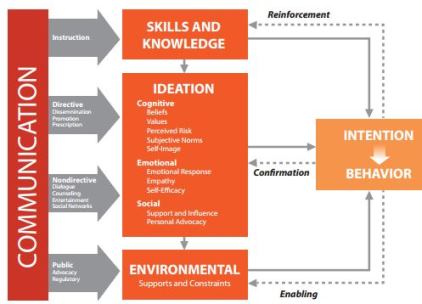
"Ideation refers to how new ways of thinking (or new behaviors) are diffused through a community by means of communication and social interaction among individuals and groups. It should be used when trying to identify the psychosocial factors that predict behavior or when trying to causally attribute behavior change to communication interventions."
This model, from a Health Communication Capacity (HC3) research primer, is designed to show how "instructive communication can teach the skills and knowledge needed to perform an action, directive (one-way influence) and nondirective (entertainment, counseling and interpersonal) communication can affect ideational factors, and public communication (such as advocacy) can affect environmental factors."
Ideational factors are grouped into three categories:
- "Cognitive factors address an individual’s beliefs, values and attitudes (such as risk perceptions), as well as how an individual perceives what others think should be done (subjective norms), what the individual thinks others are actually doing (social norms) and how the individual thinks about him/herself (self-image)."
- "Emotional factors include how an individual feels about the new behavior (positive or negative) as well as how confident a person feels that they can perform the behavior (self-efficacy)."
- "Social factors consist of interpersonal interactions (such as support or pressure from friends) that convince someone to behave in a certain way, as well as the effect on an individual’s behavior from trying to persuade others to adopt the behavior as well (personal advocacy)."
These factors influence behaviour and can be measured to give each person in a study an ideation score that predicts how likely that person is to adopt a behaviour. Thus, ideational factors are highly predictive of health behaviours. "Ideation should be used when trying to identify the psychosocial factors that predict behavior or when trying to causally attribute behavior change to communication interventions." By creating a combined ideational index, researchers can assess if respondents have:
- "Has gained sufficient knowledge about it
- Has developed a positive attitude towards it
- Thinks others support and practice it
- Has talked to others about it
- Feels good about doing it"
They can then determine which of these factors are the strongest predictors of behaviour, providing guidance about what emphasis social and behaviour change communication (SBCC) strategies should have.
Implementers should bear in mind that "culturally adapted ideation scales can be developed and used to design and evaluate programs in many different settings and for many different behavioral outcomes. Research has also found specific factors that apply across cultures." The primer gives as an example the Nigerian Urban Reproductive Health Initiative (NURHI), begun in 2009, which included "the integration of family planning services with other health services, improving the quality of family planning services in high-volume settings, creating demand and encouraging sustained use of contraceptives, and increasing funding and supportive environments at the policy level to ensure access to family planning in urban poor areas....Ideation scores were also calculated at baseline and mid-term. Among women with more exposure to the NURHI campaign, ideation scores were 13% higher than among women with zero exposure. Women exposed to the NURHI program were more likely to have higher ideational factors, and women with higher ideational factors were more likely to use contraceptives. These cognitive, emotional and social factors that influence contraceptive use included perceptions of social norms about family planning; knowledge, attitudes, and beliefs about family planning; and self-efficacy for using contraception."
Ideation: An HC3 Research Primer [PDF], March 18 2015.