











































Husbands' Schools Initiative
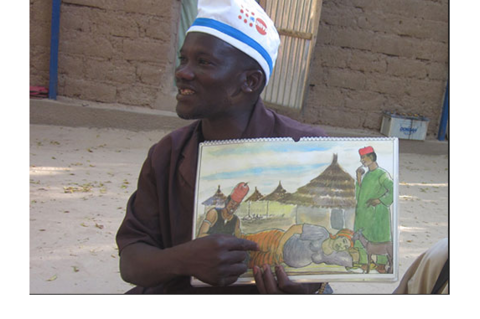
Initiated by the United Nations Population Fund (UNFPA) in 2007, the Husbands' Schools, or HS (École des Maris) initiative works to involve men in health promotion in order to foster changes in behaviour at community level around issues of reproductive health. The schools are designed to be forums to share and discuss reproductive health issues, and devise individual and community solutions. The non-governmental organisation (NGO) SongES has led implementation and technical support of the HS intervention.
Communication Strategies
In 2007, the UNFPA commissioned a study on obstacles to promoting reproductive health in the Zinder Region of Niger. Conducted by the Laboratoire d’Études et de Recherche sur les Dynamiques Sociales et le Développement Local (LASDEL – Laboratory for Study and Research into Social Dynamics and Local Development), the study identified a number of barriers to the use of reproductive health services, the most important being the power and behaviour of the men who determine whether or not women can have access to medical care. To address this, eleven pilot HS were set up in two health districts in Zinder, located in particularly vulnerable areas with low reproductive health indicators. In 2010, the initiative expanded to 137 schools in this district. It eventually spread to other regions. As of 2019, HS were present in all regions of Niger, except for the urban community of Niamey. The strategy has also been replicated in several countries in the West Africa region, including Côte d'Ivoire, Burkina Faso, Mali, and Cameroon.
The concept, approach, and functioning of the HS were defined in detail at an initial workshop, based on a participatory approach, bringing together national NGOs, health workers, volunteer husbands, support organisations, and other stakeholders. Criteria for selecting model husbands to participate in the schools were established: Participants must be 25 or over and married, have a wife/wives who use reproductive health services, allow their wife/wives to participate in community life, and be willing to volunteer in this programme.
The HS are based on voluntary membership and community involvement, the goal being to encourage men to take responsibility for their own development. There is no leader: All members are equal and work in a non-hierarchical framework, with each member assuming his share of responsibilities on a rotational basis. According to the organisers, the HS are a forum for discussion, decision-making, and action. The members meet around twice a month to analyse and discuss specific cases within the community in the field of reproductive health. This interaction is important since it gives the members insight into how they each perceive maternal health issues and problems. The group dynamic is also a tool for behavioural change.
Social and gender norms/beliefs linked to poor reproductive health outcomes are implicit to the intervention, especially:
Participating husbands look for appropriate solutions to issues raised based on reliable knowledge available within the group or obtained from a specialist resource person. For example, based on information provided by health personnel in the area, the husbands identify critical health indicators, such as low rates of prenatal consultation. Having identified the problem, the husbands can devise strategies and actions to get more pregnant and breastfeeding women attending Integrated Health Centres (Centres de Santé Intégrés, CSI), thereby improving health in the community. This has included such actions as building latrines in the CSIs to enhance women's comfort and privacy; a midwife's residence, an observation room for women in labour, and a prenatal consultation room. Awareness sessions held during religious ceremonies are also one of the strategies they use.
According to the organisers, the HS primarily influence behaviour within individual couples - wives say that there is now dialogue with their husbands and that men understand the importance of the health of their wives and children. They say that for the first time, husbands have even been attending the births of their children at the CSI. Member husbands are acting as guides and role models for their own families as well as for other families that would otherwise have difficulties using the services of a CSI. The organisers say there has also been a noticeable change in behaviour among villagers, authorities, and health workers and as the Representative of UNFPA Niger, Mr. Yacine Diallo, says "the initiative is having such an impact that is has caught the attention of other development partners". The decisive factor is the new relationship that has been built up between the HS and health workers, making the husbands direct actors of development, which is having a qualitative impact on health indicators. The objective is to involve the husbands in sensitisation around other areas such as gender-based violence, forced marriage, and malnutrition, amongst others, to increase the positive impact on development.
The concept, approach, and functioning of the HS were defined in detail at an initial workshop, based on a participatory approach, bringing together national NGOs, health workers, volunteer husbands, support organisations, and other stakeholders. Criteria for selecting model husbands to participate in the schools were established: Participants must be 25 or over and married, have a wife/wives who use reproductive health services, allow their wife/wives to participate in community life, and be willing to volunteer in this programme.
The HS are based on voluntary membership and community involvement, the goal being to encourage men to take responsibility for their own development. There is no leader: All members are equal and work in a non-hierarchical framework, with each member assuming his share of responsibilities on a rotational basis. According to the organisers, the HS are a forum for discussion, decision-making, and action. The members meet around twice a month to analyse and discuss specific cases within the community in the field of reproductive health. This interaction is important since it gives the members insight into how they each perceive maternal health issues and problems. The group dynamic is also a tool for behavioural change.
Social and gender norms/beliefs linked to poor reproductive health outcomes are implicit to the intervention, especially:
- The use of antenatal care, delivery, postnatal, and family planning services only concerns women, not men.
- Health centres are for sick people and not for healthy people.
- Men's and women's worth is related to the number of children they have.
- Men should make all the decisions.
- Wives should never say "no" to their husbands.
- Men who approve or pay for the use of family planning lack authority.
Participating husbands look for appropriate solutions to issues raised based on reliable knowledge available within the group or obtained from a specialist resource person. For example, based on information provided by health personnel in the area, the husbands identify critical health indicators, such as low rates of prenatal consultation. Having identified the problem, the husbands can devise strategies and actions to get more pregnant and breastfeeding women attending Integrated Health Centres (Centres de Santé Intégrés, CSI), thereby improving health in the community. This has included such actions as building latrines in the CSIs to enhance women's comfort and privacy; a midwife's residence, an observation room for women in labour, and a prenatal consultation room. Awareness sessions held during religious ceremonies are also one of the strategies they use.
According to the organisers, the HS primarily influence behaviour within individual couples - wives say that there is now dialogue with their husbands and that men understand the importance of the health of their wives and children. They say that for the first time, husbands have even been attending the births of their children at the CSI. Member husbands are acting as guides and role models for their own families as well as for other families that would otherwise have difficulties using the services of a CSI. The organisers say there has also been a noticeable change in behaviour among villagers, authorities, and health workers and as the Representative of UNFPA Niger, Mr. Yacine Diallo, says "the initiative is having such an impact that is has caught the attention of other development partners". The decisive factor is the new relationship that has been built up between the HS and health workers, making the husbands direct actors of development, which is having a qualitative impact on health indicators. The objective is to involve the husbands in sensitisation around other areas such as gender-based violence, forced marriage, and malnutrition, amongst others, to increase the positive impact on development.
Development Issues
Maternal Health, Reproductive Health
Key Points
In Niger, some 590 women die from complications of pregnancy or childbirth out of every 100,000 live births, according to the 2013 State of the World Population report. Only 14% of women use any form of contraceptive, and only 12% use a modern contraceptive method. These numbers contribute to Niger's high fertility rate, which increases the risks to women's health. According to the UNFPA, working to ensure that women survive childbirth is a human rights imperative and an absolute priority for international development. The organisers report that in the project area, the reproductive health indicators are improving, with particularly significant rises in deliveries assisted by skilled personnel, prenatal and postnatal consultations, and family planning.
Sources
Dimitra Newsletter, June 2010 [PDF]; and "Schools for Husbands Gaining Ground in Rural Niger", UNFPA, June 17 2014, and "Study of the Effects of the Husbands' School Intervention on Gender Dynamics to Improve Reproductive Health in Niger", Institute for Reproductive Health, Georgetown University, for the United States Agency for International Development (USAID), August 2019 - both accessed on March 31 2022; and email from Jamie M. Greenberg to The Communication Initiative on April 1 2022. Image credit: APANEWS
- Log in to post comments