










































Gender in the Belarusian Media Landscape
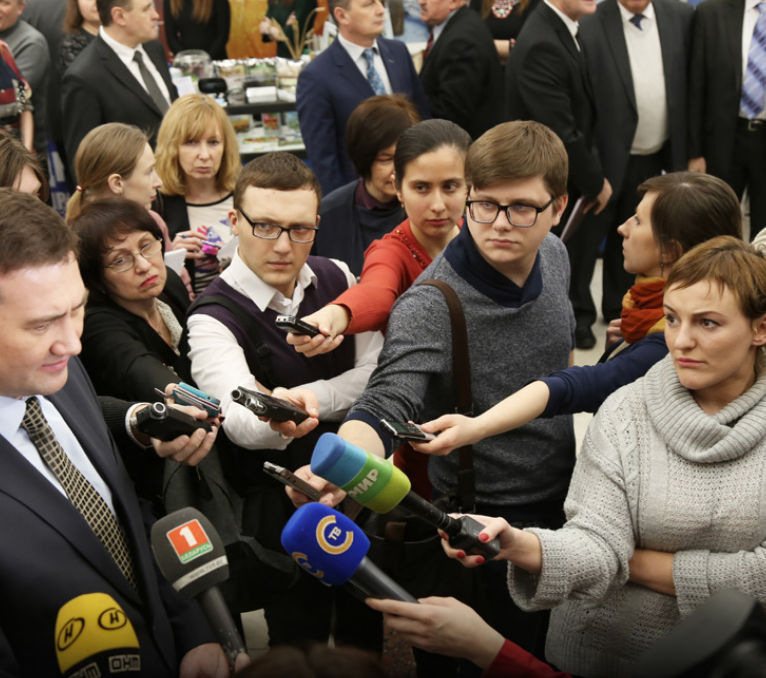
"Belittling stereotypes that hinder advancement, problems to combine work and family life, gender biased distribution of beats and a general feminization of the industry, (with declining wages and significant male drop out), are some of the challenges facing female journalists in Belarus who want to make themselves a career in the media industry." - Agneta Söderberg Jacobson, Gender Advisor, Fojo Media Institute
This report was undertaken by the Fojo Media Institute with partners the Belarusian Association of Journalists (BAJ) and Press Club Belarus to inform actors in the local media industry of the current status of gender equality in Belarus media and to shed light on the relative position of women in the industry. Furthermore, the study, conducted with support from the Swedish International Development Cooperation Agency (Sida), examines gender representation in media networks and other professional bodies, as well as the level of gender sensitivity in media content.
The report begins with a profile of Belarus in general and the gender situation there, in particular. An overview of the media industry as well as of the research methodology is provided. With regard to the latter: The research was carried out on a national basis in 2016 and consisted of 10 in-depth interviews with both male and female journalists, 4 gender-mixed focus group discussions, and an online questionnaire completed by 94 people working in the media, of which 60% were women.
Women were found to be well represented in the Belarusian media industry, making up more than 70% of the journalist corps. The number of women producing media content is increasing. Women are well represented in middle management positions, but men still dominate positions at the highest level, with the highest wages. The study shows that the reasons for this imbalance are many; however, contempt for and prejudice against women or girls (misogyny) ingrained in the society seems to be at the core. Respondents shared ideas such as: "a woman can't be a competent leader/manager" (women are "hysterics"), "women might be talented journalists but are not for leadership", etc. The fact that men to a certain extent have higher salaries seems to depend on level of seniority (management positions), but might also be partly topic bound. Women are more likely to cover "soft" issues, such as culture and health care, whereas men more often report on business and economics, areas of coverage that are traditionally better paid. In Belarus, journalism is not considered a prestigious profession - wages are low, and it is difficult to realise ambitions. This is why men are leaving this area; journalism is becoming an industry in which mostly women work. It is women who mainly study journalism, further promoting the feminisation of the profession.
Many of the interviewees think there are no gender problems in Belarus, or that gender problems exist but are not as critical as the current economic or political problems the Belarusian society face. Gender discrimination is forbidden in Belarus, and, in response to the question whether gender discrimination prevails in the media business, most respondents - both men and women - say "no". However, when applying for jobs, female journalists with children are discriminated against more than male applicants with children. This is due to women being considered the primary caretakers of children.
More than 90% of the editorial offices lack policies that counteract sexual harassment or provide channels to report it. More than 20% of the female journalists were subjected to sexual harassment in the workplace. More than half of the interviewees claim that the media environment they work in does not have a gender policy.
The research shows that, when depicting women in the media, there is a tendency to focus on outer appearance and not on professional achievements; for example, women are seldom portrayed as experts on economics and politics in the news. Women are often either referred to in sexual terms or as mothers, as the "custodians of the family hearth". The language in Belarusian media (and in the Belarusian society in general) is male-oriented. Female journalists contribute to preserving these stereotypes by letting conservative ideas about social roles of women and men be reflected in media content. Misogynistic statements were common also among female participants in the focus groups, which indicates that female media professionals may also carry harmful gendered stereotypes that might affect the media content. However, a new generation of Belarusian media professionals challenging traditional gender norms is emerging, especially in online and social media.
Most of the female and male journalists take part in professional training activities, but only 20% of the interviewees have attended training concerning gender problems; many had not heard of such courses. Most of the participants from the focus groups think that training concerning gender sensitive content is important and useful.
After an analysis section, the report provides the following recommendations based on the research findings:
Media houses/industry could create an independent institution to monitor content produced in the mass media on issues concerning gender ethics. This organisation could have the following tasks:
- "Consult mass media on how to promote gender-sensitive content.
- Receive and solve complaints against sexist content and commercials.
- Criticize mass media using sexism or gender stereotypes.
- Publish a list of female experts in all fields on a permanent basis, especially in politics and economics. This list should be forwarded to the editorial offices.
- Promote permanent trainings courses on gender-sensitive content in editorial offices in order to eliminate gender stereotypes in mass media.
- Provide antidiscrimination training concerning LGBTQI [lesbian, gay, bisexual, transgender, queer, and intersex people] in editorial offices.
- Create editorial rules or improve the existing rules aimed at promoting gender equality in editorial offices. An ethics catalogue on gender-sensitive content should be created.
- Establish an institute of ombudsman/ombudswoman to control and defend the rights of female and male journalists in trade unions and in editorial offices of more than 50 people. Special attention should be given to women with children during the procedure of employment.
- Start a women's organization in the trade unions or independently from them, in order to lobby group for the interests of women at the editorial offices and governmental structures.
- Recommend all editorial offices have a special policy concerning sexual harassment and create channels for disciplining and reporting concerns, threats or acts of sexual harassment.
- Organise targeted campaigns among male students to attract men to the profession and create a balance of sexes in journalism.
- Recommend that employers create a flexible working timetable so employees can combine work with family obligations.
- Create special programmes on radio, TV and sections of newspapers to cover gender themes.
- Form a working group consisting of female and male specialists in philology and journalism to develop a catalogue on gender linguistics and feminist/feminine expressions in the Russian and Belarusian languages."
In the area of journalism education/training, development of training concerning gender equality, with a critical approach to the traditional understanding of male and female roles, is recommended. The report suggests that this training be implemented at all levels of education, starting at kindergarden. Other ideas: Introduce mandatory courses on gender equality in higher education, regardless of their profile; develop and include mandatory courses on gender sensitivity for those studying journalism and pedaegogics; create training programmes at institutes/universities on gender equality for specialists; and prepare and publish manuals on gender equality for all levels of education.
Jacobson of Fojo says: "In summary, there is still a long way to go for Belarusian media to become gender aware and fulfil their democratic obligation to feature multiple voices, representing different needs and interests. In order to motivate change processes in the local media industries, much more research needs to be done to get a fuller picture. Referring to international data and experience is not enough, only when there is reliable local data to relate to awareness will be raised and change will (hopefully) come about."
Fojo website, April 21 2017. Image credit: Sergey Nikonovich
- Log in to post comments