










































Fragile States: The Role of Media and Communication
BBC Media Action
"This briefing examines how current media trends are affecting state and societal fragility, both positively and negatively."
This policy briefing examines the implications of current media trends for fragile states and explores whether these trends are making these states more, or less, fragile. It argues that the role of a free media should be embraced and better prioritised in strategies designed to support such states. The Organisation for Economic Co-operation and Development (OECD) classifies more than 40 states worldwide as "fragile".
The paper focuses especially on fractured, fragile states where religion, politics, ethnicity, or other factional fault lines divide society. The central part of the paper focuses on four states: Afghanistan, Iraq, Kenya, and Somalia. From the Executive summary:
"[The briefing] argues that development actors should embrace the reality and opportunities provided by changed media and communication environments and that the role of a free and plural media should be prioritised rather than - as seems the case at present - marginalised in much fragile states policy. It argues that shared identity and sustainable political settlements will be best enabled by national and local dialogue. Such dialogue is dependent on a free media that is independent of undue factional or governmental control. Efforts to shut down the media, even if feasible, risk doing more harm than good in fragile states as elsewhere. Support to the media in fragile states designed to minimise the risk of division and maximise the opportunities for dialogue should feature more prominently in assistance to such states.
The briefing is designed principally for policy-makers working to support development in fragile states. It draws on and summarises some of the conclusions drawn from earlier policy briefings published by BBC Media Action on the role of the media and communication in four fragile states - Afghanistan, Iraq, Kenya and Somalia. The central section (pages 14-28) provides a summary of each of these briefings. The rest of the document seeks to draw some insights and conclusions from this and other BBC Media Action research and experience relevant to fragile states."
In examining the question: "Is the media increasing or reducing fragility?", the briefing cites 4 trends: the rapid expansion of people's access to information and capacity to express themselves; the increased access to and appropriation of media, through social media; the fragmentation of media environments; and the changing media consumption among young people. The fragmentation has allowed for both private investment and donor funding so that, for example, so-called "warlord channels" have grown up alongside efforts toward free and independent media. "In short, fractured media markets are also increasingly co-opted media environments."
The case for and against support to media in fragile states presents themes of: the co-opting of media for propaganda or "hate media"; the possible exacerbation of tensions that undermine state building when free and unconditional debate is offered through media; and the concerns around media's role in elections when competitive and privatised media play a central role in conflictive elections in fragile situations. "This briefing reaches a conclusion at odds with much critical analysis of media support to fragile states, arguing that media pluralism and freedom of expression should provide a core foundation for the successful emergence of sustainable political settlements. Nevertheless, these critiques note that problems emerge in fragile states if the principal role of the media is to reinforce the separation of identities without also having the capacity, means or will to enable the kind of dialogue that can create shared identities."
The briefing presents its case for the political construction of shared identity, which "has historically depended on control of the media." However, national media is now less trusted and seen as less relevant by citizens in many countries. Thus, where state-owned media fail to build a shared national identity, "it seems necessary to build shared identity through dialogue and debate between groups who are confident that their own identity is secure and valued." Possible platforms for building shared national identity leading to state building could be, for example: United Nations (UN)-sponsored radio; peer-to-peer networking through social media and networks of citizen journalists; and public service broadcasting. A "genuinely trusted national media capable of providing a platform for national public debate that enables divided communities to strengthen their shared identity seems increasingly important in fragile states."
Conclusions include:
- Media matters in fragile states.
- Sacrificing media freedom and freedom of expression with the aim of making the state more stable is likely to be ineffective and counterproductive.
- "Special challenges exist in enabling the kind of media and communication system best able to provide a platform for a national public conversation to facilitate the development of shared identity....More creative strategies and external support will be required if national public service broadcasting systems are to be more successful in providing such platforms in the future." Media regulation is critical, including a framework of rules for proportionate political party coverage, mechanisms to include minority interests, and transparency guidelines for licensing.
- Integrating support to media into the post-Millennium Development Goal framework should include: "ensur[ing that] people enjoy freedom of speech, association, peaceful protest and access to independent media and information."
- Integrating media and communication issues into the fragile states agenda means considering them within national, bilateral, and multilateral development strategies and integrating them into established mechanisms set up to support fragile states.
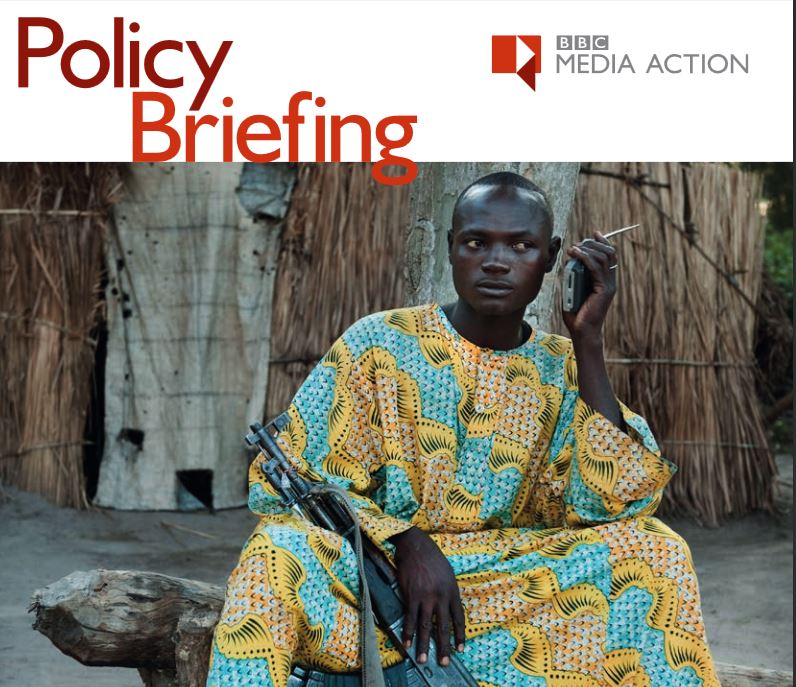
BBC Media Action website, October 2 2013. Image credit and caption: Sven Tor Finn/Panos Pictures. The media is being transformed in most fragile states. Here, a rebel soldier, armed with a Kalashnikov rifle, listens to a radio near the village of Ouandago in the Central African Republic ahead of peace talks in 2009.
- Log in to post comments