










































Encouraging Men’s Participation in HIV and AIDS Prevention and HIV Testing Services: Evaluation of the Men As Partners® (MAP) Approach in Côte d’Ivoire
The RESPOND Project (Tano-Kamelan, Yahner, Harper)
This 45-page report shares insights from a mid-project evaluation of The RESPOND Project's work in Côte d’Ivoire to build the capacity of local and international organisations to use the Men As Partners (MAP) approach to encourage men’s participation in HIV and AIDS prevention and testing. "The MAP approach, applied in more than fifteen countries worldwide, stimulates dialogue around gender norms, encouraging men and women to reject harmful norms and to promote those that protect the health of men and their families." MAP is designed to help men overcome their reluctance to seek services that they view as being predominantly focused on women, who access these services during prenatal visits. It uses "provider training, information, education, and communication (IEC) materials, and peer education to reduce men's high-risk behaviours, promote fidelity, reduce the number of sexual partners, reduce GBV, and increase men's participation in health services."
"To implement the MAP approach in Côte d’Ivoire, RESPOND works at seven pilot sites in and around Abidjan: six public-sector facilities and one faith-based facility. At each facility, a staff member designated as the MAP point focal coordinates MAP activities, liaises with RESPOND about the approach, and collates monthly service statistics." The evaluation team conducted in-depth interviews with PEPFAR partners, health care providers, and community educators. In addition, a checklist of materials, services, and activities was administered at each facility.
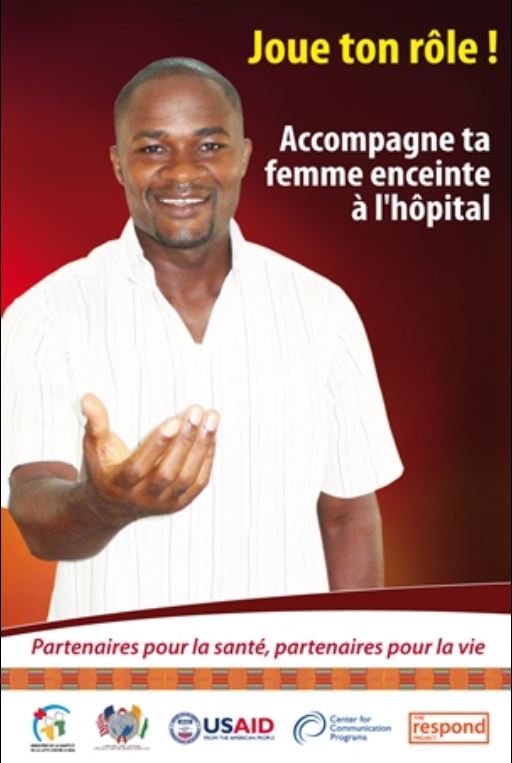
Many strategies among the MAP activities are communications-related and RESPOND has used: training of trainers to include "gender-transformative messages and to engage men in their HIV prevention work;" collaboration with the Johns Hopkins Bloomberg School of Public Health Centre for Communication Programmes (JHU-CCP) to "develop messages and materials that challenged harmful gender norms and encourage men to anticipate in HIV and PMTCT services;" training of staff on how to provide male-friendly services; support designing and implementing action plans to make facilities more friendly to men; and training of community educators at each facility to include "gender-transformative messages in their work and to engage men and couples."
For the evaluation of the MAP approach, researchers set out to describe reasons for the lack of male involvement prior to the implementation of MAP, to assess PEPFAR staff’s knowledge about MAP and services for men, delivery of services and community engagement, and to describe the capacity of facilities and PEPFAR partners to use gender-transformative messages in their ongoing HIV prevention work. The study included in-depth interviews performed with the informed consent of participants (PEPFAR partners, health care providers, and facility-based community educators) as well as site visits to the seven facilities. Interviewers also administered a checklist of "materials, services, and activities essential to male-friendly service provision..." by either asking a provider or direct observation. An analysis of service statistics disaggregated by sex reported to the Ministry of Health helped determine trends as well as inform recommendations.
Key findings from the evaluation are copied below:
- "All providers and PEPFAR partners interviewed said they would recommend the MAP approach to other organisations.
- Health facilities are highly feminised and medicalised in Côte d’Ivoire, factors that discourage men from visiting them. Facilities must address these factors if they are to attract men.
- The total number of men tested at the seven facilities increased dramatically from 244 at the programme's inception to 1,435 during the last quarter of 2012, over a five-fold increase.
- Most men received testing through combined family planning-voluntary counselling and testing (FP-VCT) services rather than through couples' prevention of mother to child transmission (PMTCT).
- The number of couples tested remained low, even though six of the seven pilot facilities had increased the number of couples tested.
- Providers and PEPFAR partners found that MAP training was innovative and practical.
- The seven facilities often lacked sufficient supplies of materials developed for information, education, and communication (IEC).
- The strategy of encouraging men to use PMTCT services during their partner’s antenatal care has not worked well. Few men were tested through PMTCT services.
- Condom promotion was not well integrated into the MAP initiative.
- Because of men’s work commitments and because of their reluctance to visit health centers, community outreach may be a more effective means of reaching men for testing than facility-based efforts."
In addition, the evaluation notes that the cultural context of testing and disclosure must be addressed because men are seen to be in charge of the household and do not want to appear weak, and women often fear disclosing their status, or that of their children, to their husbands. When most of the personnel are women, this deters men from attending, and the attitudes of personnel can also contribute to the lack of welcome (female personnel who believe men do not belong in a material and child health centre).
In general, there is a lack of privacy and confidentiality, compounded by a lack of waiting spaces. There is also a need for more materials that are male-friendly, such as posters and flipcharts, which should be displayed in prominent places. Furthermore, radio spots should not be aired in locations where male-friendly services are not available, as "men may be deterred from ever being tested."
Civil unrest and a lack of sufficient resources are among the reasons given for not fully implementing action plans - most of which included "(1)the promotion of PMTCT, (2) improving signage and posters, (3) improving the way men are welcome, (4) sensitising health care workers, and (5) sensitising the community with regard to couple counselling."
Highlights from "key recommendations regarding training, service provision, community outreach, management, supervision, monitoring and evaluation," as stated in the study, follow:
- "Increase the duration of training related to gender-based violence;
- Defeminise and demedicalise service delivery settings;
- Put condom education and provision at the heart of MAP activities;
- Make more IEC materials available;
- Increase outreach activities, especially in the workplace; and
- Create a task force for best practices and supervision."
The RESPOND Project is a five-year cooperative agreement funded by the United States Agency for International Development (USAID). It is managed by EngenderHealth and includes five PEPFAR partners: the Population Council, FHI 360, the Futures Institute, Meridian Group International, and JHU-CCP.
The Respond Project website on January 15 2014.