
























Media development action with informed and engaged societies

After nearly 28 years, The Communication Initiative (The CI) Global is entering a new chapter. 

Following a period of transition, the global website has been transferred to the University of the Witwatersrand (Wits) in South Africa, where it will be administered by the Social and Behaviour Change Communication Division. Wits' commitment to social change and justice makes it a trusted steward for The CI's legacy and future. 

On the transfer, co-founder Victoria Martin expressed her pleasure to see this work continue under Wits' leadership, knowing that co-founder Warren Feek (1953–2024) would have felt deep pride in The CI Global's Africa-led direction. 

As Wits, we honour the team and partners who sustained The CI for decades and look forward building from that strong base. This includes co-founders Warren Feek (1953-2024) and Victoria Martin as well as La Iniciativa de Comunicación (CILA), which continues independently at lainiciativadecomunicacion.com with links to The CI Global site. We are also eager to forge new partnerships and entertain new ideas as we consider how best to contribute to social and behaviour change in our rapidly evolving environment.

If you are joining the International Social and Behaviour Change Communication (SBCC) Summit in Panama, please join Wits and CILA on Monday, 22 June, to share your thoughts and suggestion for the relaunch of the Communication Initiative. We will be in Pacifica 5 from 12-1:25 for the Refuel, Reflect, and Renew Lunch Series: The Communication Initiative: celebrating a driving force for Communication for Social Change and the way forward. We will reflect on the legacy of Warren Feek and family in creating the Communication Initiative, consider the contributions of CI over the years and then turn our attention towards the future in this dynamic session. 

If you are unable to join us in Panama, we still want to hear from you. Please contribute your thoughts by following this link: https://redcap.link/CommunicationInitiative2026 or reaching out to ci_surveys@commint.com

You can also follow the QR Code:

 https://redcap.link/CommunicationInitiative2026

Time to read
1 minute
Read so far

Digital Journalism Trainers Manual - Introduction to Digital Media and Media Convergence
0 comments
Image
SummaryText

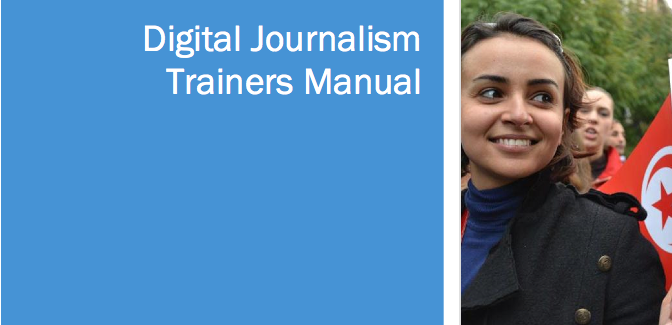
This trainers manual, developed for journalists in Tunisia, introduces the concepts, practices, and tools of digital journalism. The manual was produced as part of a 10-month project called the New Tricks Project: Re-Training for the Middle East's Established Journalists through Workshops and How-To Videos, which sought to improve the quality of journalism in the wake of the rise of social media associated with the "Arab Spring".

In particular, the project sought to support established Tunisian journalists in expanding their digital media skills and online presence so they could engage wider audiences and facilitate better news gathering.  The project wanted to tap into the knowledge and professionalism of these mid-career journalists, who were considered a great resource for young media professionals, the media sector as a whole, and the Tunisian people. The manual is therefore intended to support their training, as well as the sharing of their digital journalism skills within their media outlets. 

The manual consists of the following sections:

  • Introduction to Digital Media + Media Convergence
  • Lesson 1: Overview of digital media
  • Lesson 2: Assessment of the digital media landscape in your country
  • Lesson 3: New media and digital journalism tools
  • Lesson 4: What is a digital story?
  • Lesson 5: Digital storytelling
  • Lesson 6: Video
  • Lesson 7:  Interviews
  • Lesson 8: Filming an interview
  • Lesson 9: Production
  • Lesson 10: Video Editing
  • Lesson 11: Using Adobe Premiere
  • Lesson 12: Photojournalism
  • Lesson 13: Telling stories with photos, photo slide shows and captions
  • Lesson 14: Sound stories
  • Lesson 15: Crowdsourcing, information gathering
  • Lesson 16: Digital Journalism Ethics
  • Lesson 17: Digital Security for Journalists.
  • Lesson 18: Cloud Computing and Storage
  • Lesson 19: Introduction to Infographics
  • Lesson 20: Mobile Journalism (MOJO)
  • Lesson 21:  Intro to Data Journalism


The training guide is accompanied by a series of "how-to" videos (see below for one example):

  •    Interviewing
  •    Video techniques
  •    Camera operations
  •    Video splicing
  •    Mobile phone apps
  •    Taking pictures on smartphones

Languages

English and Arabic

Number of Pages

73

Source

IREX website on July 7 2016.