










































COVID-19 and Conflict: Communicating for Peace during a Global Health Crisis
University of New South Wales
"While the Covid-19 crisis has come to be known as a 'global pandemic', rather than bringing us all on a level playing field, it appears to have exacerbated key structural inequalities."
In this article, Valentina Baú explores some of the conflict-related issues caused or exacerbated by the COVID-19 crisis and argues that media and communication channels must be adapted to promote health messages while communicating for peace.
Of concern, per Baú, are realities like these: "disruption of peace processes, such as in Sudan's Darfur region; the escalation of existing conflicts, such as in Libya; and the formation of contested conditions that warrant new strife, such as the postponement of long-awaited elections in a number of countries in the South." More broadly, "Systems of governance and livelihoods that were already weak are being stressed further by the pandemic, giving rise to social division and hate speech, amongst other problems." Meanwhile, peacebuilders are often unable to physically reach affected people in these situations due to pandemic-related restrictions on international mobility.
Baú outlines 3 considerations for those seeking to promote COVID-19-related health messages in conflict settings:
- "Communities have been receiving a large amount of information and conflicting messages from a variety of sources....Rumours and conspiracies feed off pre-existing hatred towards a group as well as suspicion and generate fear and violence."
- "People need to trust that the health response that is being rolled out by the authorities alongside humanitarian and development actors is legitimate, equal and fair. Trust is also a central element of any behaviour change intervention. Therefore, focusing on community engagement is paramount for a successful response....Ways to promote positive behaviour change in this context involve engaging with community leaders that people regard as trustworthy, and who can show public support towards the health measures in place."
- "[L]ocal peacebuilders can become vital messengers in the fight against the pandemic, thanks to their networks as well as the knowledge they hold about communities....[P]ublic health measures such as lockdowns and distancing have brought about a significant shift in the way messages have to be delivered."
Expanding on the latter approach, Baú considers the need for international partners and donors to provide information and communication technology (ICT)-based support to local peacebuilders. Using such ICTs, citizen journalists may be able to carry out interviews and gather evidence for media reporting on the pandemic in areas like war-torn Syria - sharing such evidence with Western journalists who may not have otherwise had such access (culturally and/or geographically). Repurposing online platforms and radio programming that are typically used to circulate peace messages in order to raise awareness of COVID-19 is another method that has been adopted in various contexts. An additional avenue of support could be training local journalists to report on the pandemic in a way that does not reinforce narratives that contribute to the "othering" of specific groups, particularly minorities.
Finally, Baú reviews lessons learned on community engagement from previous pandemics, citing Maher and Murphet (2020)'s identification of 3 elements for effective information preparedness:
- Provide people with access to correct information, with regular and consistent messages.
- Identify informal communication channels used by communities: "Billboards or public service announcements will never be entirely successful unless people have the opportunity to discuss their messages with someone they trust."
- Conduct research to understand the information needs of communities, rather than making assumptions.
In short, "strategies and tools exist to address health promotion, whilst continuing to communicate for peace in conflict-affected contexts." The goal is "that harmony is achieved not only through the absence of violent conflict, but also through unity brought about by the common fight against Covid-19."
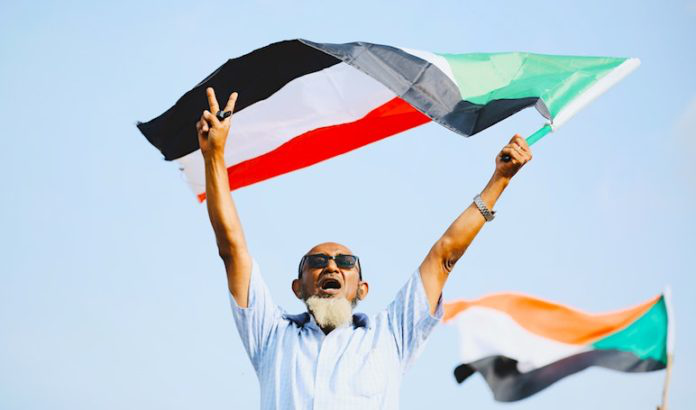
Global South Development Magazine - sent via email from Valentina Baú to The Communication Initiative on October 16 2020. Image caption/credit: A man hoists the Sudanese flag during a victory rally in Khartoum. Photo by Aladdin Mustafa from Pexels