










































Conflict Sensitive Reporting: A Toolbox for Journalists
Image
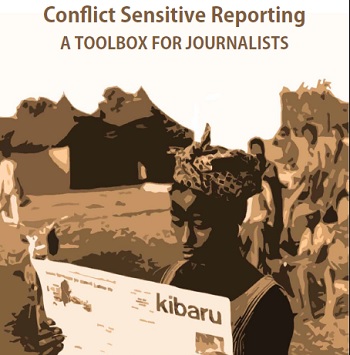
SummaryText
This toolbox was primarily developed for "journalists who are reporting on conflicts taking place in their own communities and whose coverage will reach the people directly involved in and affected by the conflict." It was developed to help journalists face the challenges of being fair and accurate while also being a force for peace and conflict resolution. According to the author, "the principles are relevant for journalists covering conflicts within and between communities, between citizens and authorities, and between groups whose different identities appear to drive them apart." They are also intended to be of relevance to journalists covering escalated and violent confrontations as well more low-level disputes that can have the potential to escalate.
Published by the Conflict Sensitive Journalism Project and the Sol Plaatje Institute for Media Leadership, School of Journalism & Media Studies at Rhodes University, the toolbox was originally developed as takeaway material for journalists participating in conflict reporting workshops to remember what was covered and enable them to review lessons in greater depth. A curriculum, together with the toolbox, was first piloted during a workshop in Nairobi, Kenya, in 2010, which was hosted by the Conflict Sensitive Journalism Project (CSJP) in partnership with Internews-Kenya. The toolbox was subsequently adapted and expanded, and made available both to journalists participating in the workshops and others.
The toolbox is divided into seven parts, each of which is designed to build on the other:
Published by the Conflict Sensitive Journalism Project and the Sol Plaatje Institute for Media Leadership, School of Journalism & Media Studies at Rhodes University, the toolbox was originally developed as takeaway material for journalists participating in conflict reporting workshops to remember what was covered and enable them to review lessons in greater depth. A curriculum, together with the toolbox, was first piloted during a workshop in Nairobi, Kenya, in 2010, which was hosted by the Conflict Sensitive Journalism Project (CSJP) in partnership with Internews-Kenya. The toolbox was subsequently adapted and expanded, and made available both to journalists participating in the workshops and others.
The toolbox is divided into seven parts, each of which is designed to build on the other:
- Part one: understanding conflict - This part draws on the field of peace and conflict studies in highlighting some concepts that are useful to journalists wanting to understand conflict.
- Part two: how journalists can contribute to peace-keeping, peace-building and peace-making - This part explores a number of roles journalists can play in making a positive contribution to peace-building.
- Part three: making a difference, some questions for reflection - This part explores some issues journalists should be reflecting on as they report on conflicts.
- Part four: conceptual tools for journalists covering conflict - This part explores concepts that can help journalists report comprehensively on conflict.
- Part five: reporting on conflicts as they develop - This part discusses how journalists should report on conflicts as they develop.
- Part six: strategies for conflict sensitive reporting - This part suggests a range of practical reporting strategies.
- Part seven: reporting tips - This part provides some general tips for the field. The Toolbox ends by recommending websites that will benefit journalists reporting on conflict.
Publication Date
Languages
English
Number of Pages
78
Source
Internews website on February 5 2014.
- Log in to post comments