










































Optimizing Pandemic Preparedness and Response Through Health Information Systems: Lessons Learned From Ebola to COVID-19
Women in Global Health (Lal); London School of Economics and Political Science (Lal); Harvard Medical School (Ashworth); Vayu Global Health Foundation (Dada); University of North Carolina, Gillings School of Global Public Health (Hoemeke); Africa Disease Intelligence, Surveillance and Communication (Tambo); University des Montagnes (Tambo)
"Despite the value of robust HIS in responding to pandemics, many countries face challenges in coordinating and expanding HIS, sharing data and information, addressing public mistrust and misinformation, and preventing negative health outcomes during and after outbreaks..."
In crisis situations, routine and emergency health information systems (HIS) provide real-time information to guide proactive and rapid response activities. This concept study assesses lessons learned from HIS deployment during the 2014-2016 West Africa and 2018-2020 Democratic Republic of the Congo (DRC) Ebola outbreaks, along with insights from the COVID-19 pandemic. It offers analysis and recommendations for ongoing and future preparedness and response actions across 3 overarching domains: governance and coordination, health systems infrastructure and resources, and community engagement.
Governance and coordination
- Ebola: As outlined here, governance in West Africa during the Ebola outbreak was weakened not only by the governments' inadequate coordination and capacity but also by the public's deteriorated trust in government intervention. Furthermore, the DRC, an active conflict zone with a complex network of informal politics, presented various challenges that impacted HIS implementation. For HIS to function effectively in such settings, governing bodies and decision-makers need to address barriers to transparent data collection, analysis, and sharing. During public health crises, ministries of health need to take ownership of and integrate routine and emergency HIS through cohesive governance of data sharing mechanisms and digital risk communication strategies.
- COVID-19: Open-access distribution and data-sharing mechanisms are an important foundation to improve HIS governance and interoperability before, during, and after health emergencies - an observation that reflects lessons learned when Guinea and Sierra Leone withheld vital information during Ebola. During COVID-19, the absence of timely information and data sharing has led to weak national and international coordination, according to this analysis. It would be advisable in the future to: (i) bolster international cooperation and global solidarity for openly publishing a wide variety of research during health emergencies and (ii) strengthen contextual HIS within countries, including centralised electronic medical records (EMRs) and interoperable digital platforms that integrate routine and active HIS at all stages of an epidemic.
Health systems infrastructure and resources
- Ebola: In the West Africa Ebola outbreak, challenges in health systems infrastructure included scarcity of both physical and personnel resources. Information about stockpiles and available resources was also hindered by poor telecommunication (especially in rural areas) and a lack of information technology (IT) equipment and expertise. To facilitate healthcare infrastructure capacity-building, HIS could help countries equitably optimise available local and international resources.
- COVID-19: As learned during Ebola, HIS can redirect the allocation of resources precisely to where they are most needed across regions and over time, so that total demand is met within the constraints of limited resources available. For example, Taiwan leveraged its integrated HIS to analyse multiple national datasets for transparent distribution of personal protective equipment (PPE) to citizens in locations of greatest need. Timely support and technical assistance from organisations such as the United Nations Children's Fund (UNICEF) could provide resource development and joint expertise to support strengthened domestic and global HIS implementation.
Community engagement
- Ebola: Widespread misinformation and rumours in the context of a chronic lack of trust in domestic governments and foreign intervention delayed control measures, as sociopolitical factors were not integrated into HIS to guide local-level responses. Community engagement and open dialogue involving local leaders gradually restored trust and eventually provided pathways for information to support HIS ownership and guide future outbreak preparedness and response. In Sierra Leone, community event-based surveillance (CEBS) systems required local buy-in and relied on relationships among volunteers, communities, and external stakeholders to supplement HIS that tracked clinical and epidemiological data but lacked social and ecological context. Strategies included recruiting local staff for social mobilisation, working with religious leaders, engaging local radio and journalists, and hosting community meetings - all possible sources for relevant contextual data to be included in HIS. When leveraged effectively, HIS can be used to incorporate data related to contact-tracing networks, as well as relevant experiences, perceptions, and rumours that may hinder response efforts.
- COVID-19: HIS have been used to generate valid scientific data but are not being used to identify at-risk populations to effectively engage. One of the biggest sources of mistrust during the pandemic has been the circulation of false and misleading information about COVID-19 prevention and treatment options. In the context of this harmful "infodemic", robust HIS could refine risk communication that builds trust and informs new population-specific community engagement methods.
The paper offers a series of recommendations under each of the three aforementioned categories. For example, in the area of community empowerment and engagement:
- Communities should guide consideration, prioritisation, and decision-making for which data are gathered and analysed. This approach could build local trust and improve accuracy to identify, track, and treat high-risk populations with targeted engagement approaches.
- In times of crisis, addressing rumours and misinformation is vital in stopping disease transmission and improving cooperation for better health outcomes. Therefore, HIS should be developed and implemented to help identify sources of misinformation and generate targeted evidence, with relevant information for specific communities.
In conclusion, "High-performing and effectively leveraged HIS are catalytic in informing coordinated global health governance and ensuring timely, transparent data sharing. They strengthen health infrastructure by reducing fragmentation and costs while streamlining equitable resource allocation. They offer new ways to foster community engagement, combat misinformation, and cultivate trust....Investments in HIS can...enable national governments to quickly prevent, detect, and respond to public health threats, fostering more robust response and recovery interventions and building a resilient post-COVID-19 world."
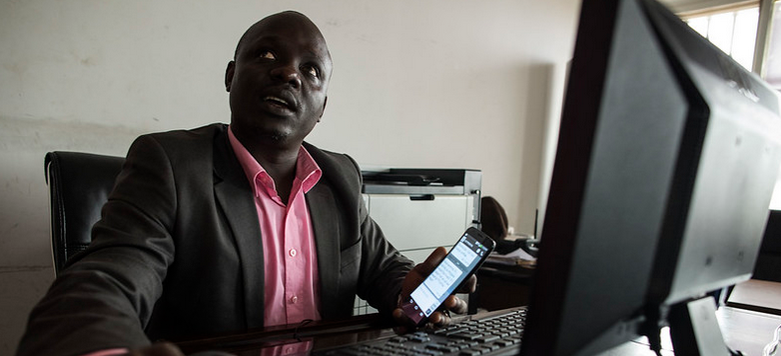
Disaster Medicine and Public Health Preparedness 16(1), 333-340. doi:10.1017/dmp.2020.361. Image caption/credit: "During the Ebola outbreak that started in 2014, there was no centralized system for the Ministry of Health to communicate to all healthcare workers across the country at the same time. UNICEF and USAID [United States Agency for International Development] teamed up to create a platform that utilized mobile phones to facilitate a two way communication system between healthcare workers and the centralized ministry. Now healthcare workers receive text messages on their phones with vital information when there is a health emergency. They can also use their phones to send important information like the status of supply stocks in the clinic." Photo of Stephen Gbanyan, Director of Health Information Systems at the Ministry of Health and Social Welfare in Liberia - taken by Morgana Wingard, via USAID on Flickr (CC BY-NC 2.0)
- Log in to post comments