










































Using Community Feedback to Guide the COVID-19 Response in Sub-Saharan Africa: Red Cross and Red Crescent Approach and Lessons Learned from Ebola
International Federation of Red Cross and Red Crescent Societies, or IFRC (Erlach, Nichol, Baggio); Norwegian Capacity (Norwegian Refugee Council) Community Engagement and Accountability (CEA) Global Advisor and freelance consultant (Reader)
"There has been increasing consensus that it is necessary to understand what community members affected by disease are most concerned about, what information they need to protect themselves, and how they perceive response actors..."
Risk communication and community engagement (RCCE) is a critical element of any epidemic response. Systems for documenting, analysing, and acting on community feedback can enable humanitarian responders to move beyond disseminating messages and to instead work in partnership with communities, gain their trust, and identify and help implement community-led solutions. This article describes how the International Federation of Red Cross and Red Crescent Societies (IFRC) and its national societies in sub-Saharan Africa set up a simple system as part of the coronavirus disease 2019 (COVID-19) response to collect, compile, and analyse unstructured community feedback from across the region.
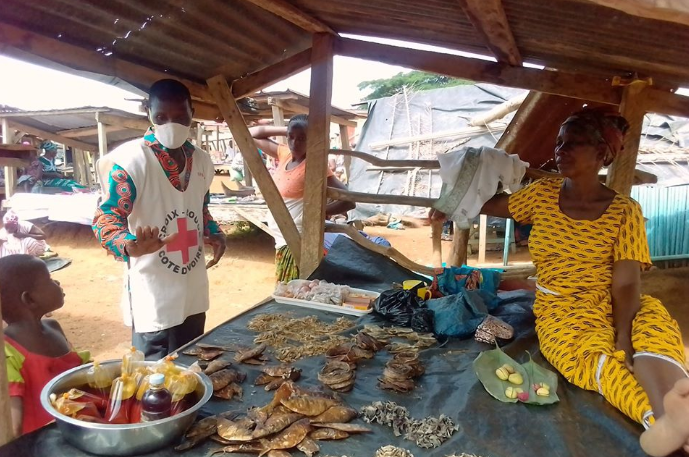
As detailed here, the IFRC Africa regional office focused early COVID-19 interventions on RCCE to ensure that national societies in Africa were able to work with communities on preventive measures (e.g., handwashing, physical distancing, mask wearing), as community ownership is considered critical to disease response. To inform these strategies, a basic level of understanding about the perceptions of community members was needed. Thus, within sub-Saharan Africa, the Red Cross and Red Crescent COVID-19 response adapted methods developed by IFRC's community engagement and accountability (CEA) team in response to the 10th Ebola outbreak in the Democratic Republic of the Congo (DRC). The tools included: (i) a simple form for recording comments shared during RCCE activities such as household visits, focus group discussions (FGDs), or health promotion campaigns in public places; (ii) a guide for conducting FGDs; and (iii) a simple Microsoft Excel log sheet for entering and managing community feedback.
With support from a behavioural science team at the United States Centers for Disease Control and Prevention (CDC), IFRC adapted the coding frame developed for the community feedback mechanism for the Ebola operation in the DRC for COVID-19 feedback data. Of the 48 national societies that had the capacity to respond to the COVID-19 pandemic in sub-Saharan Africa, as of December 2020, 40 had collected and shared community feedback. For example, WhatsApp groups with community members or community volunteers were established to receive feedback and address rumours, questions, suggestions, or concerns. National societies also scaled up their use of social media, such as Facebook, to engage with community members about COVID-19.
Many national societies have been sharing their feedback data with the IFRC Africa regional office, where the data are cleaned, coded, and analysed. The sharing of these data was harmonised by providing simple Excel log sheets for managing the qualitative feedback, and a process was started to enhance the capacity of country-level colleagues to code and analyse their data on the local level. This has been the case for several months in DRC, where a local team manages and analyses the data. Regular factsheets produced by the IFRC Africa regional office that provide simple and clear answers for staff and volunteers accompany the feedback reports. Short videos featuring health experts are produced and shared via social media and WhatsApp, with themes selected from the most common feedback topics.
Trends that emerged from the community feedback data included:
- Belief that COVID-19 was not a serious threat and that governments were using the pandemic to push their own political agendas - In response, for example, Burundi Red Cross has been working with community leaders, who are often more trusted in their communities than the government, to share the information and advice about protective behaviours with their communities.
- Belief that COVID-19 does not pose risks to those who are not white or rich - In response, national societies organised interactive TV and radio shows and worked with the community to produce testimonials from recovered people to address misbeliefs.
- Challenges faced by lower-income households in practicing some key prevention behaviours due to insufficient resources (e.g., to find soap and water) - In response, for example, teams of volunteers in Botswana and the DRC supported communities to construct traditional handwashing stations using poles and plastic containers provided by the community.
- Anxiety and stress, especially related to finances, caused by restrictions imposed to reduce the spread of COVID-19 - In response, national societies trained volunteers on how to provide psychological first aid, including through call centres.
- Criticism of politicians, military, and police officers not wearing face masks or practicing physical distancing - In response, for example, the South Sudan Red Cross shared these concerns with the police, discussed their responsibility as role models in the fight against the pandemic, and provided face masks to them.
Because collecting community feedback and using it only internally to adapt messages is not enough, IFRC and the United Nations Children's Fund (UNICEF) set up interagency community feedback working groups: one in the East and Southern Africa and one in the West and Central Africa UNICEF regions. The trends shared by partners inform specific recommendations that are incorporated into guidance notes and fact sheets, as well as media dialogues with local journalists.
Lessons learned from these experiences include:
- While the current feedback mechanism has been coding and analysing community feedback at the regional level, qualitative information can be better analysed and interpreted at the local level, where contextual knowledge is readily available. A series of webinars has been conducted to guide country-level colleagues in coding and analysing their own feedback data.
- By not collecting demographic details and names, the process is kept light and easy to manage for volunteers. However, an analysis of differences in perceptions between demographic groups is thus not possible, preventing an understanding of the nuances of the situation. In short, the current approach is a balancing act between ensuring all the information received by community volunteers is documented and having detailed demographic data and robust sampling. Triangulation with social science data and proactive ways of systematically monitoring community perceptions through structured surveys can further strengthen the system.
- Responding to community feedback is still often seen as the sole responsibility of those working on RCCE. More ownership among leaders at country and regional levels can ensure a more holistic and cross-sectoral response to community feedback.
- The different components of the feedback mechanism at both the national and regional levels need to be refined and improved over time in order to increase the amount of feedback where numbers are low and to respond to community feedback in a more systematic and effective way.
In conclusion: "The COVID-19 response showcased how simple ways to systematically listen to communities and respond to them can be integrated into an operation and harmonized across sub-Saharan Africa. It has also shown that specific actions can be taken to respond to community feedback at local and regional levels, and interagency coordination of community feedback can drive action. This regional system will provide a good basis for further integrating feedback mechanisms in programs and operations beyond health emergencies."
Health Security. Feb 2021. 13-20. http://doi.org/10.1089/hs.2020.0195; and email from Eva Erlach to The Communication Initiative on March 26 2021. Image credit: Red Cross Society of Côte d'Ivoire, April 2020
- Log in to post comments