










































Negotiating Intersecting Precarities: COVID-19, Pandemic Preparedness and Response in Africa
Institute of Development Studies, University of Sussex (MacGregor, Leach, Grant, Wilkinson); Gulu University (Akello, Baluku); Njala University (Babawo, Kamara, Mokuwa, Richards); Institut de Recherche pour le Développement (Desclaux, Sams); London School of Hygiene and Tropical Medicine (Martineau, Parker); Center Régional de Recherche et de Formation à la Prise en Charge Clinique de Fann (Sow)
"[E]pidemic preparedness and response cannot simply involve attempts to foresee and control risk of disease, through standardized, largely technical processes. Rather, it requires appreciation of preparedness and response as interconnected processes, and of multiple uncertainties and complex effects and how people interpret and respond to them, amidst everyday precarities."
Preparedness has emerged in social science as a distinctive paradigm to approach infectious disease risks. Critics of standard preparedness models argue they privilege the technical and legal over social and ethical concerns, underplay the significance of diverse forms of uncertainty, focus on emergency events in isolation from vital longer-term health system capacities, and can over-prioritise global systems. This ethnographic study shares findings on concepts and practices of epidemic preparedness and response to COVID-19 in rural villages in Sierra Leone and Uganda across 2020. The paper illustrates how, amidst uncertainties about the trajectory of COVID-19, complex dynamics emerged, as diverse actors interpreted and modified approaches according to contexts and experiences - encapsulated here by the concept of "intersecting precarities".
Drawing on fieldwork throughout 2020 and on secondary literature, the researchers begin by examining regional discourses and institutional responses to COVID-19 across Africa. In short, in the wake of the West African Ebola experience, preparedness activities for future crises were initiated in several African countries in 2015-16. Nonetheless, the emergence of COVID-19 led to anxiety regarding robustness of preparedness on the continent. Among the responses: The World Health Organization (WHO) Africa office organised sub-regional meetings, gathering key stakeholders to define a roadmap for action that was focused on better coordination and governance as identified following previous disease outbreaks. Notwithstanding various challenges, as 2020 drew to an end, the estimated cumulative mortality from COVID-19 across Africa remained low in the global tally. Toward the end of 2020, the institutional focus (e.g., of WHO) shifted toward "vaccine preparedness".
The paper then details national government responses in Sierra Leone and Uganda, two African countries with relatively low numbers of COVID-19 cases and deaths, at least during 2020. As explored in detail, in both contexts, past experiences of outbreaks and international interventions, as well as conflicts and political agendas, have shaped planning and implementation of measures:
- Highlights from the experience in Sierra Leone:
- "The first known cases of COVID-19 in Sierra Leone arrived by air in late March 2020 but the country had been preparing for its arrival from late January. Measures were enacted by the relatively sophisticated epidemic preparedness and response governance structure which had been set up after the Ebola epidemic....An early speech by the President emphasized the dangers of COVID-19 and the importance of a national response. This made heavy reference to Ebola, with little acknowledgment of the differences between the diseases. There were regular press briefings by the President throughout subsequent months, and ongoing communication, mostly over television and radio. This extended to a song in Mende by singer Jay Shine. It presented COVID-19 as a severe disease from which everyone is at risk of death, without nuancing for COVID-specific vulnerabilities such as by age..."
- "In terms of interpretations and understandings of COVID-19, a varied and shifting picture has emerged....People seemed unsure what to believe and turned most obviously to their direct experiences - which to date were mostly of a mild, or non-existent, disease. Nevertheless, others continued to look more widely and at broader implications, with anxiety....The Paramount Chief instituted a by-law to prohibit intervillage movement which many declared problematic....Interviews about people's main worries in August [2020] produced an array of pressing anxieties about food, health problems, children, and livelihood, but COVID-19 was never specifically mentioned. Confusion existed as to why the control measures for COVID-19 remained..."
- "Villagers' interpretations and practices may also reflect a legacy of distrust in local government, as well as in the health system. Despite post-Ebola strengthening efforts, deficiencies remain in health services and speak to a longer-term experience of unrealized promises. This limited the extent to which community health workers were able to deliver public health messages about COVID-19, let alone for these to be trusted..."
- Highlights from the experience in Uganda:
- "The government shifted COVID-19 planning to a dedicated national task force situated in the Presidency. What followed marked a decided militarization in the implementation of response....Early government messaging discussed COVID-19 as a virulent epidemic that had the potential to cause many deaths. However, by May [2020] no deaths had been reported and overall case numbers remained low. Trust in government initiatives, already low in Uganda, was further undermined. Public comment focused on the wastefulness of quarantining healthy people..."
- "Other infectious diseases were also on the priority list of district health authorities, such as a hepatitis B vaccination programme. As one villager commented: 'We are overwhelmed with many diseases in this village. Before we finish this disease, another disease comes. We have not yet finished protecting ourselves from hepatitis B disease. I have heard that any time Corona will be coming in this village. This is becoming too much for us to understand.'...In Buembe, COVID-19 initially seemed very distant to many, spoken of as 'a disease of the radio.'....Comparing COVID-19 to Ebola, a man reflected that Ebola is 'simple' and easy to deal with compared to the new disease which came with complicated instructions..."
- "The variation in opinion and uncertainty regarding how seriously to take the warnings was very evident as April [2020] moved into May [2020]. COVID-19 was not present as an experience of disease, but as a set of government restrictions enforced by a military presence. The public health messaging was received variably....The measures enforced by the soldiers were viewed by villagers as excessive and out of touch with an understanding of people's need to sustain their lives and livelihoods. Overall, the suffering from the restrictions exceeded any suffering from the disease....Local tensions with the military presence and distrust of state intentions extend back to a history of anti-government and anti-army feeling in this border district..."
- "With radio reports of the first deaths in Uganda in July [2020], villagers expressed skepticism as to their truth as 'corona' seemed to be more a political matter in the country. In July, the government stopped broadcasting primarily COVID-19 awareness messages, shifting to the indirect health impacts of the 'lockdown' measures - urging ongoing malaria prevention and childhood vaccination. Yet COVID-19 measures such as a curfew remained in place..."
Having traced how preparedness and response, as interconnected processes, have been articulated and enacted in these two different settings, the paper moves on to challenge "notions of a standardized response to a pandemic across the continent, with set progression through stages of emergency in a linear temporal frame....Uncertainty plays out in the confusion on the ground in terms of how people try to make sense of the new disease over time. As government messages shifted or seemed at odds with people's own observations, skepticism grew in some quarters."
In this context, the researchers argue that the concept of "intersecting precarities" extends to the effects of epidemic control measures themselves. They "contend that people do not just accept but actively negotiate these intersections as they seek to sustain their lives and livelihoods, including through mutuality and collective action. Having the preexisting capabilities, forms of collective organization, and experiences in dealing with everyday uncertainties to do so, is key to 'preparedness from below.'" People in Sierra Leone and Uganda mobilised to deal with the effects of public health restrictions and also to address other co-existing threats to health and livelihoods, considering that "The embodied uncertainties navigated in the present can be more salient than preparing for an unknown future event predicted by an authority that lacks trust or appears remote and unconcerned about everyday realities."
In short, bringing to light these intersecting precarities enables expansion of formal understandings of preparedness to include attention both to systemic conditions that influence the effectiveness of response and to chronic uncertainties that might be of greater local priority than the pandemic. This perspective can support development of more sensitive approaches that are responsive to local experiences and priorities - and, hence, more effective.
The researchers conclude that the "findings and analysis have broader significance including to settings with very different disease experiences. A consideration of intersecting precarities and preparedness from below together, in a dual conceptualization, helps to capture the dynamics and timeframes at stake in epidemics more effectively than do linear separations of 'preparedness' and 'response.' Attending to 'the below' foregrounds the significance of local forms of knowledge, experience, and agency in navigating uncertainties. These dimensions are important whatever the epidemiological picture."
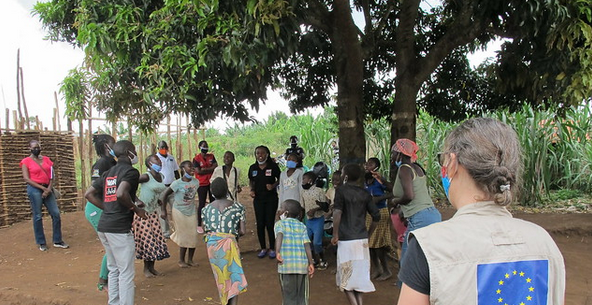
Medical Anthropology 41:1, 19-33, DOI: 10.1080/01459740.2021.2015591 - sent via email from Hayley MacGregor to The Communication Initiative on March 15 2022. Image credit: © European Union, 2021 (photographer: Mathias Eick) via Flickr (CC BY-NC-ND 2.0)
- Log in to post comments