










































Media, Information Systems and Communities: Lessons from Haiti
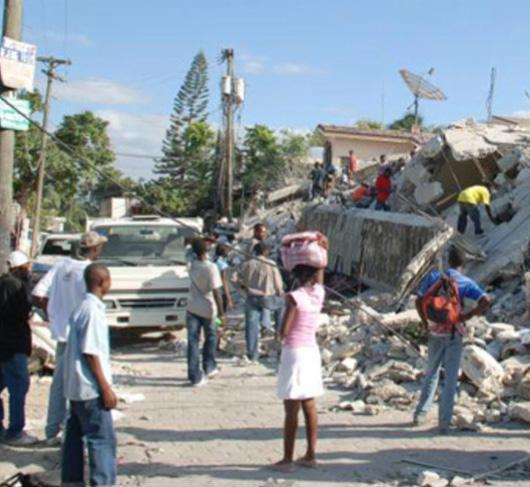
Columbia University (Nelson and Zambrano), Global Voices (Sigal)
This report documents the use of media following the January 12 2010 earthquake in Haiti. It was written to support research and planning for media development organisations, governments, and international organisations working in disaster relief. It chronicles the work of media specialists using new digital tools. The report was partly based on information gathered at a roundtable discussion on the media and communication response to the Haiti earthquake. Hosted in Miami, Florida, United States, on May 24 2010, the event was organised by Communicating with Disaster Affected Communities (CDAC) with support from the John S. and James L. Knight Foundation.
From the Executive Summary: "Haiti constituted a learning opportunity, not a perfect model. Working partnerships had to be forged quickly between traditional actors, including governments and international institutions, and more spontaneous technological coalitions. Haiti’s shaky communications infrastructure, crippled by the earthquake, often faltered under the new demands. Yet the operations also yielded a wealth of data and experience that will be of vital importance for future relief efforts.... As summarised in the document [Footnotes removed by the editor.]: "The Haitian earthquake brought together three existing trends in the use of information technology for the humanitarian response: 1. Increased usage of digital media technologies by responders to manage humanitarian information. 2. Enhanced reporting and distribution of information through local mass media to help aid recipients. 3. Customized innovative digital media tools and platforms applied to coordinate new forms of collective action and problem-solving."
The initiatives in Haiti were driven by developments in humanitarian information and communication for disaster response: "First, the media development sector had developed projects to work with local media to create humanitarian reporting programs and platforms to offer feedback for humanitarian providers. Second, digital media practitioners and information technologists formed a growing community to focus on new Internet and mobile platforms to promote mapping, geo-tagging, crowd-sourcing, micro-tasking, application development and citizen journalism.... Finally, the humanitarian sector became increasingly aware of the value of beneficiary communications, progressively expanding the exchange from an ad hoc response to individual crises to larger, more systematic applications."
Media initiatives and partnerships developed among relief agencies, the government, and media outlets. Radio became one of the strongest links for: round-the-clock emergency and humanitarian reporting, citizen information from SMS (text) messaging and telephone calls, community network and church network information, and audience content. Internews provided the humanitarian programme “News You Can Use” to all radio stations. The programme reported critical information about water distribution points, displaced persons camps, and public health. Radio contact was extended with Twitter message updates from announcers who communicated with followers via that service. Radios were distributed by relief organisations. "Local Haitian organizations and diaspora networks also joined the communications process through social media. These groups drew on telephone (and less frequently, Internet) contact with friends and family in Haiti to post updates on Twitter, Facebook and Flickr to communicate to a broader public.... Ushahidi, a crisis-mapping platform... was quickly adapted to provide emergency and rescue data in Haiti."
SMS mobile text messaging via short code - a four-digit code - enabled cell phone users to send free messages to central information centres about missing persons and emergency needs. Those needs were mapped via geographic information systems (GIS) coordinates and crowd-sourced to identify areas with the most damage. Rescue and relief organisations shared the information in a coordinated effort that included the military and governments of many nations. SMS was also used to distribute health and sanitation information, including availability for such relief services as condom distribution for HIV prevention, vaccine availability, and malaria prevention. Innovations particularly developed in this emergency effort were:
- "The translation of crowd sourced data to actionable information.
- The use of SMS message broadcasting in a crisis.
- Crowd sourcing of open maps for humanitarian application."
Findings include:
- Sectoral development and coordination. The community of implementers now recognises that this application of information technology to disasters constitutes an emerging field of practice:
- The technology community acknowledges a need to relate its work to humanitarian codes of conduct, and devise commonly held principles for engagement.
- The community is actively seeking to hold ongoing forums for coordination, learning, and sharing of best practices. CDAC and the Crisis Mappers events are two examples.
- Integrating technology into humanitarian response. The media development sector and the information technology communities recognise the value of engagement with the humanitarian sector, but processes remain uncertain:
- The technology and media communities recognise that the informal responders provide value in crises, and will not align their work solely with formal humanitarian institutions.
- More advocacy, preparation work, and simulation exercises between media and new technology developers and humanitarian agencies (U.N. [United Nations] and international NGOs [non-governmental organisations]) need to be done in order to mainstream humanitarian media and new technologies within future emergency responses.
The document concludes with specific recommendations to highlight priorities for next steps by sector. "One overarching recommendation for all sectors is that more advocacy is needed to build the base of understanding among governments, donors and the humanitarian communities on the role and need for coordination on media and technology efforts."
Knight Foundation website, October 3 2011.
- Log in to post comments