










































Mobilize Against Malaria Ghana
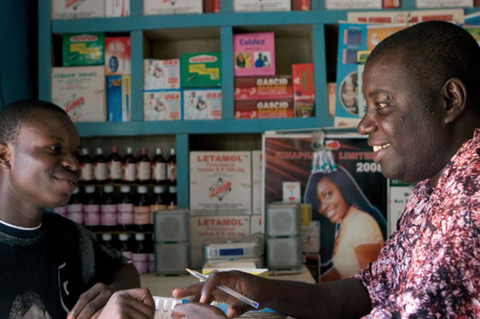
Mobilize Against Malaria (MAM) Ghana is working to build the capacity of Licensed Chemical Sellers (LCS) and their counter assistants in the Ashanti and Brong Ahafo regions to recognise and respond to malaria symptoms, while also conducting a campaign to raise awareness among the general public about the symptoms of malaria and the importance of early recognition and prompt, effective treatment. The overall strategy is to create "demand" through community awareness and ensure "supply" through LCS education. Launched in 2006, the 5-year programme was initiated by FHI 360 (formerly Family Health International) in partnership with Pfizer, in collaboration with the Ghana Social Marketing Foundation (GSMF).
According to FHI 360, in Ghana many people seeking initial treatment for malaria consult a licensed chemical seller (LCS) rather than a doctor or a nurse. The thousands of LCSs in communities throughout Ghana are major sources of basic medicines, particularly in rural areas. Licensed by Regional Pharmacy Councils, LCSs sell over-the-counter medication but unlike pharmacists, they do not undergo rigorous medical education and are usually licensed following a few weeks of training. Formative research carried out by FHI 360 indicated that many LCSs were unsure of the signs of malaria, and were not able to identify the symptoms of severe malaria that warranted referral to a health facility. The Mobilize Against Malaria Ghana programme is working to help build LCSs into effective national healthcare partners.
As part of the planning phase, the programme team worked in collaboration with the National Malaria Control Programme to develop various tools, including training manuals, branding materials, posters, billboards, hand-outs, record books, and referral books. The training manuals developed for MAM programme are being used by both the NMCP and in MAM activities. Tools such as job aids were developed to provide LCSs with a quick reference guide for malaria diagnosis, treatment, and dosage.
Following advocacy at the national, regional, and local level, and in partnership with the district health administration, the implementing partner, the Ghana Social Marketing Foundation, selected several local organisations for training, who in turn identified and trained volunteers from the community. Training manuals developed by GSMF and endorsed by the NMCP were used to "train the trainers" in the methods and messages necessary for mobilising communities against malaria. GSMF also used various media to communicate messages, including mass media, community information centers, and radio dramas. These broadcasts are designed to capture the attention of the community and raise awareness about malaria, while at the same time avoiding overt lecturing.
While the media campaign sought to increase demand for malaria treatment, FHI 360developed a training programme for LCS to ensure supply. LCSs are trained in the recognition of and process of referring complicated cases to the nearest health facility. Through group activities and role-playing exercises, LCSs learn to use structured questions to obtain information from customers (such as a patient's age, symptoms, and their duration) before dispensing medicines. Participants learn how to correctly dose and administer Artemisinin-based Combination Therapy (ACT), the national standard for treating uncomplicated malaria. In the past, LCSs were not permitted to dispense ACT because it required a prescription. FHI 360 supported the Ministry of Health's efforts to declassify the drug.
LCSs are also encouraged to advise pregnant women visiting their shop to sleep under long-lasting insecticide-treated bed nets and to refer them to the nearest health facility to receive intermittent preventive treatment (IPT).
To promote the continuation of high-quality services, FHI 360 supports district-level advocacy meetings to update and provide feedback to District Health Management Teams. Quality assurance activities, including client and household interviews, are conducted to assess the quality of LCS services and provide a basis for making improvements. FHI also supports regional advocacy sessions in which LCS leadership, regional, and district directors of health services, the regional pharmacy council, and other health partners meet to review MAM implementation and share knowledge and experiences.
Malaria
Mobilize Against Malaria (MAM) is Pfizer’s programme to combat malaria. MAM is a five-year (2007-2011) programme designed to address critical gaps in malaria treatment and education in Ghana, Kenya, and Senegal. The purpose of the MAM initiative is to reduce malaria morbidity and mortality through the effective delivery of Artemisinin-based Combination Therapy (ACT), the national standard for treating uncomplicated malaria in Ghana, Kenya, and Senegal. Each of Pfizer’s three MAM programmes use a dual-pronged approach that addresses both the supply of quality public healthcare, as well as communities’ demand for treatment.
According to the MAM programme, baseline data in Ghana showed that 56% of children under five with a fever were taken to an LCS for treatment. Of these, 43% received an anti-malarial, but only 4.5% received an ACT. The MAM programme has trained over 1,100 LCSs in the Ashanti Region, representing 46% of the registered LCS in the region. The percent of LCSs trained within the 27 districts ranges from 22% to 97% with a median coverage of 54%.
FHI 360 website and Mobilize Against Malaria: Lessons Learned from Ghana [PDF] on October 1 2011.
- Log in to post comments